• Page list
    • Posts
    • The Book of Psalms

The Book of Psalms

  • March 28th, 2023

    Psalm 17

    (prayer of David)

    * * *

    Psalm 17 is a first-person appeal that emphasizes the body, just like Psalm 16. Like Psalm 15, however, it appeals not to joy but to justice, which the moral deserve. Though the psalm is a prayer, its guiding images are not auditory but visual, its unity the watchfulness of the Lord’s face.

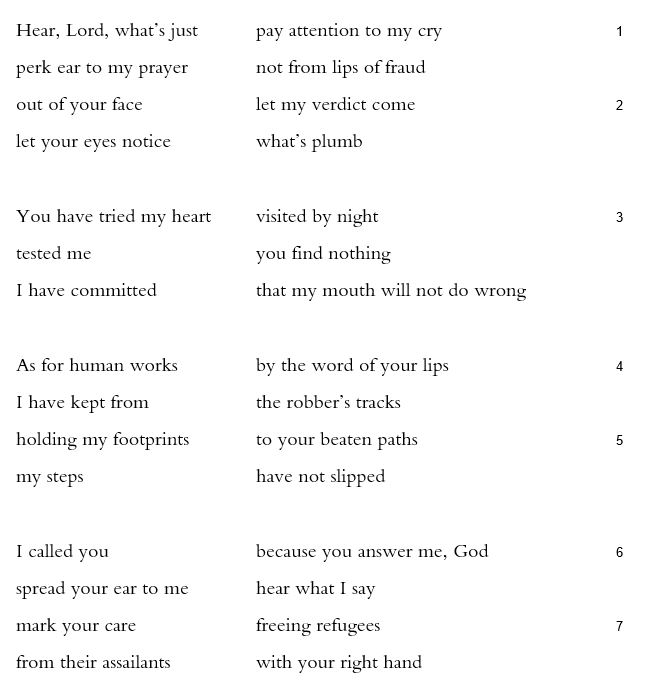
    It starts with—and later returns to—the figure of the Lord’s ear, so common in psalms and prayers: “pay attention… perk ear” (1), “spread your ear to me | hear what I say” (6). But it is the rest of the body that stands out in this psalm: the Lord’s face (2, 15), the mouth and lips (3, 4), heart (3), feet (5, 11), hand (7, 14), the neck or throat (the nefesh, 9,13), the “innards” (lit. “fat,” 10), the belly (14), and the open-ended “form” with which the psalm ends (15).

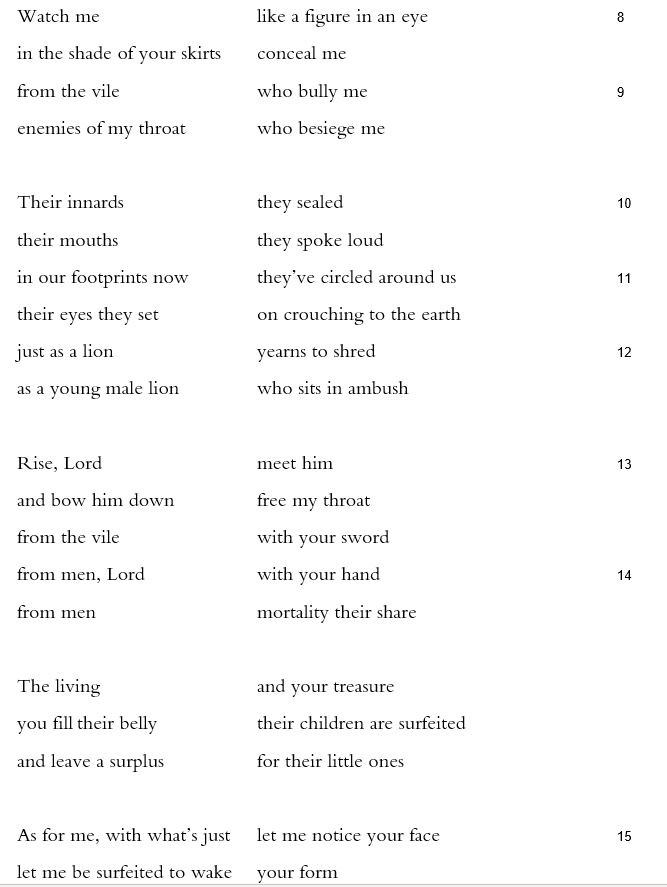
    Even more, we see eyes. “Let your eyes notice | what’s plumb,” the speaker prays in verse 2. Eyes replace ears, “what’s plumb” translates the horizontal balance of “what’s just” (1a) to the vertical axis of uprightness. Even more significantly, the Lord’s being asked to “notice” (chezeh) becomes, over the course of the psalm, “let me notice your face” (15). It’s not that eyes appear often in the poem. It’s how they look out, what they see. There are the fixed eyes of the stalking enemies, “their eyes they set | on crouching to the earth” (11). More impressively, there is that unforgettable line, so beautiful in both Hebrew and the well-known English: shamreini ke-ishon bat-ayin, lit. “guard me like the little man, daughter of the eye”; in the King James, “Keep me as the apple of the eye” (8a). The verb means to keep watch, and the metaphor aims to capture how very closely the speaker wants the Lord to watch: “don’t shoot until you see the whites of their eyes.” But it’s not the whites of the eyes here, it’s some quintessence of them, the pupil, the aqueous humor. I first had “like the soft of the eye,” but that’s not it. I see it now: the tiny reflection of oneself in another’s pupil, hence the very human “little man” and “daughter” all powerfully condensed in half a line: “like a figure in an eye.”

    That recognition, that the center of the psalm features not just an eye, but the speaker seeing their own reflection in an eye of the Lord—or the Lord seeing the Lord’s reflection in the speaker’s eye—helps make sense of the prayer’s last line: “let me notice your face | let me be surfeited to wake | your form” (15). In contrast to both enemies, who are preoccupied with death, “mortality their share” (14b), and the “living,” who are satisfied with reproduction (their bellies stuffed full of children), the speaker is satisfied “with what’s just” (15a). But justice is now not abstract. It’s intimate, and momentous: that overfull moment on waking when one sees oneself a likeness in a beloved’s eye. The last line is literally “let me be stuffed full to awake your likeness.” It parses so many ways without the need for imposed, anachronistic doctrines of immortality. Let me be full of waking, in front of your likeness, as your likeness, with your likeness. Let me be full, to awaken your image, to awaken before your image, to awaken as your image.

    *

    17:1 Hear, Lord… The language is stereotypical, but the rhythm is potent. Each half-line builds nicely, from three two-syllable words to two three-syllable words, two four-syllable words, back to three two-syllable words.

    17:1-2 perk ear… let your eyes notice  In addition to the semantic parallel of ear/eyes, there’s a play on words between ha’azinah, “perk ear,” and techezenah, “let… notice.”

    17:7 mark your acts of care  I.e., make your caring stand out

    17:8 Watch me | like a figure in an eye  Both halves of the line are visual. See the Psalm 17 note for a discussion.

    17:10 Their innards | they sealed The word chelbamov seems to refer to the abdomen, perhaps abdominal fat, which would have not been culturally scorned. The image of closing is clear, even if the exact meaning isn’t. The enemies cinched themselves tight against the speaker and raised their voices.

    17:12 like a young male lion  At two or three, male lions look and behave differently from both cubs and fully grown males. Adult males bear impressive manes and live in their territorial pride with a few other adult males, more adult females, and their young. As male cubs mature, they have to venture off on their own to claim new territory. Thus the movement from “a lion” to “a young male lion” is meaningful, from the settled to the rangy, from the protective to the aggressive, from the plural community to the singular predator.

    17:14 from men…  The whole verse is troublesome. (1) The word translated “from men,” mimtim, might derive not from mat, male, but from mot, death. That would make the first two lines a repeated request to kill them, which is certainly possible, given the sword in verse 13. (2) “Mortality their share” is mecheled chelqam, which others parse differently. The JPS version is compelling: “from men whose share in life is fleeting.” This translation sees bachayyim, “the living,” as belonging to the next part. (3)  “And your treasure/ you fill their belly” is syntactically ambiguous, but the contrast is clear between the “vile” of verse 13 and the abundance of the last part of this verse.

    17:15 Let me be surfeited to wake | your form  Like those in verse 14, whose bellies are full of children who themselves are full, the speaker is overfull with the Lord’s face, ”your form.” See the Psalm 17 note for a discussion of this verse.

    Share:

    • Share on X (Opens in new window) X
    • Share on Facebook (Opens in new window) Facebook
    Like Loading…

    About Me

    My name is Mark Minster. I’m an English and Comparative Literature professor with a background in ministry and in poetry. I teach courses on writing, reading, religion, and nature.

    Recent Posts

    • Psalm 150
    • Psalm 149
    • Psalm 148
    • Psalm 147
    • Psalm 146

    Newsletter

  • March 27th, 2023

    Psalm 16

    (in stone, of David)

    * * *

              In recent decades, Hebrew Bible scholars have identified Psalms 15-24 as a relatively cohesive unit, arranged concentrically, with Psalms 15 and 24 as matched endpoints and Psalm 19 as the center. Given the strength of those three psalms, not to mention the verbal and thematic parallels, the conjecture makes sense. It pays off, too, looking from the centered Psalm 19 out, since Psalm 18 shares with Psalms 20 and 21 militaristic themes and royal imagery, and Psalms 17 and 22 are both supplications that end in consolation. This structure pairs Psalm 16 with Psalm 23, a comparison that does Psalm 16 no favors. We can call both psalms “songs of trust” if the goal is to classify them, for both do feature a first-person speaker confident in the protection of the Lord. But beyond those parallels and a few verbal similarities shared by many biblical poems, Psalm 16 pairs with Psalm 23 the way a sophomore’s draft pairs with a virtuoso’s magnum opus.

              It’s not at all that this psalm is bad. It has memorable moments and compelling textual knots, such as the obliqueness of the first-person “I said” in verse 2: “you, throat, said.” It’s just that, as a declaration of commitment, it’s like an early American conversion narrative, dominated by its rhetorical aims. It may actually be a conversion narrative, in which the speaker claims asylum (1), a share in the land (5-6), and other rights of membership, including protection (1, 8, 9, 10) and above all, joy (2, 3, 6, 7, 11). These claims are supported, each in turn, with verbal assertions and evidence from the speaker’s body. Protect me because I have sheltered in you, the speaker starts, then pledges allegiance to the Lord (2) and pleasure in the Lord’s people (3). The claim to a portion in Israel’s inheritance (“my share… and my cup… the lines… an estate,” 5-6) is supported first by the cursing of outsiders (4), then by performative kneeling (7). This demonstration of fidelity continues with bodily evidence of commitment and pleasure that the audience cannot see: “my insides have nagged” (7b); “Thus my heart has joyed | and so my heft whirls / even my skin rests secure” (9). Statements of joy function circularly, tautologically, as both claim and evidence.

              It’s those last lines that are the psalm’s most remarkable. Their delayed direct object arrives as the fifth of a series of seven nouns predicated of the verb “you show me”: “track of life / surfeit of joys | your face / the beauties at your right | to the last” (11). Only “your face” is explicitly marked as a grammatical object, retroactively making “track of life” and “surfeit of joys” both anticipations of the real object, appositive metaphors for the Lord’s face, figures for the glad life lived on the right side of God’s face. “The beauties at your right | to the last” conveys with the plural adjective a whole range of pleasures. These pleasures, the psalm claims, began before this verbal commitment and last long after.

     *

    16:1 in stone  The likeliest meaning of miktam is a stone inscription. The other psalms with this word in their superscriptions are Pss 56-60, in the second major collection of Psalms.

    16:2 you, throat, said of the Lord  The verb ‘mrt is pointed in the Masoretic text as a second-person feminine perfect verb, literally, “you (f) said.” There is no feminine antecedent in the text, but the King James Version takes the implied referent to be nefesh, the word too abstractly translated as “soul,” a common synecdoche for the self. The other main option is to follow Dahood and take ‘mrt as Phoenician spelling for “I said.”

    16:3 of the hallowed of the land  To whom does the word liqdoshim “to/of the hallowed/holy” refer? There are three broad choices: the holy ones of Israel, i.e., the powers-that-be, either divine or human (the choice of most translations); foreign gods, or Canaanite powers (see Dahood and Alter); or both, in an intentional ambiguity that marks the transition to a new allegiance from an old one. Either way, the broad purpose is clear—the speaker has cut ties with others and declares commitment to the Lord and the lord’s.

    16:4 May their injuries grow | who rush for some other  This is a relatively literal reading of a puzzling moment in the text. It’s clearly a wish for harm.

    16:4 I do not toast | their toasts of blood  Strictly speaking a libation is not a toast—one’s poured, the other’s drunk. But “I will not pour out their pourings-out” clunks like a square wheel and makes distant an image that’s clear and not archaic. What’s needed is immediacy, not entfremdung.

    16:5-6 The Lord my share… the lots for me  If indeed the speaker was a convert, he/they would not already have a tribal allotment, and would need a portion—a place to live, a share in the feasts. The language here is consistent with this image, from “share of land” (menat-chelqi, lit. “the portion of my portion” to “the lots” (5), from “the lines fell”—i.e., both the casting of lots and the boundary lines—to “an estate” (6), property that might have been either metaphorical or literal.

    16:9 and so my nimbus whirls  I follow the Masoretic text for kevodi, my weight/honor/glory, which I see as a bulk. Other manuscripts point the word as keveidi, which works, too, though “my liver dances” struggles. The speaker is overjoyed and their body moves.

    16:10 my throat to the grave… your caring one  Any text can be made prophetic, perhaps, but the interpretation of this psalm’s conclusion either as messianic or as evidence of belief in personal immortality is forced. As Rozenberg and Zlotowitz say, “this verse is often interpreted by traditionalists to allude to immortality. There is, however, no hard evidence that immortality as understood later on was a living concept in biblical times.” Dahood egregiously inserts and appends the word “eternal” to “life” in 11a, while the King James mistranslates chasideika “your caring one” in 10b as “thine Holy One,” which is plain wrong. The speaker in the psalm is glad to be part of a new community and grateful not to be dead.

    16:11 track of life / surfeit of joys | your face  The object marker ‘et- clearly renders ‘et-paneikha the object of the clause’s only verb, “you show me.”  Alter parses 11b as “Joys overflow in your presence,” while Dahood has “filling me with happiness before you,” readings that obviously get the gist, but lose the syntactical energy, not to mention the literal, intimate, bodily image of the face, which is picked up by the beginning and end of the psalm that follows.

    Share:

    • Share on X (Opens in new window) X
    • Share on Facebook (Opens in new window) Facebook
    Like Loading…

    About Me

    My name is Mark Minster. I’m an English and Comparative Literature professor with a background in ministry and in poetry. I teach courses on writing, reading, religion, and nature.

    Recent Posts

    • Psalm 150
    • Psalm 149
    • Psalm 148
    • Psalm 147
    • Psalm 146

    Newsletter

  • March 26th, 2023

    Psalm 15

    (a David lyric)

    * * *

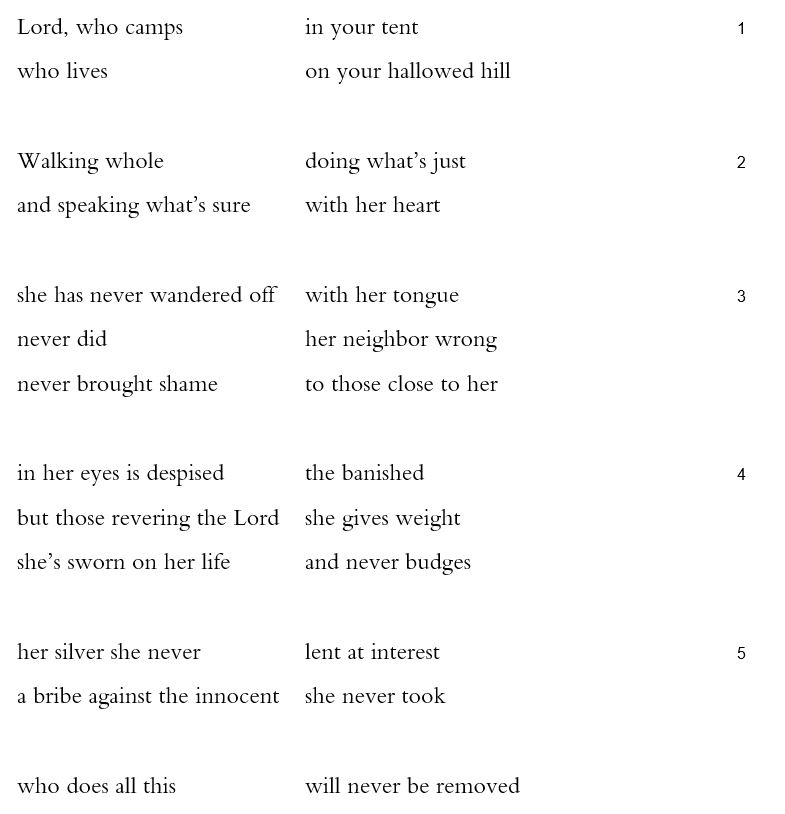
    The most famous list of moral principles in the Hebrew Bible is certainly the Ten Commandments—or, rather, that group of injunctions, sometimes called the Ethical Decalogue, that appears with subtle differences in Exodus 20 and Deuteronomy 5. (There is a Ritual Decalogue in Exodus 34 as well.) Psalm 15 is an ethical decalogue all its own. It is not a series of apodictic commands in the second-person singular (“thou shalt” or “thou shalt not”). Instead, it’s a character sketch, defining the moral community by describing ten traits of goodness that a member needs in order to be admitted and remain in the Lord’s circle, “your tent… your hallowed hill” (1).

    Written of a generic individual— third-person masculine in the text, third-person feminine in this translation— the psalm moves with clarity and precision through meticulously patterned principles. Verse 1 asks questions that the rest of the verses answer: in the tabernacle, later in the temple, still later, by extension and diaspora, in the grand circle of divine care, “who camps… who lives?” By the end of verse 5, a promise arrives: “who does all this | will never be removed” (5c).

    Between questions (1) and promise (5) are ten traits grouped into three threes plus one, with six negatives (made a series of seven by the psalm’s last line: “will never be removed”). The definitional member of the community is a moral being who moves with integrity, who works for justice, and who speaks the truth: “Walking whole | doing what’s just / and speaking what’s sure | with her heart” (2). As participles, these three words work like a left-branching sentence, setting up the next group of three, all negated verbs in the completed tense: “she has never wandered off | with her tongue,” “never did | her neighbor wrong,” “never brought shame | to those close to her” (3). Each line tightens the last, from loose-tongued slander all over, to wrong among fellows, to making a mockery of intimates. Each also intensifies its correlate from the first trio, walking (2a) means not wandering off (3a; the verb ragal is denominative from the word “foot”), doing what’s right (2a) means not doing bad (3b; the verb ‘asah is used in both), and speaking truth with the heart (2b) has an intimacy fitting “those close to her” (3b).

    The final group of three traits is also marked by perfective negations, things the good person has not done: broken her word (4c), abused the common wealth by seeking personal gain (5a), or used a broken economy plus a broken word to harm the innocent (5b). Again, in the last group of three, each “has not done” picks up on its correlates: “walking whole” becomes “not wandering off” which becomes “having vowed, she does not move” (4c); “doing what’s just” becomes “never did | her neighbor wrong” becomes “her silver she never | lent at interest” (5a); and speaking the truth in the heart becomes honoring those near which becomes, profoundly, honoring anyone innocent, no matter how close (5b). These three groups of three move from general traits of personal integrity to their consequences for others and for the social order. Integrity, fairness, fidelity to the truth—these three recur: twice generically (once by assertion, once by negation), and once more specifically, in how one treats others.

    The seventh of these ten traits stands out. It’s unpaired, but presents a careful chiasm, a pivot for the entire list: “in her eyes is despised | the banished / but those revering the Lord | she gives weight” (4a-b). It pits how she, the model devotee, treats those outside the community against those inside. More particularly, her condemnation (nibzeh) of the nim`as, the one abhorred, “the banished” (compare 1 Sam 15:9, which links bazah and ma`as together to the root word cherem, the ritual ban), contrasts with how she treats the yireh-Adonai, “those revering the Lord.” This group are treated as a specific class throughout the book of Psalms especially (e.g., 22:23, 61:5, 135:20), and in a Hellenistic context are identified in Greek as proselytes, converts from other cultures and races (oi phoboumenoi ton Theon, e.g., Acts 13:16). The moral person’s valuation of these others, then, is as much about trajectory as about position: she esteems those who are moving towards and within, and spurns those who have moved (or been moved) out and away. She herself “never budges” (4c).

    There’s something particularly ancient about this conception, perhaps, bounded by the tabernacle’s enclosures. But then every community defines its borders, some more explicitly than others. Few definitions are as taut and crafted as this psalm. Who gets to stay? Anyone who wants to, with integrity, fairness, and fidelity.

    *

    15:2 walking whole In Hebrew, too, the construction is participle + adjective: one who walks complete/sound/perfect/blameless. There’s a moral component to tamim, as there is to “whole,” but also a purely practical sense of healthiness, being intact, hale (which derives from the same root as “whole”).

    15:3 wandered off | with her tongue  The literal line is even more potent, “has not footed with her tongue.”

    15:3  her neighbor wrong  In Hebrew, a pointed pun: lerei’eihu ra’ah.

    15:3 never brought shame  Lit., “a taunt never lifted”

    15:4 the banished The nim’as is perhaps a class of those who have been officially despised. See note above.

    15:5 her silver she never | lent at interest  The laws against changing interest in Exodus 22:25-27, Leviticus 25:35-38, and Deuteronomy 23:19-20 are clear, if distinct: it was illegal to charge interest on loans. The Exodus and Leviticus interest laws are both conditional, contextualized by poverty, though poverty is defined relationally— “any of my people that is poor by thee” (Exod 22:25) or “waxen poor, and fallen in decay with thee” (Lev 25:35). Whether people ever lent money to someone richer is a fair question. Deuteronomy removes the condition of poverty, but adds that charging interest to non-Israelites is legal (25:20).

    The backbends that commentators do, trying to justify modern economies by qualifying this proscription against charging interest, are impressive. “The prohibition of interest looks more to charitable loans made to the poor… to relieve distress than to purely business transactions” (Dahood 84). Kraus says, without evidence, that the line means “to be helpful with the proceeds of a loan and not to practice usury” (230). “In a commercial society where money is a commodity, interest becomes acceptable as a price paid for goods and promotes business ventures. Any commodity demands a price. When money is viewed as a commodity it is also entitled to a price. Interest is nothing more than the price paid for money. This was not the view shared in the biblical world,” say Rozenberg and Zlotowitz (74).

    Share:

    • Share on X (Opens in new window) X
    • Share on Facebook (Opens in new window) Facebook
    Like Loading…

    About Me

    My name is Mark Minster. I’m an English and Comparative Literature professor with a background in ministry and in poetry. I teach courses on writing, reading, religion, and nature.

    Recent Posts

    • Psalm 150
    • Psalm 149
    • Psalm 148
    • Psalm 147
    • Psalm 146

    Newsletter

  • March 25th, 2023

    Psalm 14

    (director: of David)

    * * *

    Psalm 14 and Psalm 53

    Not quite the same psalm, Psalms 14 and 53 should be discussed together in broad strokes before being distinguished. They share a theme: the world is stuffed to the gills with wrongdoers and fools. (Our news says much the same.) The two psalms share a basic conflict: as at Sodom and Gomorrah, as before the flood, God spies no good in people at all. And the psalms share the same resolution, a wish for the Lord (“God,” in Psalm 53) to turn the turning, to bring back captives, restore fortunes. Each psalm also has the same challenges of camerawork and perspective. We are located in God’s point of view, divine free indirect discourse, but for how long? Every verse except the first and last? And where—when—does the nearly central locative word sham, “there”/“then”, point? To Zion? But that’s where the rescue is coming from, no? Who says “you” in 14:6 (plural) || 53:5 (singular)?

    Both psalms also share difficult lines and differ exactly at the logic’s weakest point. If everyone is awful, why rescue Israel and Jacob? Is it that God is “with the cohort of the just” as Psalm 14 has it, or that God “has scattered the bones of the besieger” as Psalm 53 says? The same formulation of dread/awe/reverence in the psalm’s key moment (pachdu pachad: “they dreaded a dread,” something FDR might have said) seems to differ between the psalms as well, signifying reverence in Psalm 14, but terror in Psalm 53. Every part of this assertion could be wrong.

    There’s no shortage of attempts to explain how the two psalms relate, or why both appear in the book of Psalms, appearing where they do. A range of explanations is theoretically possible: that, given the preference of Psalm 53 and the rest of the Elohistic Psalter for “God” instead of “Lord” (changes in 53:2, 4, 5, 6, for a total of seven namings), the two lyrics come from different regions or time periods; that Psalm 14 revises 53 (few claim this), that 53 revises 14, or that both revise a lost original, perhaps by the same editors, who fitted them to different parts of the Psalter. Perhaps it’s just variations on a theme. There is compelling slippage of language between the two: 14:6 has ets-ani tavishu… machsehu, while 53:5 reads atsmot chonakh hevishotah… me`asam. The sounds are close enough to each other to suggest a desired consistency, but far enough away to suggest neither slavish copying nor mere accident. What the differences and similarities do show is a living tradition, not fixity but flux.

    *

    14:1 no God / they’ve ruined  It’s not clear where the quotation starts or where the voice of the narrator begins again. Much depends on what is meant by “no God.” Is this a lament about an immoral world? A declaration of atheism? The internal voice of the idiot, the fool, may just be saying “no God,” or it may be thinking the rest of the whole verse, that “no one’s doing good.” What’s particularly compelling is that 14:1 anticipates the Lord’s assertion— or the narrator’s— in 14:3 that no one’s doing good. Does this mean that the clueless person is right and is echoed by the Lord? Or is this the narrator both times?

    14:4 eating my people / as they ate bread  There’s no “as” in Hebrew, which energizes the meanings of the line. My people were just (or ritually) eating bread together when they were consumed by the villains. The villains ate my people the way one eats bread. To eat my people is to eat bread that is not your own.

    14:5 There they trembled | trembling  The phrase pachdu pachad is only part of what makes this line the crux of the poem—they, the wrongdoers, were in terror? Or they, my people, were reverent? The real hinge is the word sham which clearly points to some location, but the location shapes the meaning.  

    14:6 The council of the weak | you mock  Who are the you and they? The blocking and the stage directions are blurred. Dahood is good here: perhaps this should read: “the council of the weak will shame you.”

    14:7 when the Lord brings back | his people’s captivity  The words are beshuv and shevut, from similar roots: when he turns his people’s turning. Both words resonate meaningfully with yeshuat, rescue.

    Share:

    • Share on X (Opens in new window) X
    • Share on Facebook (Opens in new window) Facebook
    Like Loading…

    About Me

    My name is Mark Minster. I’m an English and Comparative Literature professor with a background in ministry and in poetry. I teach courses on writing, reading, religion, and nature.

    Recent Posts

    • Psalm 150
    • Psalm 149
    • Psalm 148
    • Psalm 147
    • Psalm 146

    Newsletter

←Previous Page
1 … 32 33 34 35 36 37
Next Page→

Blog at WordPress.com.


Loading Comments...
 

    • Subscribe Subscribed
      • The Book of Psalms
      • Already have a WordPress.com account? Log in now.
      • The Book of Psalms
      • Subscribe Subscribed
      • Sign up
      • Log in
      • Report this content
      • View site in Reader
      • Manage subscriptions
      • Collapse this bar
    %d