• Page list
    • Posts
    • The Book of Psalms

The Book of Psalms

  • March 24th, 2023

    Psalm 13

    (director: lyric, of David)
    * * *

    Some meanings hang on a syllable.

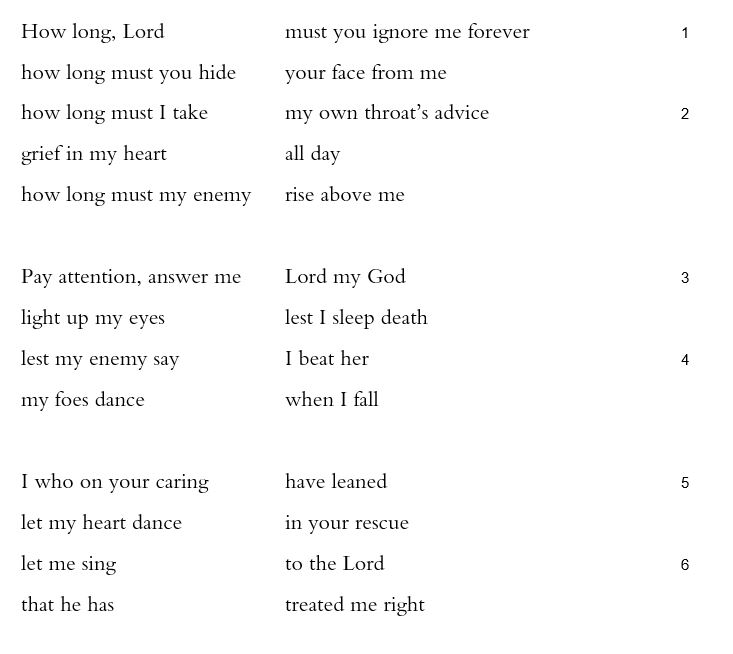
    For five and a half verses, the anger and fear of this psalm’s plaint are perfectly clear. Aching and lonely from the outset, the speaker cries how long? Four times in two verses, she cries. Three urgent imperatives follow— “Pay attention, answer me… light up my eyes”—followed by three unwanted consequences: “lest I sleep death” (3b), “lest my enemy say | I beat her” (4a), and “my foes dance” (4b). The movement of both outcry and argument goes twice from God to the speaker to the enemy. “How long?” is asked twice about God (1a, 1b), once about the speaker (2a-b), and once about her enemy (2c). The imperatives follow a similar causal chain, from “Lord my God” (3a) to “lest I” (3b) to “lest my enemy… my foes” (4a, 4b). After these two verse pairs (1-2 and 3-4), the final pair softens to a plea as third-person wish becomes first-person: “let my heart dance… let me sing” (5b, 6a).  

    Those two imperfect-form verbs, expressing desire, are surrounded in the final verses by two other verbs, both in the perfect form, showing completed action: “I… have leaned… he has | treated me right” (5a, 6b). The meaning of this verb sequence is three-quarters clear: “since I have trusted you, I’d like my heart to dance and I’d like to sing.” The final verb, gamal, followed by alai means “he has dealt well with me,” “he has rewarded me,” “he has paid me back.”

    But the rub, the kicker, the single syllable on which the psalm depends, is the word that introduces the final clause: ki, a conjunction with startling range. Two of its most important meanings are “for” or “because,” showing causality, and “when” or “if,” though this use is somewhat rarer with the perfect verb form. Thus it is possible to read the last verse to say either “I will sing to the Lord if he has treated me well” or “let me sing to the Lord because he has treated me well.”

    The challenge is to render in one English translation the two strikingly different readings that the line—and thus the psalm it concludes—allows. Either the speaker’s wishes have suddenly come true off-stage, in which case the genuine anger and fear of most of the psalm have been erased in too swift a consolation. Or the patient movement of the psalm from “how long” to “answer me” to “let it be my heart [not my foes’] that dances in your rescue” has one final step, a wish in an imagined past-perfect tense: “I want to sing… once he has rewarded me.” Since we cannot have both “because he has | treated me right” (as most versions express) and “when he has | treated me right” (as only the NET Bible has, though this reading feels more honest), “that he has | treated me right” seems both literally accurate and appropriately open-ended.

    *

    13:2 my own throat’s advice  Lit. the counsel of my neck. With the Lord’s face hidden, the speaker has to consult herself, turning inward from neck to heart.

    13:3 lest I sleep death  Lit. “lest I sleep the death.” The image is potent, and the King James is idiomatic and lovely: “sleep the sleep of death,” far superior to the NIV’s “sleep in death.” The sudden strangeness of the object is important to capture. 

    13:4 I beat her  Lit. I beat him. Every gender deserves favor.

    13:6 that he has | treated me right  See the introduction to this psalm for a discussion on this verse. Alter comments wisely on this verse: “perhaps the prayer itself served as a vehicle of transformation from acute distress to trust.”

    Share:

    • Share on X (Opens in new window) X
    • Share on Facebook (Opens in new window) Facebook
    Like Loading…

    About Me

    My name is Mark Minster. I’m an English and Comparative Literature professor with a background in ministry and in poetry. I teach courses on writing, reading, religion, and nature.

    Recent Posts

    • Psalm 150
    • Psalm 149
    • Psalm 148
    • Psalm 147
    • Psalm 146

    Newsletter

  • March 23rd, 2023

    Psalm 12

    (director: in eighths, lyric, of David)

    * * *

    This powerful lyric centers on the divine response to corrosive human speech, which oppresses as it deceives. The Lord’s speech-in-action is literally centered, with “right now I rise | says the Lord” in the exact middle of the psalm’s chiastic structure (5b). Divine speaking is framed, first, by the not-quite-speech of the weak, the “groans of the poor” (5a) and “the rescue | he breathes for” (5c). In turn, these lines are framed by the repeated verb “say,” which pairs the reported speech of the boastful (4) with a celebratory description of the Lord’s sayings (6). Their talking is not God’s talking. This whole unit is framed once again by verses 3 and 7, which match the imaginary punishment of “slippery lips” by the Lord in the third person, with the Lord in the second person, who instead of punishing, protects. The psalm begins and ends with the problem of corrosion, which not only persists, but spreads. The bookending phrase “the human race” repeats (1b, 8b), while “worthless they speak | to each other” becomes, at the end, “all around, cheats | traipse / as cheapness rises” (2a, 8).

    As a coherent whole, the psalm wisely diagnoses the problem of cheap and careless speech: “slippery lips” (2b, 3a) arise from the deeper problem of “a split heart” (2b). The phrase rendered here as “split heart” is so profound in Hebrew it’s a shame it doesn’t work literally in English: belev valev, “with a heart and a heart.” Both the King James Version’s phrase “a double heart” and Robert Alter’s “two hearts” imply a heart that is beside itself. They far surpass the NIV’s ruinous “deception in their hearts.” And while those images of lips that slip around and a heart as halved as it is doubled do indict duplicitousness, they also critique “flattery,” as the KJV and NIV say.

    And yet the psalm’s dual moral is half a consolation. On the one hand, the Lord rises and speaks truly to guard the weak, rising not just for, but out of, the groans of the poor (5-7). On the other hand, while the rescue called for from the psalm’s first word indeed arrives mid-poem, the lyric ends as it began, with the unsolved, unsolvable problem of unreliable human speech, the unreliable heart. It evokes the Tower of Babel, and 1 Samuel 16:7 in its Shakespearean iteration, King Duncan’s observation that “there’s no art/ To find the mind’s construction in the face.”

    *

    12:2 slippery lips with | a split heart they speak  The word chelqah means smoothness and is often translated as “flattering.” A smooth talker may be a flatterer—or a liar, or someone who evades care or truth. As ever, the translator’s job is to present the image, not to take the reader’s responsibility. The introduction above discusses belev valev, “with a heart and a heart,” here presented as “a split heart” only because a more literal translation misleadingly sounds additive rather than divided.

    12:3 Let the Lord snip  Lit. “cut off.” A fitting punishment for duplicitous speech and a divided heart.

    12:4 who is our boss?  Perhaps too colloquial, especially since adon elsewhere in this translation is “lord.” But in reported speech, “who is lord to us” is too stilted, not just in the phrasing, but in the comparatively medieval world of lords and ladies. “Master” is far too fraught in an American context, given the legacies of slavery.

    12:5 from the wreck of the weak | from the groans of the poor  The prepositional prefix mem- before missod “from the wreck” and mei’anqat “from the groans” can be causal— “because of”— rather than partitive— “out of.” But there are other causal particles that might have been chosen, whereas the doubled mem invites the image of the Lord arising and speaking out of the injustice itself.

    12:7 you guard them / you protect him The focusing move from plural to singular is common enough in biblical Hebrew poetry: it happens repeatedly in this very psalm (in verses 3,5,6,7). Moreover there are multiple possible antecedents for both “them” and “him,” which makes the efforts of several translations unwarranted: “thou shalt keep them… thou shalt preserve them” (KJV) and “will guard him, will keep him” (Alter) are understandable, but the NIV overreaches and misreads (the energic nun) with “will keep the needy safe and will protect us forever from the wicked.”

    12:9 as cheapness rises | in the human race  The line does not look “tacked on,” as Alter has it. “Cheapness” picks up “worthless” from verse 2, and “the human race” here forms an inclusio with “the human race” in verse 1.

    Share:

    • Share on X (Opens in new window) X
    • Share on Facebook (Opens in new window) Facebook
    Like Loading…

    About Me

    My name is Mark Minster. I’m an English and Comparative Literature professor with a background in ministry and in poetry. I teach courses on writing, reading, religion, and nature.

    Recent Posts

    • Psalm 150
    • Psalm 149
    • Psalm 148
    • Psalm 147
    • Psalm 146

    Newsletter

  • March 22nd, 2023

    Psalm 11

    (director: of David)

    * * *

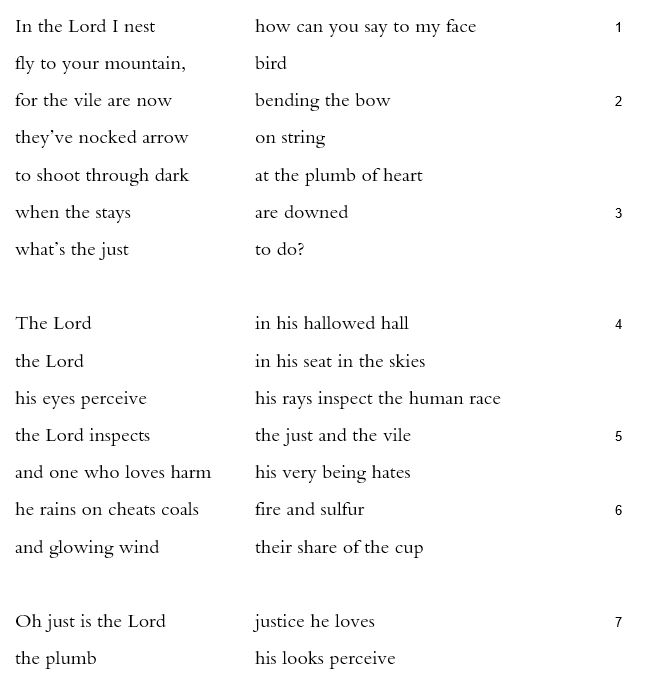
    This short psalm is swift, with a cascade of movement. In the first two verses, the speaker imagines herself a bird not yet in flight, which suggests the near-flight of threatening arrows. To this threat, the Lord responds by shooting glances from above, raining his elevated response: “coals | fire and sulfur rage / and glowing wind” (6). Images precipitate from potential to kinetic, the feathers of birds become feathers of arrows, and the darkness of verse 2 and of the human world yield to the fire of verse 6, which comes from the skies. Against this mostly downward movement, there is upward flying to the mountain and the upright person whose heart is plumb.

    Over against all of this movement is the constant of justice, a root word repeated four times, the name of the Lord five times. The avian imagery and the emphasis on eyes make the Lord’s vision seem like a raptor’s, with large eyes ranging across a wide field.

    *

    11:1 to my face  Lit. to my neck, which doesn’t work idiomatically in English.

    11:1 fly to your mountain, bird  Or, “flee your mountain, bird.” There are textual variants here in the manuscripts.

    11:2 are now | bending  Lit., “for look, the bad ones bend.” The word hinneh gestures to something, much like the French “voilà,” but also functions grammatically to make imperfect verbs anticipatory: the bad ones are just now about to bend the bow

    11:3 the stays | are downed  Lit. “the foundations are broken down.”

    11:4 his eyes perceive | his rays inspect  The word `af`afav might well mean “eyelids,” though this makes no sense. Maybe “rays” seems fanciful, yet ancient theories of optics generally imagined visual emission, that eyes had the power to send out beams.

    11:4 the human race  Sometimes it’s still 1611 in my ear, and I want to preserve “the children of men.” Even “the sons of men” is so muscular. But both now sound willfully archaic.

    11:7 the plumb | his looks perceive The King James Version has “his countenance doth behold the upright,” which singularizes the plural noun paneimov (lit. “his faces”) and the plural verb yechezu, which also appears in v. 4, a synonym for seeing that emphasizes perception and discernment. Most other translations emend the text to read “the upright shall behold his face,” reasoning, as Herb Marks does, that the subject and object were “transposed in deference to the interdiction on seeing God’s face” (The Norton Bible 968 n.11:7). But the reading of this line that best fits the rest of the psalm is to see this line as continuous with verse 4, “his eyes perceive.” To see if a plumbline remains vertically true, it takes multiple looks. Plenty of biblical texts feature people with multiple “faces,” where the plural is a shrewd touch: “And the Lord said to Cain, why have you gotten angry? And why have your looks fallen?”

    Share:

    • Share on X (Opens in new window) X
    • Share on Facebook (Opens in new window) Facebook
    Like Loading…

    About Me

    My name is Mark Minster. I’m an English and Comparative Literature professor with a background in ministry and in poetry. I teach courses on writing, reading, religion, and nature.

    Recent Posts

    • Psalm 150
    • Psalm 149
    • Psalm 148
    • Psalm 147
    • Psalm 146

    Newsletter

  • March 21st, 2023

    Psalms 9 & 10

    * * *

    * * *

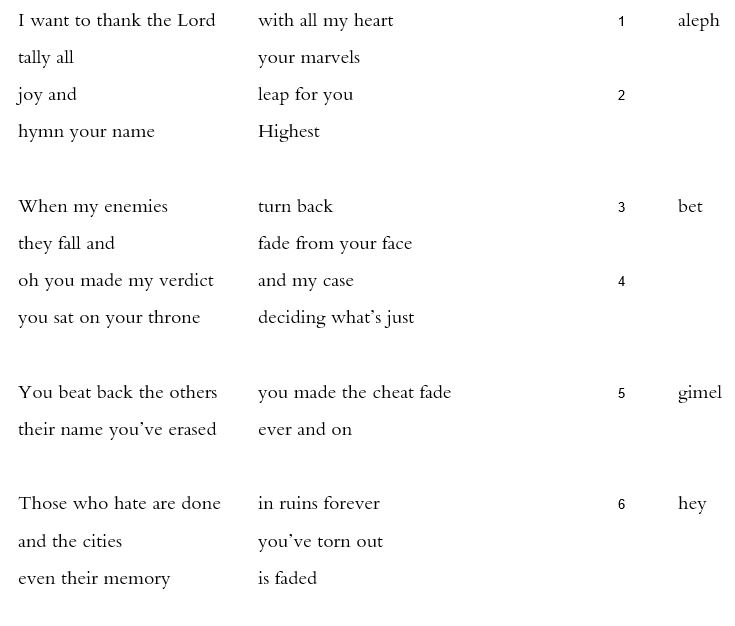
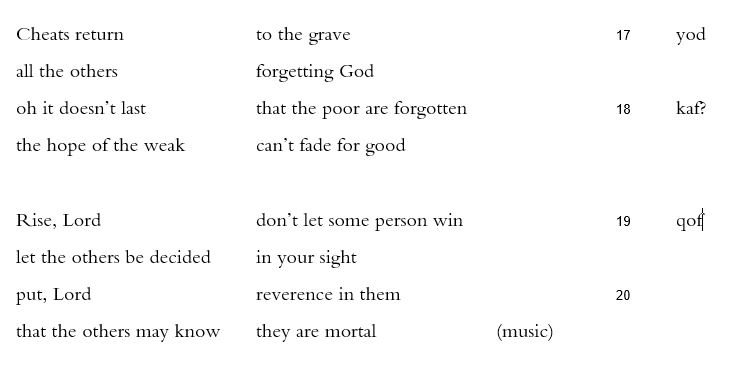
    With Psalm 10, Psalm 9 is a broken acrostic, its contents shaped by both the form and its obvious ruptures. To take the second point first, this is not a well-preserved acrostic. Readers disagree about whether it is a single psalm or two, underemphasizing the more important point that what we have here are fragments, far more than two. If there are two groups of pieces here, it’s not quite Psalm 9 and then Psalm 10. The first goes most of the way through Psalm 9, then picks up again at the end of Psalm 10. The other makes up the bulk of Psalm 10, including… other verses?

    Through the acrostic, the pattern appears to be four half-verse lines for each letter: aleph (9:1-2), bet (9:3-4), zayin (9:11-12), chet (9:13-14, maybe five lines), tet (9:15-16) and maybe yod (9:17-18), qof (10:12-13), resh (10:14, which is long), shin (10:15-16), and tav (10:17-18). Gimel and hey have two or three half-verse lines (9:5 and 9:6), while vav gets eight (9:7-10). Dalet, lamed, mem, nun, samech, peh, ayin, and tsade are all either missing or present but unrecognizable. That leaves 9:19-10:12, of which only 10:2-9 feels both cohesive and yet stylistically distinct.

    As for the first point above, that Psalm 9 and 10 is/are limited by form, even intact acrostics tend to feel forced or choppy. It’s likely that acrostics played an important part in scribal traditions, teaching students passive content as they actively practice skills. As with other primers, hornbooks, elementary readers, and abecedaria across cultures, biblical acrostics tend to favor handwriting and piety over poetic risk. Not always. Poetic forms can encourage surprise as well as order, leading one away from what one merely wanted to say. Still, the best way to read these acrostics is probably Hebrew letter by letter, almost the way one reads a Japanese renga or Persian ghazal, looking for leaps across stanzas, one link at a time.

    Aleph, for example, feels traditional. All four half-verses (lines) start with aleph, which in the first-person is easy to do. Bet introduces the theme—the bad will be punished because the Lord is a judge enthroned. Gimel and hey, which survive even though the dalet verses that should lie between them do not, follow the motif from bet, the leitwort, that the bad will vanish or “fade” (9:3b, 5a, 6c; compare 10:16). The vav verses return to the theme from bet, that the Lord judges from his throne.

    Yet from the punishment of the cheat, the verses turn to shelter for the weak, the theme that guides the acrostic from 9:9 through 9:18. In 10:2, the two sides of the same theme come together: “Conceited the cheat | stalks the weak / let them get stuck | in webs they wove.”

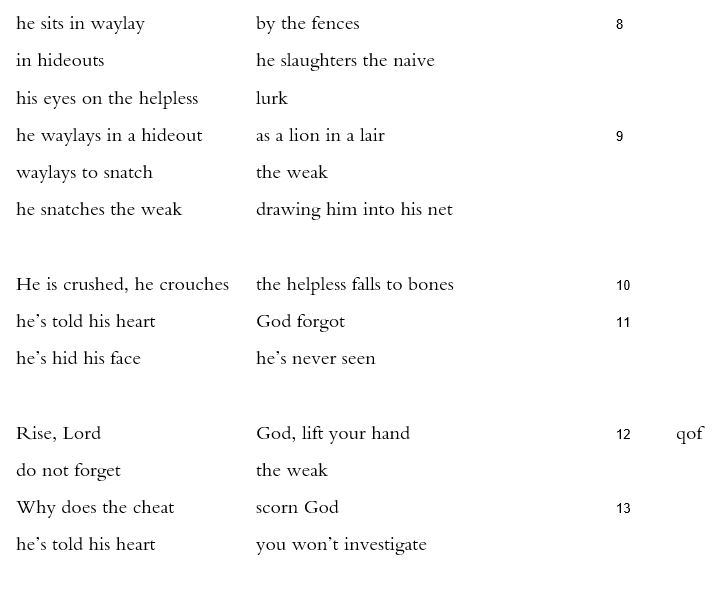
    As the theme develops, the form slips, carried away by the most interesting verses of this one/these two psalms. Our camera tracks the bad person’s twisting paths. We hear his internal monologue, see inside his mouth, follow him into hiding. The effect is to take the relatively typical language of the acrostic— “he has not forgotten | the cry of the weak” (9:12); “do not forget | the weak” (10:12)— and splice into them the dramatic energy of a detailed scene:

    he sits in waylay                   by the fences                      

    in hideouts                          he slaughters the naive

    his eyes on the helpless       lurk

    he waylays in a hideout       as a lion in a lair

    waylays to snatch                 the weak

    he snatches the weak           drawing him into his net  (10:8-9)

    It’s possible, even likely, that the received text includes scribal errors, given the discontinuities, the lengthy interruptions of the form. And yet the breaks improve the psalm. So does that polyvalent blurring of pronouns right before the acrostic form resumes: “He is crushed, he crouches | the helpless falls to bones / he told his heart | God forgot” (10:10-11). Who is crushed? Who crouches? Who told whose heart that God forgot? The criminal, or the victim? Or both? The psalm looks for all the world like a broken-open seedpod, with something far more lively growing out from within.

    * * *

    9:1 “Death of the Son”  Literally this would seem to be the meaning of almut labben, which may be the name of a tune or some unknown musical cue.

    9:2 glee and leap Typically paired (e.g., Ps 5:11, 68:3), the verbs samach and alats both describe celebratory actions, one a brightening, the other a dance.

    9:4 decision… deciding  The words mishpat and shophet. On campus once, I overheard two music composition majors talking. One said, “I showed him four measures I’d written and asked him what he thought I should do next.” “What did he say?” asked the other. “He said, ‘well, you can either repeat what you’ve written or write something new.’”

    9:9 cliff fort  A mishgav is a stronghold, yes, but the word “stronghold” doesn’t necessarily convey stone or heights, which are both visually valuable.

    9:14 whirl in your rescue  The common translation “rejoice in your salvation” treats the verb gil, to dance a circle, the way Michal treats David in 2 Samuel. Outside of a church or synagogue, who says “rejoice”? “Do a jig” is too casual, but closer: “rejoice” is disembodied and so uptight.

    9:16 (loud music) The Hebrew is higgayon selah. This is a relatively wild guess.

    9:19  Alter takes 9:18 as the beginning of a kaf section, which solves one problem but creates two more: then we have half a yod section and an overlong kaf section. Moreover the kaf section would have to begin with the ki that might make more sense as a conjunction within the yod section. An alternate possibility is a spelling error, assuming that the kaf and qof sounded as similar as they do now. Another alternate possibility is that, as in other places, textual transmission is just rough. Perhaps the most compelling alternative is that the break in the acrostic was intentional, though the intention is by no means clear.

    10:3 it’s greed he’s bowed to   The masculine pronoun here sets up the ambiguity of the cheat and the weak in verse 10 and 11.

    10:4 with nose aloft  “The pride of his countenance” works, but the literal Hebrew conveys the same idea so much more vividly.

    Share:

    • Share on X (Opens in new window) X
    • Share on Facebook (Opens in new window) Facebook
    Like Loading…

    About Me

    My name is Mark Minster. I’m an English and Comparative Literature professor with a background in ministry and in poetry. I teach courses on writing, reading, religion, and nature.

    Recent Posts

    • Psalm 150
    • Psalm 149
    • Psalm 148
    • Psalm 147
    • Psalm 146

    Newsletter

←Previous Page
1 … 33 34 35 36 37
Next Page→

Blog at WordPress.com.


Loading Comments...
 

    • Subscribe Subscribed
      • The Book of Psalms
      • Already have a WordPress.com account? Log in now.
      • The Book of Psalms
      • Subscribe Subscribed
      • Sign up
      • Log in
      • Report this content
      • View site in Reader
      • Manage subscriptions
      • Collapse this bar
    %d