• Page list
    • Posts
    • The Book of Psalms

The Book of Psalms

  • March 20th, 2023

    Psalm 8

    (director: on the Gath harp, lyric, of David)
    * * *

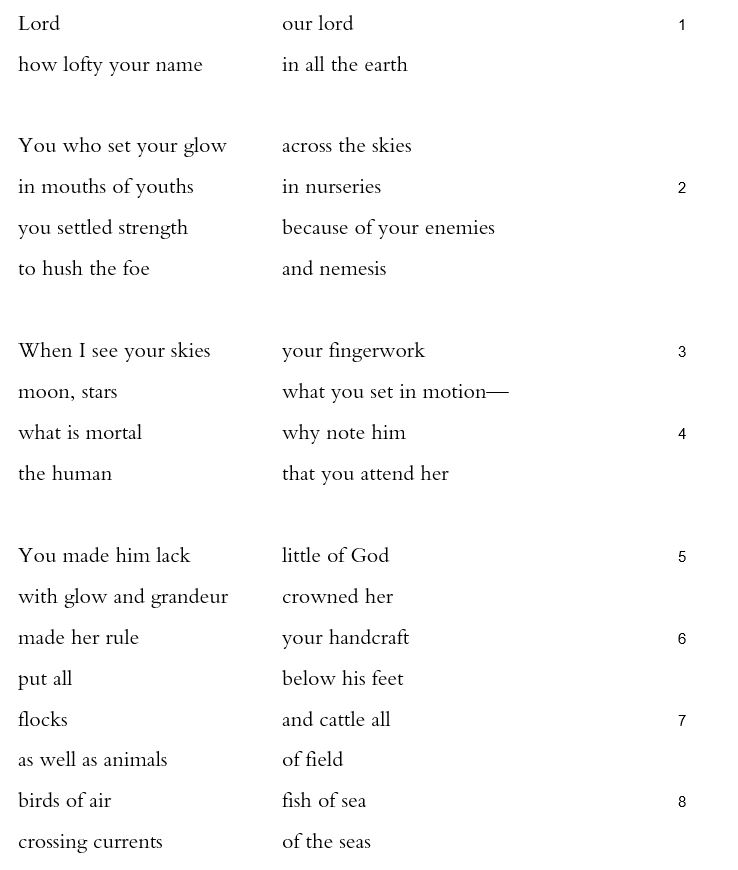
    Among the strongest of all psalms, Psalm 8 is a tightly constructed poetic commentary on the beginning of Genesis. It starts and ends with a refrain that includes God’s personal name, yod-hey-vav-hey, a renaming of him as adonai, our lord, and an exclamation that is half a question: “how lofty / your name | in all the earth” (1, 9).

    How lofty? We move from “your glow | across the skies” (technically verse 1c, though it belongs with verse 2) into the “mouths of youths” (2). (In the Bhagavata Purana, Krishna’s mother peers at the cosmos within her son’s mouth.) Verse 3 returns us to the skies with another half-question, half-exclamation—

    When I see your skies       your fingerwork

    moon, stars                         which you set in motion—

    —setting up the psalm’s key moment, the break, the aposiopesis, a Dantean moment of ineffability. In colloquial English, the speaker can’t even.

    What follows this charged instant of rupture is first a double question that returns, for the second time in the psalm, to the small scale: “what is mortal | why note him / the human | that you attend her” (4). Then we’re lifted again to the heights: “You made him lack | little of God” (5). The back half of the poem sifts down through the days of creation in Genesis, through its version of a chain of being, from “below his feet” (6b) to the depths of the oceans, “crossing currents | of the seas” (8b).

    This marvelously vertical poem may follow Genesis 1:28 in describing humans as putting other creatures underfoot, but its vision of the cosmos stresses the word “all,” used four times. It repeatedly interleaves the whole and the part, the large and the small. There are many ways to rule, many ways for that strength in the mouths of youths, for our human heft and grandeur, to note and to attend to the birds of air and fish of sea, ways that differ from those that now threaten their very existence. Surely the psalmist—at least—would grieve the loss of one of every four birds, nearly three of every four fish.

    *

    8:1 on the Gath harp  Another unknown term, ha-gittit could mean “for the winepresses,” as the Septuagint suggests.

    8:1 how lofty your name  God’s name itself may be majestic, but “name” also signifies reputation, in both languages. The English phrase “the heights of fame” comes to mind.

    8:1-2 You who set your glow… and the nemesis  These are perplexing lines. The last third of verse 1 really does seem to belong here, rather than with the opening and closing refrain, though the grammar is awkward. The idea seems to be that the same Lord who set a “glow | across the skies” also created the human mouth as a potent weapon, though the mouth might figure breath or speech. More specifically, the strength that is fitted into the mouth might be the power of naming, which allows both the naming the Lord and the naming of the other living beings of earth. Even so, the three words “enemies,” “foe” and “nemesis” stress an antagonism that’s not picked up by anything else in the poem. Nahum Sarna follows Dahood in suggesting that these are references to “mutinous forces of primeval chaos” that are part of ancient Near Eastern creation myths (57).

    8:3 When I see…  The syntax is interrupted at the end of this verse, after the dependent clause (the protasis) only to restart with rhetorical questions as a different construction. The effect is like the English expression “what the—?” It deepens both verses.

    8:3 fingerwork  Very literally, “the work of your fingers”

    8:4 mortal… him/ the human… her  There are all kinds of ways to address the patriarchal language of the Hebrew Bible: carry every “he” over into English; try to elide grammatical gender with plurals and fewer pronouns; or change some pronouns to balance out the insistent masculine. This translation opts to minimize pronouns when that works, without changing singulars to plurals. When pronouns are needed, I have generally kept masculine pronouns for God, and for humans only when the masculine preserves some valuable ambiguity. Otherwise I attempt to use mostly feminine or neutral/third-gender pronouns in generic reference to humanity. Occasionally, as here, it made sense to shuttle back and forth. In a matter of years, this particular solution may seem archaic. The attempt is to acknowledge all.

    8:5 lack | little of God  It seems willful to translate ’elohim here, in a poem that starts and finishes with “your name” as anything other than God, which is what the word nearly always means. It can mean gods plural, or other divine beings.

    8:5 heft  The word kavod has an array of figurative, abstract meanings— from “honor” and “glory” to “dignity” or “worth.” The concrete meaning at its heart, however, is of heaviness, weight, a fullness, perhaps because to be large or loaded down implies having wealth and respect. Heaviness has different connotations in English, however. See introduction to Psalm 57.

    Share:

    • Share on X (Opens in new window) X
    • Share on Facebook (Opens in new window) Facebook
    Like Loading…

    About Me

    My name is Mark Minster. I’m an English and Comparative Literature professor with a background in ministry and in poetry. I teach courses on writing, reading, religion, and nature.

    Recent Posts

    • Psalm 150
    • Psalm 149
    • Psalm 148
    • Psalm 147
    • Psalm 146

    Newsletter

  • March 19th, 2023

    Psalm 7

    (rendition of David, which he sang to the Lord with the words of Kush the Benjamite)

    * * *

    While both can be classed as individual laments, Psalm 7 is a study in contrasts with Psalm 6. There’s less turning in this psalm, and no pleading for a change of heart or diversion of enemies. Instead of appealing to sympathy, the speaker names a threat (1-2), swears innocence (3-4), and calls on the Lord for legal intervention, a fair ruling (6-8). The rest of the psalm reflects on justice (the root tsadiq is used five times), a property it asserts is integral to God’s identity (6-11, 17). The psalm sees punishment as the fitting, even logical, outcome of meanness (12-16). Instead of begging God to be less angry, Psalm 7 demands God to remember who God is. Not “Lord don’t scold me | while you’re mad,” but “Rise, Lord | in your rage” (7:6a).

    The psalm is at its most unique in the second half, from the end of verse 11 through verse 16, because of what looks like intentional ambiguity. From at least verse 8 to at least verse 11, the focus is on divine justice. By the time we get to verses 15 and 16, the focus shifts to the wrongdoer, who’s done in by the wrong he’s done. In between, however, in verses 12-14, there’s a remarkably blurred sequence of grammatically masculine verb forms and masculine noun suffixes with no named subjects: “If he doesn’t turn | his blade he whets / his bow he’s strung and readied” (12). If who doesn’t turn? Who sharpens whose sword? Who has prepared for whom “the tools of death” (13)? The English Standard Version tries to be helpful and clear: “If a man does not repent, God will whet his sword.” That’s a little like taping a photograph over a Cubist portrait. It misses the point. The bad man doesn’t turn. God doesn’t, either. The bad man sparks his arrows. God does, too. Double-duty pronouns depict the exact overlap of punishment and crime. The grammar may not be clear, but the significance is.

     When I was in divinity school, I once misquoted a line from Elie Wiesel: “God made people because God loves stories.” I was trying not to use exclusionary language. My classmate Nina jumped in. “Yes, but you killed it. ‘God made man because he loves stories.’ We can’t tell who loves stories. It’s both/and.” It’s a cat and a vial of prussic acid, alone in a room for an hour.

    *

    7:1 rendition  The word shiggaion is unknown and most often left in Hebrew. It might come from the root shagah, which has something to do with wandering off in one’s own direction. Some speculate that it means dithyramb. It could be an instrument, a style, any number of things.

    7:1 Kush the Benjamite  Not clear who this is. Kush is the name for Nubia and Ethiopia, Benjamin the tribal territory just north of Jerusalem (“between his shoulders he lives” Deut. 33:12), a region linked to David for being Saul country.

    7:2 lest one slash my neck  The slasher is unnamed but singular. As in other psalms, the word nefesh is often rendered “soul,” but refers to the vulnerable part of the front of the body.

    7:4 stripped my attacker  The word chatsal for stripping away means something similar to natsal, used in verse 1 and verse 2 (“whisk away”). “Attacker” is literally “one who binds me”

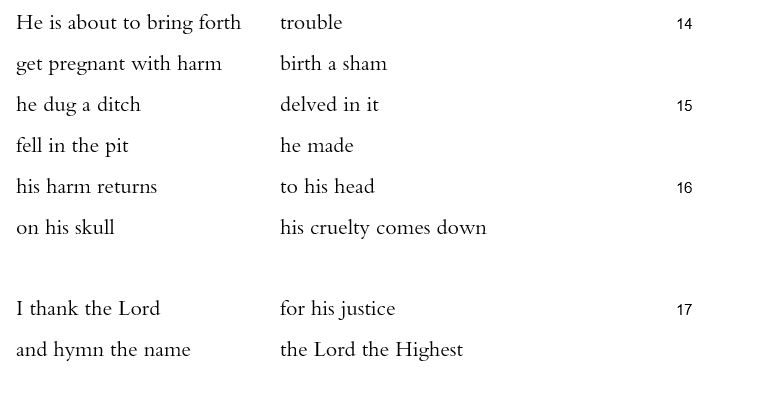
    7:14 He is about to bring forth…  The sequence is clear, and it’s vivid. He—more likely the bad man than God—is in labor: the hinneh-plus-verb formula generally yields a continuous tense. The verbs in the second half of the verse are in the vav + perfect form, which can result in either past or present tense constructions: “get pregnant with harm | birth a sham” is a leap that shows consequence as clearly as “sow” and “reap.” A wrongdoer is always in labor pains with trouble; impregnated by harm, he—that he is no she is the point—bears sham babies.

    7:16 his harm returns  This turning calls to mind Psalm 6, when read in sequence, but more immediately verse 12, “if he doesn’t turn.” If the villain doesn’t turn, villainy will turn on him.

    7:17 Thank… hymn  As an ending, the whole verse is kind of pat, but not necessarily added later. The verbs yadah and zamar are frequently paired.

    7:17 The Lord the Highest  The usual formulation of one of God’s names (or titles) is El Elyon, but YHWH Elyon works, too. This translation assumes that readers want to say something meaningful in English if they’re reading aloud or even mouthing these words. Saying the names in an old language has its own pleasures.  

    Share:

    • Share on X (Opens in new window) X
    • Share on Facebook (Opens in new window) Facebook
    Like Loading…

    About Me

    My name is Mark Minster. I’m an English and Comparative Literature professor with a background in ministry and in poetry. I teach courses on writing, reading, religion, and nature.

    Recent Posts

    • Psalm 150
    • Psalm 149
    • Psalm 148
    • Psalm 147
    • Psalm 146

    Newsletter

  • March 18th, 2023

    Psalm 6

    (director: with strings, in eighths, lyric, of David)

    * * *

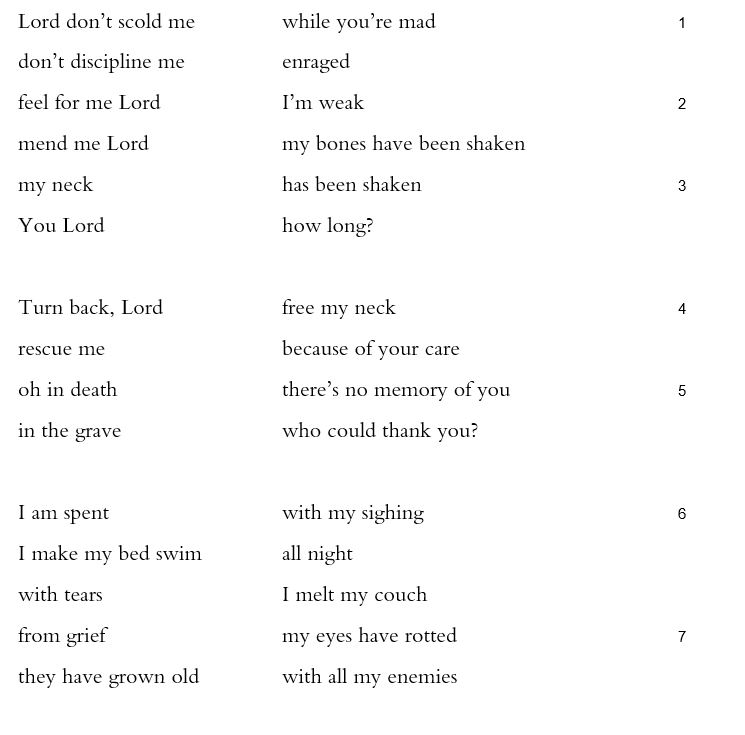
    The sharp-eyed critic Bernhard Duhm, who allegedly quipped that “commentaries make one stupid,” wrote of Psalm 6 in his 1899 commentary on the Psalms, “as a reading at a Christian sickbed this psalm is not suitable.” Two thoughts arise. First, the modifier “Christian” seems wholly unnecessary. Second, it stuns that this advice should need to be said. What dim chaplains have seen fit to console loved ones with a text that blames enemies for illness and flatters God to relent from punishment: “in death | there’s no memory of you / in the grave | who could thank you?” (6:5)? But perhaps Cassiodorus’ traditional grouping of seven penitential psalms (Pss 6, 32, 38, 51, 102, 130, 143) led passive priests and pastors to flip to this one too quickly at bedsides.

    In translation and in the original, it’s evident how many times “me” shows up, and how thickly the tears flow. Some psalms are just weaker than others, as Duhm had the courage to admit: “[those] who know only the best poems… and mostly have a false conception of their originality usually consider the Psalter the classic model of sublime oriental poetry; however, the one who reads the collection in their original… perceives the dominance of the conventional and the extensive dependency of most poems upon older models” (xxvii, qtd. in Kurtz, “The Spirit of Jewish Poetry” 2020).

    Not that the psalm is poorly structured. It turns on the trope of turning, which is one of the most significant images in both poetry and the Bible. Interestingly, the word “verse” refers to the turning of a line (see “reverse,” “inverse,” and “version”), and the volta of a sonnet is the turn from octave to sestet. Biblically, the Lord turns towards or away, the people turn towards or away, they swerve, their hearts or faces are turned, they return. “Turn back, Lord,” the speaker pleads in verse 4, and then demands that enemies “turn from me” in verse 8, which the final verse actualizes: “they turn and blanch”  (6:10). In a deft move, their blanching—their shame—is their turning: yashubu yeboshu, in which bosh literally turns shuv around.

    So Psalm 6 is not without its moments. It closes well, returning to the image of being shaken (6:2,3,10) and to the image of the eye from verses 6 and 7 which now “blink” (10). Verse 5 is nice, pairing that statement about death and memory with a rhetorical question about the grave and gratitude.

    It’s just marred by its sentiment, its self-pity, and its lashing out. Not all psalms are great poetry. We who read them, maybe we don’t expect them to be.

    *

    6:1 on the eighths The notation clearly has to do with eight, but what does that mean? The Vulgate says pro octava (Dahood 38), suggesting low pitch or complete scale. The NASB has “eight-stringed instrument.” Eighths could also count beats, syllables, or any number of things.

    6:2 feel for me  See 4:1 note.

    6:3 my neck The word is nefesh, which, rendered as “soul,” gets my vote for the most significant poor translation decision.

    6:4 turn back  Shuv may be the most important trope in the Bible.

    6:5  in death | there’s no memory of you The rhetoric here is audacious: “what good am I to you dead?” The Hebrew Bible, with the exception of part of Daniel, likely the last-written of its texts, does not have a vision of an afterlife that accords with most contemporary Jewish and Christian belief. There’s a shadowy underground, but neither a heaven nor a hell nor any detachable soul to survive a person’s death. All three of these concepts arrive in the Hellenistic context over several centuries.

    6:6-7 with tears | I melt my couch  The synaesthesia here is notable, despite the bathos: eyes too worn to see still generate tears, which speak with a voice the Lord can hear.

    6:9 my feeling pleading  The speaker returns to the appeal for pity and favor from verse 2.

    6:10 blanch  The word bosh does mean shame, but a kind that looks pale, coming from disapprobation, being a disappointment. There are other words in biblical Hebrew for the blushing kind of red-faced shame, embarrassment.

    Share:

    • Share on X (Opens in new window) X
    • Share on Facebook (Opens in new window) Facebook
    Like Loading…

    About Me

    My name is Mark Minster. I’m an English and Comparative Literature professor with a background in ministry and in poetry. I teach courses on writing, reading, religion, and nature.

    Recent Posts

    • Psalm 150
    • Psalm 149
    • Psalm 148
    • Psalm 147
    • Psalm 146

    Newsletter

  • March 17th, 2023

    Psalm 5

    (director: with flutes; lyric, of David)

    * * *

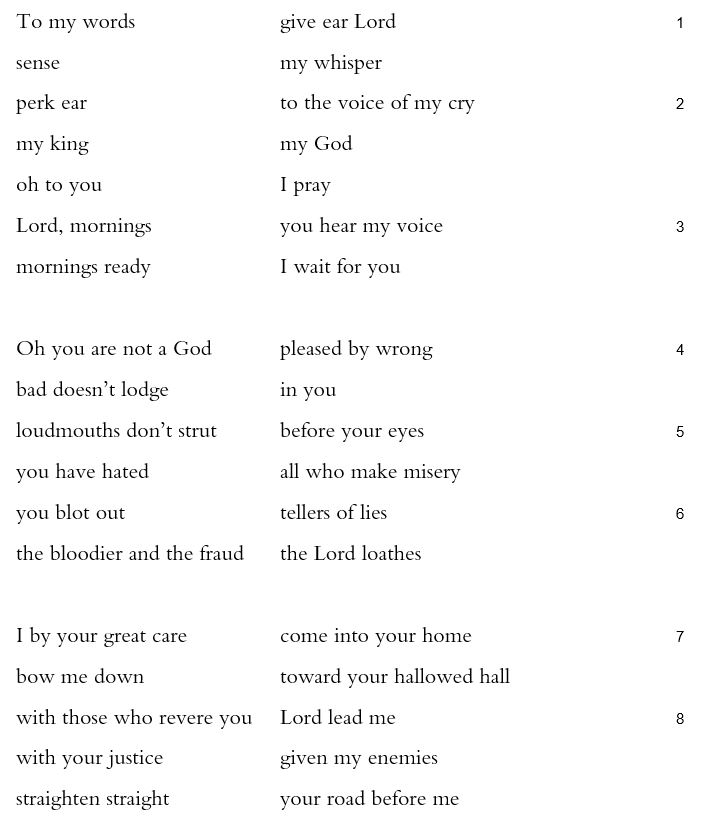
    Though its opening pairs well with the closing of Psalm 4— as reclining to sleep in peace is followed by readying at dawn— Psalm 5’s closer parallels are with Psalm 1 (see Botha 2018, Barbiero 1999). Both starkly contrast the paths walked by the good and the bad (1:6). In Psalm 1, the good person roots and follows direction, while the bad is scattered as chaff and cannot stand (1:4-5). Psalm 5 has only one road, the good person’s road, which is the road of the Lord: “straighten straight | your road before me” (5:8). The good person moves along a road that leads to and from “your home” (7a), “your hallowed hall” (7b). As for the bad person, instead of walking a road, in this psalm they get broken down into a tight, static typology of corruption in verses 4-6: “wrong,” “bad,” “loudmouths,” “all who make misery,” “tellers of lies,” the “bloodier and the fraud.” This rogue’s gallery of seven synonyms is woven together with three negative predications of God—“not a God | pleased” (4a), “does not lodge | in you” (4b), “do not strut | before your eyes” (5a)—and three synonyms for abjection—“you have hated” (5b), “you blot out” (6a), “the Lord loathes” (6b).

              Near the end of the psalm, the speaker claims alignment with those “who shelter in you” (11a), those “who love your name” (11c), and finally “the just” (singular, 12a). Three times, the speaker prays that this threefold crowd of the good will be embraced and encircled: “may they joy” (11a), “may you wrap them” (11b), “may they leap in you” (11c). Again, as for the bad, alas— the speaker names them as enemies, asking, in imperatives, for three punishments: “declare them guilty” (10a), “fell them” (10b), “exile them” (10c).

    Good, the psalm seems to assert, is centripetal; bad, centrifugal. It’s fitting that its poetic highlight is verse 9, which so memorably depicts badness with four images of emptiness at the center:

    For nothing in their mouth    is firm                               

    their inside is want               an open tomb their throat

    their tongue                        slips around

     Look inside every kind of cheat—the braggart, the harmful, the liar, the bully, the fraud. See how hollow it is inside.

    *

    5:1 flutes  The word is a hapax legomenon. Some say “strings,” some “the droning of bees” (Rozenberg & Zlotowitz 22). Kraus justifies “flutes” by reference to 1 Kgs 1:40 and Isa 30:29.

    5:1 to my words | give ear… This put the object first, the word “words” (or sayings), and then the imperative.

    5:1 sense | my whisper The word hagigi is decidedly sensory, and the movement of the first verse is intimate: “consider my meditation” is all wrong, abstract when it should be concrete. Dahood has “attend to my utterance” which is justified, as often in his commentary, by reference to Ugaritic—in particular, a parallel passage to the beautiful phrase “word of tree and whisper of stone” (Dahood 29, my emphasis).

    5:2 perk ear | to the voice of my cry Again, very literal here because the power and the beauty are in the intimacy.

    5:5 bad does not lodge  The Septuagint “the evil man shall not dwell with you”

    5:5 loudmouths do not strut  The word halal conveys both praise to the point of boasting and volume. The verb yityatstsebu is the reflexive form of standing: they stand themselves up. By transitive property, this became “strut.”

    5:6 the bloodier The word dammim probably refers to a particular kind of bloodguilt, which makes this as much about vengefulness as about violence. Dahood speculates that this half-verse concerns idolatry: “the man of idols and figurines” (31).

    5:8 with your justice… straighten straight  Note that both of these figures for goodness are directional. They have to do with alignment, balance, linearity.

    5:9 firm  Dahood points out that Mot, the death god, has a miry mouth as well (34).                  

    5:10 Declare them guilty  This is the only time in the Bible this root is used with a causative stem, but its association with formal wrongdoing is clear from Leviticus (especially chapter 5, where it appears seven times).

    Share:

    • Share on X (Opens in new window) X
    • Share on Facebook (Opens in new window) Facebook
    Like Loading…

    About Me

    My name is Mark Minster. I’m an English and Comparative Literature professor with a background in ministry and in poetry. I teach courses on writing, reading, religion, and nature.

    Recent Posts

    • Psalm 150
    • Psalm 149
    • Psalm 148
    • Psalm 147
    • Psalm 146

    Newsletter

←Previous Page
1 … 34 35 36 37
Next Page→

Blog at WordPress.com.


Loading Comments...
 

    • Subscribe Subscribed
      • The Book of Psalms
      • Already have a WordPress.com account? Log in now.
      • The Book of Psalms
      • Subscribe Subscribed
      • Sign up
      • Log in
      • Report this content
      • View site in Reader
      • Manage subscriptions
      • Collapse this bar
    %d