• Page list
    • Posts
    • The Book of Psalms

The Book of Psalms

  • July 28th, 2023

    Psalm 138

    (of David)

    * * *

    Nearing its end in Psalms 138-145, the Psalter returns to the figure of David. A surprising number of readers have seen this string of psalms with David’s name in the superscription as evidence of a programmatic messianic eschatology. From these psalms especially, they build an argument that the book as a whole promotes the return of a Davidic king who will rescue Israel from its oppressors. These eight psalms, however, only get anywhere near eschatology or apocalyptic imagery in a single part of Psalm 144 and only sound remotely messianic like Second Isaiah or Zechariah in one part of Psalm 143. And yet, overall, they present David not as a king whose line is to be restored, not even as a priestly king, but as a model of worship at the temple he himself never saw. If anything, this run of psalms seeks to contain and control disruptive messianism, displacing it with appropriate piety.

    The first of the sequence, Psalm 138, lies between two of the most vivid and memorable poems of the entire Bible, a less-than-favorable position for a psalm so choppy and tricky to parse. Psalm 138 relies on the handing-off and expanding of images, which amplify and complicate the speaker’s gratitude. This gratitude is already complicated at the beginning, given that the speaker thanks an unnamed “you” who is in front of or over against or “in the face of” ’elohim, either “God” or “gods” or both. Like Psalm 137, Psalm 138 depends on the range of the repeated preposition `al. The speaker expresses the wish to “thank your name | even above your care / even above your loyalty | for you grew / even above all | your name your word” (2b-d). Using “even above” for the single syllable `al aims at the Hebrew word’s potential to mean elevation, superiority, and reliance all at once. The speaker thanks “your name” on top of, both more than and because of, “your care” and “your loyalty.” Paraphrases of this look like logical flowcharts, both meticulous and a mess: I thank your name more than your fidelity and care because it rests on them and because you made your word even bigger than your name—or, because you made your name and your word even bigger than everything. Hard to put any other way, these three lines gesture towards and above, seeming to indicate both intimacy and God’s ability– because of and beyond loyalty and caring, name and word– to exceed even God.  

    At the center of the psalm, this exceeding and making-great— translated here as “growth,” the most obvious way in which life exceeds itself (2c, 5b)— spreads beyond the speaker to “all the kings of earth,” who “have heard | the words of your mouth” (4). The speaker’s thanks give way to theirs. In “They thank you Lord,” the Lord is named for the first time. The speaker’s song, too, gives way to others’ (“they” may or may not point back to those kings): “and so they sing | in the roads of the Lord / oh grown is | the glow of the Lord” (5). By verses 6 and 7, the lift and spread of the Lord has become universal. “Oh the Lord’s up high | yet sees the low,” the speaker or the others sing. From these heights, the psalm returns to the first-person singular, to the nameless “you” and to the exceeding `al,  while borrowing from the poem’s middle the image of the road: “As I walk the center of sorrow | you give me life / even above my enemies’ rage | you reach out your hand” (7a-b). Divine “care” reappears (2, 8), as does the image of the hand (yod, 7-8), implicit earlier in thanking (yadah, 1-2, 4). The primary effect is to show both the continuity and the increasing of the Lord’s care.

    Given the superscription, the psalm’s secondary effect is to associate the continuity and growth of divine care with David. If we take David as the speaker, then the psalm starts by having the monarchy bow to the temple, where the name of the Lord and the word of the Lord are celebrated— “oh they have heard | the words of your mouth / and so they sing” (4b-5a). The psalm then transfers that celebration of the Lord from one local king in Israel to “all the kings of earth” (4), returning to David, whose gratitude started what others continue. This point is explicit: “The Lord completes things | on my behalf,” (ba`adi) the speaker states (8a). The speaker’s part ends, in contrast with the Lord’s care, which is “always” (8b). Far from encouraging hope in a triumphant return of a Davidic king, the psalm ends by letting the Lord end things in David’s stead, keeping David in the role of a supplicant, praying to the Lord, “what your hands do | don’t let go” (8c).

    Share:

    • Share on X (Opens in new window) X
    • Share on Facebook (Opens in new window) Facebook
    Like Loading…

    About Me

    My name is Mark Minster. I’m an English and Comparative Literature professor with a background in ministry and in poetry. I teach courses on writing, reading, religion, and nature.

    Recent Posts

    • Psalm 150
    • Psalm 149
    • Psalm 148
    • Psalm 147
    • Psalm 146

    Newsletter

  • July 27th, 2023

    Psalm 137

    * * *

    No psalm haunts more than this, among the most poignant poems of the horrors of war. David may have slain his ten thousand. Achilles may have his epithets, his tent and shield. But this song sings as it says it cannot, turning tears to gruesome smiles, aching through remembered trauma, lashing out in a howl for justice. It is a psalm of mothers who relive their rape and grieve their murdered children.

    The narrative situation, set in medias res in the Babylonian Exile of the 6th century BCE, works in three temporal directions. In its present-tense scene, captives from Jerusalem are made to remember their home and forced to sing when they wanted to cry. The central narrative question for the present tense is whether they will comply with their jailers’ requests, and if so, what song they sing: “Ah how can we sing | a song of the Lord / on a land | so strange” the psalm sings, with performative irony (4). Or perhaps verses 5-6 are lines of the song they sing, “If I forget you | Jerusalem” and following.

    At the same time, the psalm glimpses hypothetical futures even as it flashes back to snapshots of terror from the destruction of Jerusalem. “If I forget you” does at least quadruple duty, then. As an “if” it’s a worry. In Hebrew, an ’im also marks a vow: “I swear I won’t forget you.” Narratively, it seems like a line from the song the captives sing. For us, it is a line of the psalm, a song, a line that makes sure we the readers don’t forget, every time we sing.

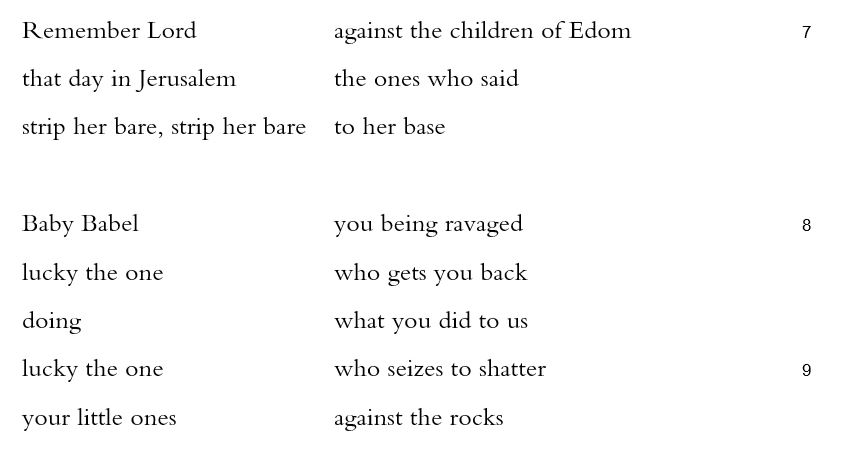
    If verses 5 and 6 anticipate the future, verse 7 recalls the past, asking the Lord (and readers) to remember Edom’s role in razing and raping Jerusalem: “that day in Jerusalem | the ones who said / strip her bare, strip her bare | to her base.” The image is unmistakable in Hebrew, with `aru `aru `ad haysod bah meaning literally “expose, expose her down to the bottom” (see Job 4:19, Hab 3:13). It may be a metaphor for the destruction of the temple or the city walls, but its literal meaning is of stripping a woman naked.

    Deeply and paradoxically auditory, the psalm is equally vividly visual. It presents speech and/or music in each of its first 7 verses, not to mention tears in verse 1 and the exclamations ki (3) and ’akh (4). The sounds are frequently forceful, from sham she’eilunu shoveinu… shir lanu mishir tsiyyon in verse 3, to ’et-yom yerushalayim ha’omerim `aru `aru `ad hayesod bah in verse 7, to the cluster of zakhar (to remember 1, 6, 7), naharot (rivers or waterways, “channels” 1), nekhar (strange, 4) that runs throughout. The music of the psalm is paradoxical, like Yeats’s “On Being Asked for a War Poem” or Hayden Carruth’s “On Being Asked to Write a Poem Against the War in Vietnam.” To the captors’ demand, the psalm protests, “Ah how can we sing,” a kind of continuity and rupture, a sure sign of the ineffable. And yet to express this ineffable, the psalm relies on primarily visual imagery, “let my right hand | forget how / let my tongue clutch | the roof of my mouth” (5). The profoundly ambivalent picture of harps “strung up” “on poplars” in verse 2, conveys both silence and the readying for music. And the most vivid image in Psalm 137 is the final one, grotesque in what it makes us see, and hear, and in its silence.

    Against these horrors are the psalm’s care and poise, with repetitions, for example that are meaningful and perfectly timed. Babel and Babel frame the poem (1, 8), while Zion and Zion begin it (1, 3). The name of the Lord appears twice (4, 7), the word for gladness twice (here, “smile” in 3 and 6) along with two uses of “lucky” (8, 9), “sing” twice, “song” three times (3-6), Jerusalem three times (5, 6, 7), and three times the word “remember” (1, 6, 7). Twice the psalm reports foreign speech, of Edom (7) and of the captors (3), and three times the speaker’s “if” (5-6). The patterns are thorough contrasts: the two capitals and the measure-for-measure revenge implicit in the repeated “strip her bare” (7c), with a feminine ending that is picked up in the very next line by the word “daughter,” used of cities idiomatically in the Bible and rendered here as the diminutive “Baby” (8a).  

    Subtlest of all, so easily lost in translation, is the insistent `al that runs throughout the psalm, the preposition that means “towards” and “up” among many other things. It begins verse 1 and verse 2 and helps conclude verses 4 and 6: “Up the channels,” “Up the poplars” (whose name `aruvim anticipates, even triggers the `aru `aru memory of assault), “up a land | so strange,” and “up top of my smile.” It may sound awkward, the “up” of this particular translation. But it is a necessary part of the psalm, that repeated direction of awkward lifting up. In verse 6, the preposition becomes the verb “to go up,” `alah, where it is negated in the causative stem: “if I can’t lift up / Jerusalem.” The payoff of all this lifting up and up arrives in the psalm’s brutal closure, where `al is revealed to be just a fragment of the word for a young child, `olalayik, “your little ones” and the final preposition changes terribly from `al to ‘el, “against.”  

    Of course the ending is uncharitable, horrible, and cruel. Far worse is the pearl-clutching of prim readers who wish this psalm would have ended instead with the turning of a cheek. The right response to atrocity is not to want victims not to want justice, but to want war to end, full stop. And war only ends if we all stay with its scenes long enough, hearing and seeing the pain of the orphan and the widow’s grief and the righteous rage of mothers bereaved.

    Share:

    • Share on X (Opens in new window) X
    • Share on Facebook (Opens in new window) Facebook
    Like Loading…

    About Me

    My name is Mark Minster. I’m an English and Comparative Literature professor with a background in ministry and in poetry. I teach courses on writing, reading, religion, and nature.

    Recent Posts

    • Psalm 150
    • Psalm 149
    • Psalm 148
    • Psalm 147
    • Psalm 146

    Newsletter

  • July 26th, 2023

    Psalm 136

    * * *

    To think about Psalms 135 and 136 is to consider the relationship between history and poetry, between the blessing and praise of Psalm 135 and the thanking of Psalm 136, and between the instants of gratitude and the constant of care.

    Too often— in analyses of Psalm 136 in particular, but more broadly in biblical studies and in culture at large— history and poetry are portrayed as opposed to one another: history as substance and actuality, poetry as imagination or style. One the body, the other the clothes. According to one particularly wooden formula, “the words ‘history’ and ‘poetry’ are irreconcilable terms. ‘History’ proper refers to nonrecurrent events within an unrepeatable context. ‘Poetry’, on the other hand is a literary genre, a restricted way of formulating verbalised knowledge” (Van Rensburg, “History As Poetry” 80). (That scene in Dead Poets Society where Robin Williams’s character has his students rip pages from their textbook.)

    Even a sophisticated, insightful analysis of Psalm 136 relies on conceptions such as (a) history being “a narrative that preserves a past,” differentiating psalms “that contain historical traditions” from those that “incorporate historical references,” distinguishing two colors of Tupperware, and (b) Psalm 136 being an example of how “earlier traditions are poeticized… the process of poeticizing earlier texts containing historical traditions,” as if “poeticizing” is self-explanatory (Brettler 393). But poetry is no more ornamented than history, no less real, no less a product, no less a making-sense of time. History and poetry are modes of rhetoric; both use language, all apologies to Auden, to make things happen. Both select. Both arrange. Both are stylized, remembered, pronounced. Texts we call historical may traffic more in causalities in the past, while texts we call poetic may elide causality and remain silent about the past altogether. But both are modes of speaking and writing that often recreate or invent the past for the sake of the present.

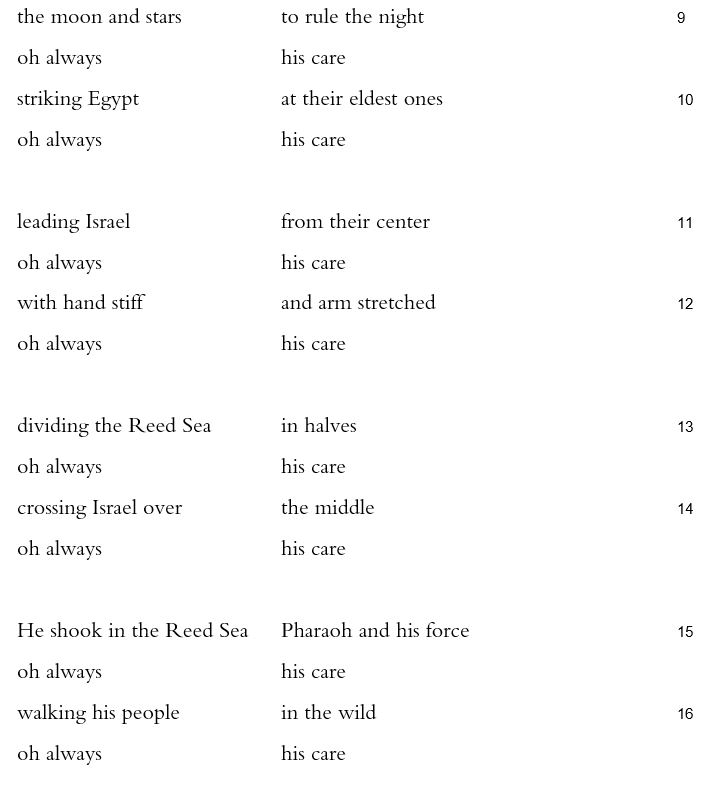
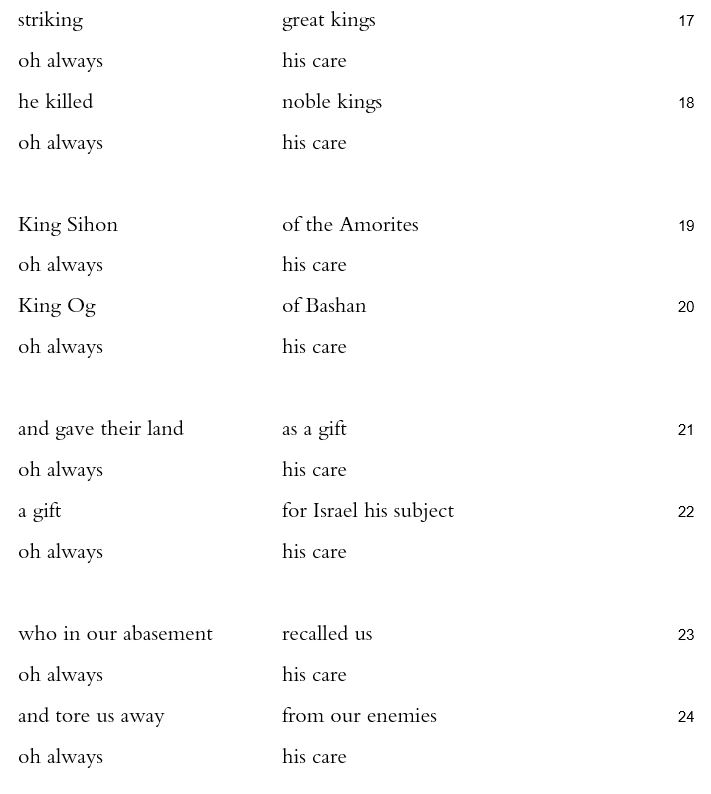
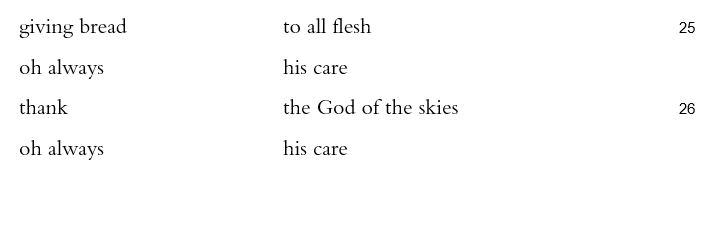
    Both history and poetry also often treat time not as chronology, but as a moment or as eternal. In the modes of theophany, epiphany, liturgy, and recitation, the fleeting present tense is all that is. History is not “incorporated” in poetry: rather, the linguistic present absorbs the past as soon as it conjures it. Like all memory, the past must be retold in the present if it is to exist at all. Psalm 136, for its part, is dominated by statements that only make sense in and of the present tense: its fourfold imperative “Thank” (1a, 2a, 3a, 26a), its fourteen participles (4a-14a, 16a, 17a, 25a) and its verbless phrases, which appear three times in the first half of a verse (19a, 20a, 22a) as well as in the refrain in the second half of every verse: “oh always | his care.” All of these stand apart from time as chronology, which is represented by the conjugated verb. The psalm’s refrain may indeed “poeticize” history, but only if poeticize means to replace the history it invents with timelessness, engulfing the past into eternity. The scene of grateful repetition, in other words, participates in what Benjamin calls messianic time, what Plotinus calls the eternal now.

    So much of what Psalm 136 does by reciting bits of text from Deuteronomy and other poetic reinventions of Israel’s past is to layer texts on other texts, relighting neural pathways to make some memories seem inevitably linked, even teleological. Marc Zvi Brettler has shown convincingly that Psalm 136 clearly alludes to and borrows from Deuteronomy 10:17-11:5, even if not why the psalm might do so. That earlier passage contains this remarkable, strange, even poetic verse: “That you may know today– oh not your children who have not known and have not seen the punishment of the Lord your God, his hand stiff and arm stretched…” (Deut 11:2). The Moses of Deuteronomy tells the people in Midian that they should consider their own obligations in the present day because of all that they themselves— not their children, don’t think about them— have known and seen of signs and wonders. And yet the entire passage is both a didactic reworking of select moments cherrypicked from Israel’s past, a second giving of the law, and a journey directed towards the future, the land toward which Israel is heading, the others Israel is told to dispossess, the children conspicuously presented in Deuteronomy 11:2 as not there, who return in 11:19 and 11:21. The purpose of revisiting, revivifying this passage in Psalm 136 may not be easily linked to a particular cultural context or window of time— clearly postexilic, but when? But the rhetorical purpose of the poem and history is clear: “oh always | his care” makes Israel’s covenant with the Lord permanent no matter the day. The citations of Deuteronomy remind Israel that if continuing care is the Lord’s part of the deal, continuing gratitude is part of Israel’s part.

    More than benediction and praise, thanking is a social obligation. In Hebrew, the term yadah derives from the word “hand,” perhaps from the raising or extending of hands, though the associations of hands and gratitude multiply: handing it to someone, giving them a hand, putting hands together, the sign in American Sign Language of one hand coming from the mouth to meet the other hand. If Psalm 136 is older than Psalm 135, then lasting divine care necessitates first, in Psalm 136, a particular covenantal response that begins by throwing hands of thanks, and later, in Psalm 135, a particular liturgical response that raises the voice and bends the knee. If the dependency of the two psalms lies the other way around, then Psalm 136 functions, as the order in the Psalter suggests, as a kind of return.

    Share:

    • Share on X (Opens in new window) X
    • Share on Facebook (Opens in new window) Facebook
    Like Loading…

    About Me

    My name is Mark Minster. I’m an English and Comparative Literature professor with a background in ministry and in poetry. I teach courses on writing, reading, religion, and nature.

    Recent Posts

    • Psalm 150
    • Psalm 149
    • Psalm 148
    • Psalm 147
    • Psalm 146

    Newsletter

  • July 25th, 2023

    Psalm 135

    * * *

    The liturgical postures of benediction and praise can seem to overlap, especially in standing and in the raising of hands. But blessing kneels and bows for what’s to come, while lauding sings loudly for now and what’s been. Psalm 135, which blends the two modes of worship, also spends a third of its verses memorializing the Lord’s repeated interventions on Israel’s behalf, less for timelessness or the sake of the past than for the community’s immediate future, its desire to unseat its contemporary opponents, current versions of pharaohs and kings.

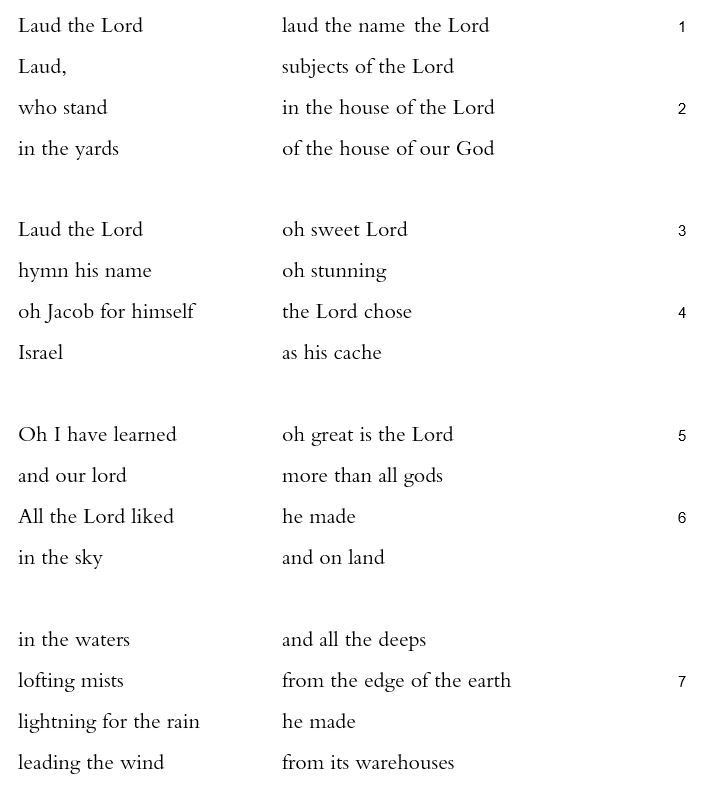
    The psalm feels very much like an expansion, an explosion, of the psalms that precede it, into which have been inserted bits and passages from all over, the whole thing introduced with formulas of praise. “Laud the Lord | laud the name the Lord,” the psalm begins (135:1), urging those who just, in the previous psalm, blessed the Lord (“all subjects | of the Lord / who stand in the house | of the Lord by night” 134:1) to now praise: “Laud, | subjects of the Lord / who stand | in the house of the Lord / in the yards | of the house of our God” (135:1b-2). The next verse reaches back to Psalm 133, repeating the words “sweet” (tov) and “stunning” (na`im), only paired in these two verses (133:1, 135:3; cf. 147:1). The prior psalms’ forward-looking blessings have become Psalm 135’s backward-looking praise. The psalm reaches back all the way to creation (135:6-7) and to Exodus (135:5 || Exod 18:11; 135:8 || Exod 12:12; 135:13 || Exod 3:15) and Deuteronomy (135:4 || Deut 7:6, cf. 32:9; 135:10-11 || Deut 4:46, 31:4; 135:12 | Deut 4:38 and often; 135:14 || Deut 32:36). Other psalms and poetry also appear to be included, by quotation (135:7 = Jer 10:13, 51:16) and near-quotation (135:6 || 115:3) , though determining the direction of allusions is often educated guesswork. Does Psalm 136:17-22 quote Psalm 135:10-12 or vice versa? In the case of Psalm 115:4-11 and Psalm 135:15-20, it’s logically simpler to assume that Psalm 135 adds the Levites in 135:19 than to explain why Psalm 115 would leave them out. And it is far simpler to assume that Psalm 135:17b energizes and extends the expected “a nose theirs | they do not smell” of 115:6 to “a nose—there is no | breath in their mouths.”  

    That Psalm 135 gathers quotations is clear. But to what end? Verse 11c offers one subtle clue. The common biblical phrase is “all the kingdoms of the earth” (Deut 28:25, 2 Kgs 19:15, 19; Ezra 1:2, Ps 68:32; Isa 27:16, etc.) which this psalm localizes in a phrase unique in the Bible (though an individual king of Canaan is named in Judges 4) “all the kingdoms | of Canaan.” A line that marks “all the kingdoms of the earth” as Israel’s inheritance could easily be perceived as a threat to any foreign ruler. A second hint comes in verse 14’s partial quotation of Deuteronomy 32:36 which omits the crucial next words: that the Lord governs “when he sees that [Israel’s] hand is spent: no one, chained or freed.” The implication here, too, is perfectly clear to any reader who knows the quoted passages: the providential theology of overthrowing rulers and taking back lands is alive and well. The psalm may begin with the fourfold imperative “laud” and end with the fourfold imperative “bless,” but its real work lies in its subversive core. The final lines of veneration— “May the Lord be blessed | from Zion / who lives in Jerusalem | Laud the Lord” (135:21)— offer blessing and praise as a pair. But their pairing of history and hope is just as significant, and potentially just as subversive.

    Share:

    • Share on X (Opens in new window) X
    • Share on Facebook (Opens in new window) Facebook
    Like Loading…

    About Me

    My name is Mark Minster. I’m an English and Comparative Literature professor with a background in ministry and in poetry. I teach courses on writing, reading, religion, and nature.

    Recent Posts

    • Psalm 150
    • Psalm 149
    • Psalm 148
    • Psalm 147
    • Psalm 146

    Newsletter

←Previous Page
1 2 3 4 5 6 … 37
Next Page→

Blog at WordPress.com.


Loading Comments...
 

    • Subscribe Subscribed
      • The Book of Psalms
      • Already have a WordPress.com account? Log in now.
      • The Book of Psalms
      • Subscribe Subscribed
      • Sign up
      • Log in
      • Report this content
      • View site in Reader
      • Manage subscriptions
      • Collapse this bar
    %d