• Page list
    • Posts
    • The Book of Psalms

The Book of Psalms

  • July 20th, 2023

    Psalm 130

    (a song of steps)

    * * *

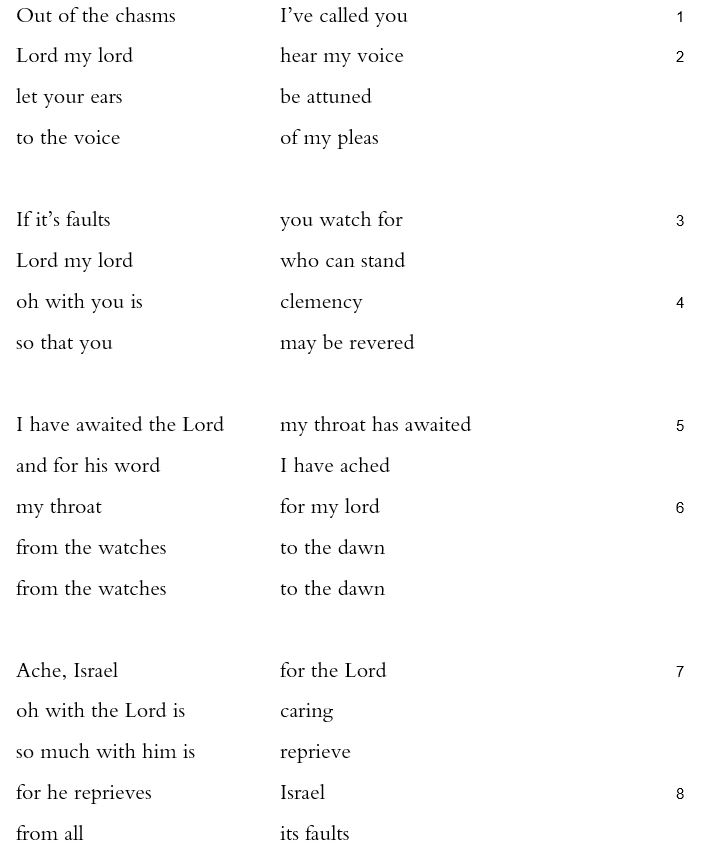
    The least penitent of the traditional “penitential psalms,” Psalm 130 twice follows a stanza of poignant experience with a stanza of theological reflection. The first stanza (verses 1-2) deepens the typical opening of a psalm of lament, while the second (3-4) describes the Lord as forgiving, not fault-finding. The third stanza returns to the first-person in passionate expectation (5-6); the fourth converts that personal energy to a characterization of the Lord as pardoning (7-8). There is not a single note of remorse or apology in Psalm 130, no sackcloth or self-flagellation. It is a crying from deep chaos, a throat that hopes in the dark, and an argument that the omnipresence of wrong cannot be met by divine prosecution, but only by acquittal and care.   

    The first stanza doubles the word “voice” and adds “my lord” to the name of the Lord as it borrows conventions from other psalms of complaint: the speaker’s call (e.g., 4:1, 28:1, 141:1), the imperative to hear (17:1, 61:1, 102:1), intensified by the audience’s “ears” (e.g, 31:2, 71:2; 86:1; 88:2). It is that first half-line, “Out of the chasms,” literally “From the deeps,” that gives this psalm particular strength: a preposition before a place, a place before a person or sound. Scores if not hundreds of choral compositions have been made of that phrase, De Profundis in Latin. In Hebrew, the word is mimma`amaqim, which works the entire mouth except the front of the tongue, with opening and closing buzzing lips in the sequence of m’s, alternating with those three low vowels in a row, ah-ah-ah, deepened by the `ayin and qof, pronounced at the pharynx and uvula, all between two high vowels that start and end the word, ee and ee: mimma`amaqim. The watery abysses the word indicates are not the fires nor shades of some punitive underworld or putative afterlife, but the primordial depths of chaos. Psalm 129 began by figuring oppression as the noose of a siege. Psalm 130 begins from trauma as the lowest of lows. It asks the Lord not just to hear, but to render the Lord’s ears attentive, “attuned,” a late, precise adjective (used elsewhere only in Nehemiah and in 2 Chronicles, though the verb is older) that calls on the Lord to adjust to the voice.

    Another late, precise abstraction arrives in the second stanza in the word “clemency” (elsewhere only in Nehemiah and Daniel, though again the verb is older). Only in the repetition of “Lord my lord” (1-2, 3) does the second stanza invoke the first-person. Rather, the stanza is insistently second person:

    If it’s faults | you watch for

    Lord my lord | who can stand

    oh with you is | clemency      

    so that you | may be revered (3-4).

    Explicit markers of reasoning— “if,” “oh” [or “because”], “so that”— make clear that the move away from the immediacy of first-person experience is part of an inductive argument, a generalization after evidence. Put deductively, its theology seems to be that God’s desire for reverence necessitates forgiveness since, we infer, guilt exempts no one and thus watchfulness for guilt must be a long, lonely task that triggers nothing like reverence. Far from depicting or enacting penitence, the first half of Psalm 130 attunes the Lord’s ears by obviating fault-finding altogether.

    Where the first and second stanzas both say “Lord my lord,” the third repeats the phrase, but inserts whole lines inside:

    I have awaited the Lord | my throat has awaited

    and for his word | I have ached

    my throat | for my lord     (5-6a).

    Here the poignancy comes from repetition, which underlines the experience of waiting, and from the return of the first-person, intensified by the repeated metonym for the self, the throat (5a, 6a). The stanza’s doubling continues in the repeated line “from the watches | to the dawn” (6b, 6c), which could equally well be rendered “more than watchers | for the dawn.” The worry from the second stanza that the Lord might be the one “watching” for faults here returns, but is exceeded by the speaker’s own expectancy and desire. We have not left the dark chasms. We just feel them now not as space but as time passing slowly.

    The final stanza retrieves the ache (5, 7) as well as the faults (3, 8) only to dismiss them both. Now it is Israel in the second person, the Lord in the third person, about whom theological claims are made: “oh with the Lord is | caring / so much with him is | reprieve” (7b-c). The Lord’s care compensates for the speaker’s yearning, just as the Lord’s “reprieve” takes care of the speaker’s, and all Israel’s, faults. The resolution is both abstractly theological and personally felt.

    Perhaps the most affecting feature of this final stanza and of the psalm as a whole is its rejection of a narrative solution, any convenient closure that would have tidily ended this speaker’s cries. This is no facile “I cried; you answered” psalm. It is an “I suffer; with the Lord come clemency and care” psalm. It neither ignores suffering nor wishes it away. Instead it responds by utterly separating trauma from fault, marking as divine attributes caring and pardon.  

    Share:

    • Share on X (Opens in new window) X
    • Share on Facebook (Opens in new window) Facebook
    Like Loading…

    About Me

    My name is Mark Minster. I’m an English and Comparative Literature professor with a background in ministry and in poetry. I teach courses on writing, reading, religion, and nature.

    Recent Posts

    • Psalm 150
    • Psalm 149
    • Psalm 148
    • Psalm 147
    • Psalm 146

    Newsletter

  • July 19th, 2023

    Psalm 129

    (a song of steps)

    * * *

    The two halves of Psalm 129— four verses of oppression, four of enemies undone—cohere by their defiance and imagination. They hold together, too, by perfective verbs in the third-person plural: “they,” and what they have and will not have done.

    An us-against-them psalm, it begins by borrowing pathos from the first-person singular, though it clearly intends a collective meaning. “They’ve choked me so | since childhood,” the psalm starts, but immediately turns to stage direction: “let Israel | now say” (1). Even the verb translated here (after much revision: not “harried” nor “hurt,” not “squeezed” nor “crushed”) as “choked” is as much collectively experienced as it is personally felt, tseraruni indicating the kind of cordoning and constriction associated with siege, to be besieged, hemmed in from all sides. Likewise the tilling and plowing of verse 3 are deep cuts made “on my back,” a striking image of damage that is as much the body of the land as an individual’s scars, a map of flesh. The first-person disappears from the middle of the psalm, only to reappear in the plural in the final line, “we bless you | in the name of the Lord” (8c), a phrase that those who have passed by Zion’s enemies have left unsaid.

    It is the third-person plural that remains consistent throughout the poem. They may have choked me, but they “haven’t stopped me” (2b). They, “the tillers | tilled” (3a); they lengthened their furrows (3b). In a sudden switch to the imperfect form in verse 5, the collective speaker of the psalm wishes that they might “blench | and flinch” (5a), they “who hate | Zion” (5b). And, in the psalm’s most blurry sequence, it is they who “are like the grass | of rooftops” (6) and another they “who pass them by” who have not said words of blessing to the first “them.” They and they run together, the besiegers of verses 1 and 2 who seem to be the tillers and rogues of verses 3 and 4, as well as the haters of Zion of verse 5, who are passed over by a second they, travelers who seem neutral at the start of verse 8 before becoming “we,” a not-them they so doubly negated they are almost the voice of the start of the psalm. What the passersby have not said, in other words, is what “we” would say to ourselves and each other.          

    Most important to the meaning of the poem are the verb forms, which present most of the action of the psalm as complete. The traumas of Israel’s past, which are one with the speaker’s bodily harm, as well as the determined line “and yet | haven’t stopped me” (2b) and the Lord’s intervention, “has slit the ropes | of rogues” (4b) are best translated by the present perfect. They have happened. The second part of verse 6 begins a second sequence of perfective-form verbs as the psalm imagines what has not happened. The grass on the roof has not grown, “and so has not filled | a mower’s palm / let alone the arms | of a gleaner” (7). Passersby have not said words of blessing. Only at the beginning, middle, and end of the psalm do imperfect or jussive verbs appear. In the middle, the psalm wishes— “May they blench | and flinch” (5a)—and either wishes or conjures: “They are like the grass,” which could also be “May they be like the grass,” to much the same effect (6a). At the beginning and end, the verbs are liturgical, pointing the poem to the present tense of the reciter’s experience: “let Israel | now say” (1b) and “we bless you | in the name of the Lord” (8c). The reader gets to take part in the same blessing that has simultaneously been withheld from them.

    Share:

    • Share on X (Opens in new window) X
    • Share on Facebook (Opens in new window) Facebook
    Like Loading…

    About Me

    My name is Mark Minster. I’m an English and Comparative Literature professor with a background in ministry and in poetry. I teach courses on writing, reading, religion, and nature.

    Recent Posts

    • Psalm 150
    • Psalm 149
    • Psalm 148
    • Psalm 147
    • Psalm 146

    Newsletter

  • July 18th, 2023

    Psalm 128

    (a song of steps)

    * * *

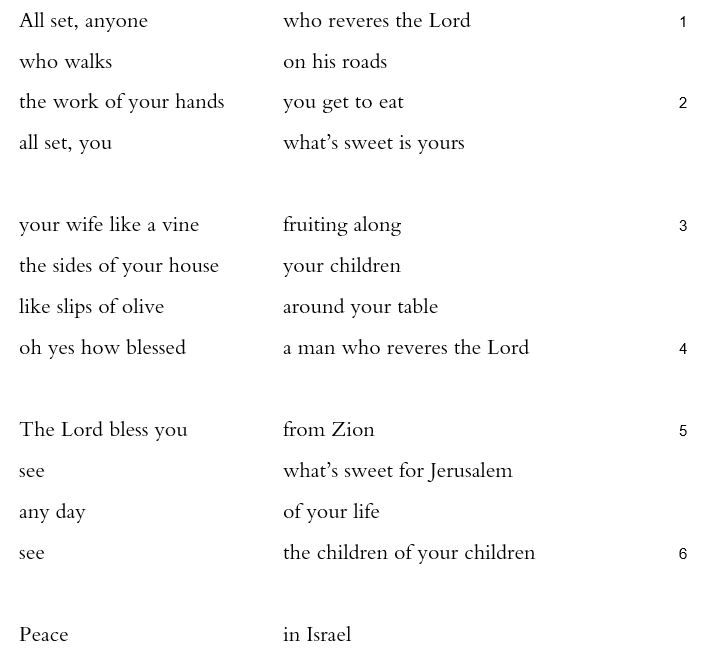
    In contrast with Psalm 127, to which it seems a linguistic and thematic retort, Psalm 128 does not imagine deploying children from private home to public gate, the domestic against the civic, as in combat. The prior psalm began by doubting divine support for communal projects before claiming, tautologically, that human fertility is God-sanctioned beyond dispute: the Lord may not want urban development, but each son is a sign that the Lord wants sons. This psalm, however, sees family and community, private and public, as aligned. In Psalm 128, the domestic happiness of “anyone | who reveres the Lord” (1) comes as a consequence of that reverence. Maternity is restored. Children here are olive trees (3), not arrows. And most importantly, reverence and fertility are followed by blessing and by a vision in which “what’s sweet is yours” (2) becomes “what’s sweet for Jerusalem” (5). The psalm ends not with conflict but with “Peace | in Israel” (6).

    The psalm is shaped first by two “all set” phrases—responding to “All set, the man | who has filled / his quiver | with them [sons]” from Psalm 127:5—in Psalm 128:1 and 128:2: “All set, anyone | who reveres the Lord” and its partner, “all set, you | what’s sweet is yours.” These two expressions of fulfillment give way to two expressions of blessing: “look oh how blessed | a man who reveres the Lord” (128:4, which doubles both “the man,” haggeber, from 127:5, and “who reveres the Lord” from 128:1) and “The Lord bless you | from Zion” (128:5). Both the “all set” phrases and the blessing phrases move from third person to second person, moves of immediacy. That same intensification occurs in the psalm’s last two repetitions. “Your children” in verse 3 become “the children of your children” in verse 6, while the two payoff imperatives, “see | what’s sweet for Jerusalem” (5b) and “see | the children of your children” (6a), repeat the shift of person and of scope.   

    That culmination in seeing is registered by a deft pun, Psalm 128’s response to the ben/banah and shav’/sheina’ puns of Psalm 127. The one “who reveres the Lord” (128:1, 4) is the yir’ei-adonai. The “see” imperatives of verses 5 and 6, introduced by a vav to register purposiveness, are ur’ei: “see | what’s sweet for Jerusalem,” “see | the children of your children.” Reverence yields vision, the yir’ei – ur’ei connection implies.

    If, as seems likely (see Psalm 15 introduction), the category of the yir’ei-YHWH indicated converts to worship of the Lord during the Second Temple Period, the contrast between Psalms 127 and 128 becomes even more pronounced. While Psalm 127 applauds patriarchs for siring soldiers, militarizing the family against “enemies | at the gate” (127:5), Psalm 128 invites outsiders in, where they participate not only in generativity, but in nourishment. “The work of your hands | you get to eat” (128:2a) is an easy line to overlook, but its promise must have felt very real for a whole underclass of citizens. As Karen Armstrong notes in The Lost Art of Scripture, the ancient Near East was not exactly known for laborers who ate the work of their own hands:

    “Sumerian aristocrats and their retainers—bureaucrats, soldiers, scribes, merchants and household servants—appropriated between half and two-thirds of the crop grown by peasants, who were reduced to serfdom. They left fragmentary records of their misery: ‘The poor man is better dead than alive’, one lamented. Sumer had devised the system of structural inequity that would prevail in every single state until the modern period.” (19-20)

    (“Until the modern period.” Hm.) “Within their walls | they squeeze the oil / tread the wine troughs | and thirst,” Job rages (Job 24:11). Against this injustice and in keeping with the prophetic claim that the Lord aligns with victims rather than oppressors, Psalm 128 offers its vision of “what’s sweet” to “anyone | who reveres the Lord.”

    It would be negligent not to add that to the writers of Psalm 128, this “anyone” was clearly male, a father whose worth was measurable by family size. My translation here opts for a strange compromise. Both 127 and 128 use the word for male offspring, literally “sons” rather than “children.” Erasing all gender from Psalm 127— a quiver full of children— would lose what that psalm clearly intends— a patriarchal family that only counts its fathers and sons. It would also leave out what Psalm 128 does to challenge and correct Psalm 127, adding back “your wife” to the depiction of fertility. Because Psalm 128 is more inclusive, “your children / like slips of olive | around your table” (3b-c) registers that inclusivity more than “your sons” would. Because the psalm is nevertheless a product of its time, “your spouse like a vine | fruiting along / the sides of your house” (3a-b) would mischaracterize its gender politics, which are fraught with, for example, the common biblical mirroring of woman and nature. What’s needed is to appreciate Psalm 128’s rejoinder to the prior psalm as close to precisely as we can, not assuming it will be equally appreciable or quotable by every one of its readers, whose experiences in the world differ.

    Share:

    • Share on X (Opens in new window) X
    • Share on Facebook (Opens in new window) Facebook
    Like Loading…

    About Me

    My name is Mark Minster. I’m an English and Comparative Literature professor with a background in ministry and in poetry. I teach courses on writing, reading, religion, and nature.

    Recent Posts

    • Psalm 150
    • Psalm 149
    • Psalm 148
    • Psalm 147
    • Psalm 146

    Newsletter

  • July 17th, 2023

    Psalm 127

    (a song of steps, of Solomon)

    * * *

    Psalm 127 is known more as parts than as a whole. Some know the foundational counterfactuals of its long first verse; some love the little lullaby at the end of verse 2, “thus he gives his dearest | sleep”; and others cite those final three verses, whose memorable natalism monetizes and weaponizes male youth. The psalm’s quotability and art of collage has led some scholars to the faulty conclusion that it is not one psalm but two (verses 1-2 and 3-5) or three (verse 1, verse 2, verses 3-5) or even four—two proverbs (1 and 3) plus commentary (2 and 4-5). Yet even if the leaps between and within the psalm’s halves are striking, and even if verse 2 clearly does comment on verse 1, the psalm as a whole coheres linguistically, narratively, and ideologically.

    The whole psalm gathers around a significant pun, the words ben, “son,” and banah, “to build.” Together with the naming of Solomon in the superscription (absent from the Septuagint), the relationship between the two words calls to mind the Dynastic Oracle of 2 Samuel 7, in which David offers to build the Lord a house, but instead, through Nathan, is promised a lineage: “I will lift your seed after you who will come from your belly, and I will found his kingdom; he will build a house for my name… and your house and your kingdom will be stood up ever and on before you” (2 Sam 7: 12-13, 16). David’s house is his son Solomon, and by extension, his enduring male line. This link explains why some readers see Psalm 127 as pre-exilic psalm for a king, others as a Second Temple psalm, and still others as a timeless psalm for the birth of anyone’s son. Two pair of house-building words in verse 1 are linked by consonance—lo’ yibneh bayit…bonaiv bo’ (“doesn’t build the house… who build it”)—to a pair of words in verse 3—banim…habeten (“sons… the womb,” rendered here as “pelvis” to note the psalm’s elision of the mother).

    The bet-words are followed in both halves of the psalm by a cluster of shin-words. In verse 1, this is lo’ yishmar `ir shav’ shaqad shomer, “doesn’t guard the city / who guards is awake | for what.” In verse 5, the shin-cluster includes ’ashrei… ’asher… ’ashpato… lo’ yeiboshu…basha`ar, “all set… who… his quiver… they do not blanch… in the gate.” If the ben-banah-bayit connection combines male offspring with building blocks, the shomer-basha’ar connection with shav’, “pointlessness” (1 x2, 2) and “they do not blanch” (lo’ yeiboshu) replaces the city’s guards with the sons at the gate. The worthlessness of guards who stay awake without divine protection is replaced by the sons who speak down enemies at the gate, the sounds of shav’ being undone by those sounds reversed in lo’ yeiboshu.

    That word shav’ for pointlessness, rendered here by the rhetorical question, “for what,” is also undone at the end of verse 2 by the troublesome word sheina’, “sleep.” The two words are consonantally barely half a stroke away, shin-vav-aleph and shin-nun-aleph looking almost the same. There is thus an interesting slide from the fruitlessness of work done without divine support to the seeming fruitlessness of sleep. Is effort worthless, according to verse 2? Apparently not. Waking early, retiring late, working hard: “thus he gives his dearest | sleep.” The Lord’s cure for insomnia seems to be a long day of labor. In context, however, verse 2 becomes more than a factory poster touting industry over indolence: the Lord may be needed for construction and maintenance and everything urban in between, but work still makes the day and night go round.

    Narratively, the central line of the psalm—“Look, a gift of the Lord | sons”—shows the second unseeable benefit of the seeming fruitlessness of work and sleep: a specific kind of fertility. Obviously procreation is sleep-adjacent rather than a product of sleep itself, but the poem still jump-cuts (“his dearest | sleep / Look, a gift”) from loving sleep to children, presented in a thoroughly masculine way as the fruit of the procreative torso, the belly. Mothers are elided here in the juxtaposition of affectionate sleep and sons. Verses 3 and 4 both sound aphoristic, one stressing male children’s economic value—“a gift” (literally, “inheritance”) and  “income” (3)— the other the aggressive virility of both fathers and sons as “arrows | in a champion’s hand” (4).

    Monica Duffy Tuft uses the term “wombfare” to describe “the weaponization of fertility” in religious and ethnic conflict. Certainly the image of the filled quiver has had an afterlife, the second half of Psalm 127 providing rhetorical cover for natalist politics and their close allies: xenophobia and the oppression of women. Usually “we” are encouraged to have more sons because “they,” the others, have too many young males, a set of assumptions that has led to hawkish claims which Goran Therborn has characterized, in one context, as “neo-social-darwinist discourse, a demonization of extra-European youth.” If sons are wealth and weapons, consider what happens to mothers, who become banks and factories. Consider too what happens to the public sphere, which is done away with in this psalm by the paterfamilias. Instead of turning to a prayer—“build and guard this place”—the psalm that begins by imagining the futility of godless builders and guards, turns instead to missiles of masculinity, sons divinely sanctioned just by being born, who march upon the city gate armed to the teeth.

    Share:

    • Share on X (Opens in new window) X
    • Share on Facebook (Opens in new window) Facebook
    Like Loading…

    About Me

    My name is Mark Minster. I’m an English and Comparative Literature professor with a background in ministry and in poetry. I teach courses on writing, reading, religion, and nature.

    Recent Posts

    • Psalm 150
    • Psalm 149
    • Psalm 148
    • Psalm 147
    • Psalm 146

    Newsletter

←Previous Page
1 … 4 5 6 7 8 … 37
Next Page→

Blog at WordPress.com.


Loading Comments...
 

    • Subscribe Subscribed
      • The Book of Psalms
      • Already have a WordPress.com account? Log in now.
      • The Book of Psalms
      • Subscribe Subscribed
      • Sign up
      • Log in
      • Report this content
      • View site in Reader
      • Manage subscriptions
      • Collapse this bar
    %d