(a song of steps)
* * *
A marvelous interweaving of lines, Psalm 126 shows in its few verses that biblical poetics needs for an operating principle, its ars poetica, only the two-step of parallelism. If we feel like it, we readers can measure syllables and mark rhymes. But pairs and binaries are as simple and varied as tides: between the lows and highs so much is alive.
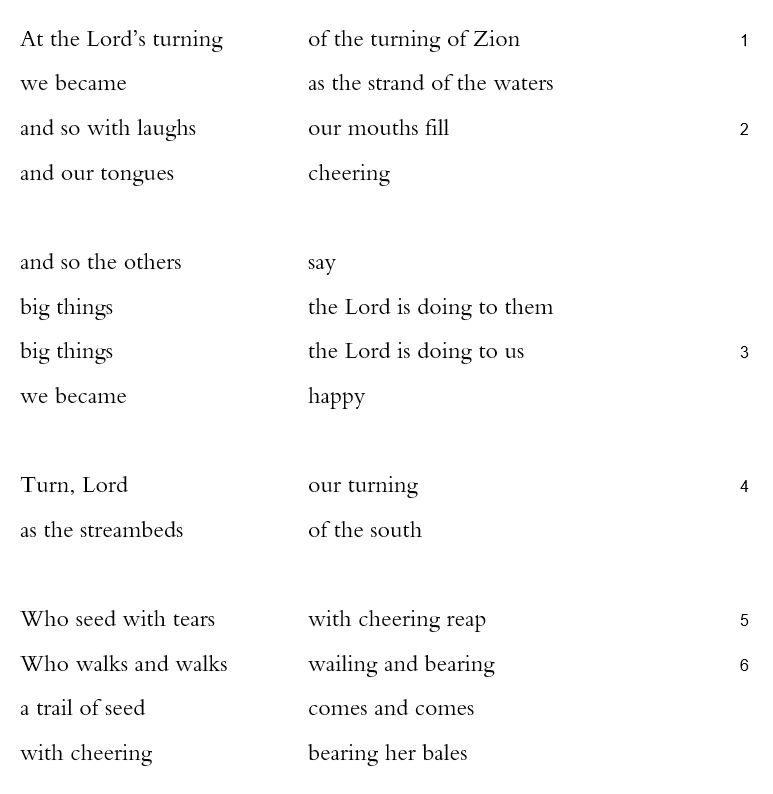
The psalm turns— both “verse” and “trope” literally mean “turn”— on two pair of turns: “At the Lord’s turning | of the turning of Zion” in verse 1a, and “Turn, Lord | our turning” in verse 4a. In Hebrew, these four turns share the biliteral root shuv or the triliteral root shabah, but each takes a slightly different form: beshuv… et-shivat Tsiyyon; shuvah… et-sheviteinu. Infinitive + object phrase, imperative + object phrase. Choreographically, “turning” comes to mean “captivity” or “restoration” because it depicts a reversal of course: this way becomes that way becomes this way again. (Still, it’s not a “restoration of fortunes,” as Dahood says, since the concept of “fortune” is so alien to the Bible.) Innocents turned captives turn free—once in memory, once in wish. This tight plot frames the psalm, with transformations in verses 1 and 4 beginning the psalm’s two halves.
Its two near-halves, that is. Like a sonnet, the psalm benefits from uneven halves of eight lines plus six (the sonnet, for what it’s worth, features another poetic turn, the volta, between octave and sestet). Like the word “turning,” the name of the Lord appears four times in the psalm, first and last at the paired verses 1 and 4. In between, in the slightly longer first half, the Lord’s name shows up in another pair: “big things | the Lord is doing to them / big things | the Lord is doing to us” (2d-3a). While the first of these affirmations is in the voice of “the others,” the second affirmation shifts from the Israelites/Judeans, as “them,” back to the “we” with which the psalm began: “we became | as the strand of the waters” (1b). This becoming, yet another transformation, hayinu, is mirrored at the end of verse three by a second hayinu: “we became | happy” (3b). (Note, too, the pair of “and so” constructions, which catalyze a logical chain reaction: the turning turned, we became like the sand of the waters, and so our mouths and tongues were full of laughter and cheers, and so others spoke of God’s intervention, which sparks our speaking of God’s intervention, that we have become happy.)
The usual translation of kecholemim at the end of verse 1, “we became as dreamers,” is enchantingly lyrical: “it was like | we were dreaming,” an early draft of this translation read. But Dahood’s suggested repointing of kechul yamim, “like the sands of the sea,” is compelling, if reliant on an abbreviated spelling of chul, sand, and a transposition of a yod and a mem. In passing, Dahood mentions as a possibility “like the sands of the waters,” kechul mayim, which keeps the consonantal text intact. More importantly, while dreamers can doubtless be happy, those who swim ashore, their mouths full of laughter rather than seawater, are more singularly and vividly relieved, even ecstatic. This possibility does a better job than the conventional translation does of pairing the psalm’s two explicit similes, “as the strand of the waters” (1b) and “as the streambeds | of the south” (4b), both of which occur immediately after the two pair of turnings. The pairing of beach and creekbank aptly tropes rescue first as the movement from saltwater to land, then as the conversion of a desert channel to a stream.
Moreover, that unwatering-rewatering movement sets up the fertility imagery of the psalm’s ending, itself a pair of pairs, plural followed by singular, sowing followed by reaping:
Who seed with tears | with cheering reap
Who walks and walks | wailing and bearing
a trail of seed | comes and comes
with cheering | bearing her bales (5-6)
Just as the psalm’s first four verses move from what is known to what’s new— as we were happy, make us happy again— the psalm’s last two verses move from what sounds like a maxim (“Who seed with tears | with cheering reap”) to its elaboration (“Who walks and walks | wailing… comes and comes | with cheering”). The doubled “cheering” (lit. “shout”) of verses 5 and 6 recalls the pairing of “laughs” and “cheering” of verse 2. The proximate repetition of “seed” and “cheering” and “bearing” calls to mind not just the turnings, but also the doubled “big things | the Lord is doing.” As at a satisfying dance, everyone has a partner for turning.
Taut, the entire psalm works as a figure of hope, the call for another reversal like the one in verse 1. A reversal from what, to what? The vehicle of the psalm’s tropes is clear—we who’ve sown grief would like to reap joy. It’s the tenor that is left wide open, undecidable. Does Psalm 126 crave intervention from a kind of captivity, from some “scepter | of wrong” like the one veiled in the previous psalm (125:3)? Is it a wish for fertility, as its proximity to Psalm 127 might suggest? Nothing nails down such potent hopefulness, “energies beyond intent or control,” as the introduction to Psalm 125 says as well.


 The Book of Psalms