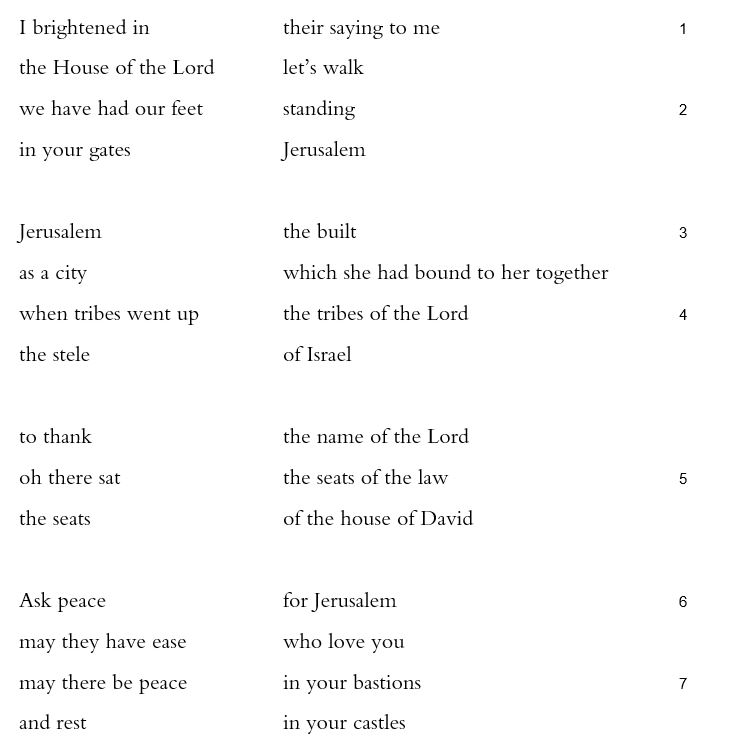
In Psalm 122, a shared walk to the temple in Jerusalem, in the present tense, calls to mind past-tense unity, leading to an impassioned plea for present and future peace. In addition to this narrative movement from present experience (1) to cultural memory (2-5) and back to the urgent now (6-9), the psalm is tightly knit by a host of subtle techniques. Tight knitting itself may be the psalm’s most important theme, shown first in that strange and lovely formulation of verse 3b, “as a city | which she had bound to her together” (ke`ir shechubberah lah yachdav). Once, the line implies, Jerusalem bound her tribes to her, and Jerusalem was their binding.
Invisible in English are the many verbal repetitions that knit the name Jerusalem (yerushalayim) to the word “peace” (shalom). These puns emphasize the shin and the mem, or shin and lamed, or all three letters at once. Verse 4, for instance, begins with shessham shebatim, “when [or where] tribes,” and ends with l’sheim YHWH, “to the name of the Lord.” Verse 5 starts, “oh there sat | the seats of the law,” ki shammah yashbu kis’ot lemishpat. Verse 6 is most explicit and most concentrated: sha’alu shalom yerushalayim; yishlayu ohavayikh, “Ask peace | for Jerusalem / may they have ease | who love you.” Verses 7 and 8 both name “peace”; verse 7 adds the word shalvah, or “rest.” Collectively, then, both when and where, the word “name” and the the law, and ease, rest, and asking, all are bound verbally together with both Jerusalem and peace.
A number of these repetitions are patterned. Psalm 121 had six uses of the word shomer, “to guard,” arranged in two groups of three, plus four instances of the Lord’s name. Psalm 122 also names the Lord four times (1, 4a, 4c, 9), adding Jerusalem three times (2, 3, 6), “peace” three times, and “house” three times (1, 5, 9). The three mentions of the house set the temple at the psalm’s beginning, middle, and end, with its historical identity as “house of David” centered in verse 5. There in the psalm’s center, another pattern culminates: the echo of Psalm 1:1’s movement from walking (121:1) to standing (121:2) to sitting (121:5), marking the remembering, the reimagining, of the first temple as an act of wisdom and morality.
A whole theology or politics might be built on the final two verses, verses 8 and 9, the twinned purposes of the speaker’s walk through the city to the temple. If it is easy to play on words, it is much harder to really wish for peace. And it’s downright dangerous to equate Jerusalem with peace or to view the binding together in verse 3 as anything but ideology dressed up as memory. In Jerusalem, so much blood has risen, so very much has fallen.
As Philip Larkin suggests in “Church Going,” a temple may be destined, once “disbelief has gone,” to become “A shape less recognizable each week,/ A purpose more obscure.” And yet Psalm 122’s final pairing of two cohortative verbs, “I want to say” and “I want to seek,” with their contents, “please, peace be with you” and “what’s good to you,” show that this destination can indeed be “A serious house on serious earth.” Seeking what’s good for one’s neighbor takes poem and psalm beyond words.
My name is Mark Minster. I’m an English and Comparative Literature professor with a background in ministry and in poetry. I teach courses on writing, reading, religion, and nature.
One can live with words a long time and not see them for all they are. Psalm 121 is sung and said so often and its care runs so deep and clear it is easy to miss its more-than.
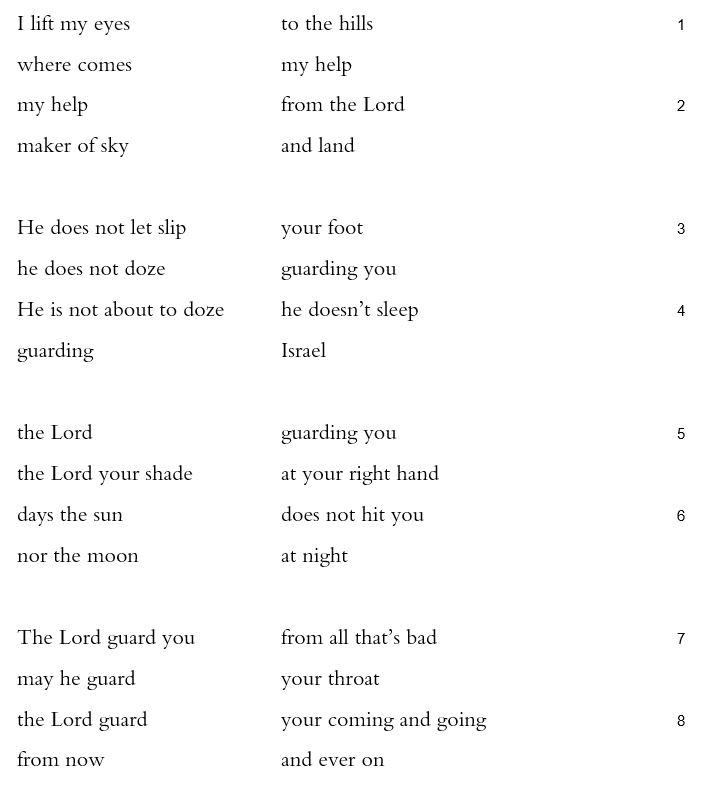
At first glance or at five hundredth, the psalm’s gestures of comfort are plain. A person needs. She yearns. She lifts her eyes up the ridgetops to the ranges where earth and air meet, “to the hills” (1) at the edge of “sky | and land” (2). In most English translations, she asks where her help comes from. In the King James Version, she assures herself that her help does come from the hills. The Hebrew is ambiguous. A good director might suggest the actor deliver the psalm’s first verse equal measures worry and pep talk: “where comes | my help.” Verse 2, likewise, could be delivered by a skilled actor as half an assertion— “my help [is] | from the Lord” (2a)— and half a continued question: “where comes | my help / my help | from the Lord” (1b-2a). In measures, the psalm registers both confidence and anxiety, in its gesture of lifting eyes.
Verses 3-8, the rest of the lyric, rely on the comforting gesture of benediction pronounced by a second person, who identifies the Lord as a watchkeeper, a guard. Three times this second speaker, a priest or parent or other voice, uses the participial form of the verb shamar: “guarding Israel” (4b), “guarding you” (3b, 5a). Three more times, this second speaker puts the same verb into the prefixed form, somewhere between present and future declaration or jussive modality: “The Lord guard you” (7a), “may he guard” (7b), “the Lord guard | your coming and going” (8a). These six guardings accompany four uses of the name “Lord” in the psalm’s last five verses.
Between the two guarding triplets is a figure for God that haunts as much as it comforts, the tsel of verse 5, a shadow or shade, a covering darkness: “the Lord your shade | at your right hand.” Such companionship consoles as it protects, shielding from burning sun as well as from the baleful influences of the moon. But it lurks as well, a constant fellow traveler of the dusk. In his essay “Ascent to Darker Hills,” biblical scholar and poet Karl Plank has written insightfully of the ambiguity of verse 1’s hills as danger and shelter both and of how the Lord’s dark shade in verse 5 conceals more than it reveals, half-answering the first speaker’s early half-question with simultaneous presence and absence. The image, Plank writes, “returns one to the threat of constriction, of being trapped within the very bounds that have given refuge” (163). This is not at all to deny the psalm’s comfort. Instead, it is to celebrate both of the psalm’s humane gestures: the first speaker’s attempt to assuage her own fear, and more, the second speaker’s efforts not just to reassure, but to acknowledge the dark.
My name is Mark Minster. I’m an English and Comparative Literature professor with a background in ministry and in poetry. I teach courses on writing, reading, religion, and nature.
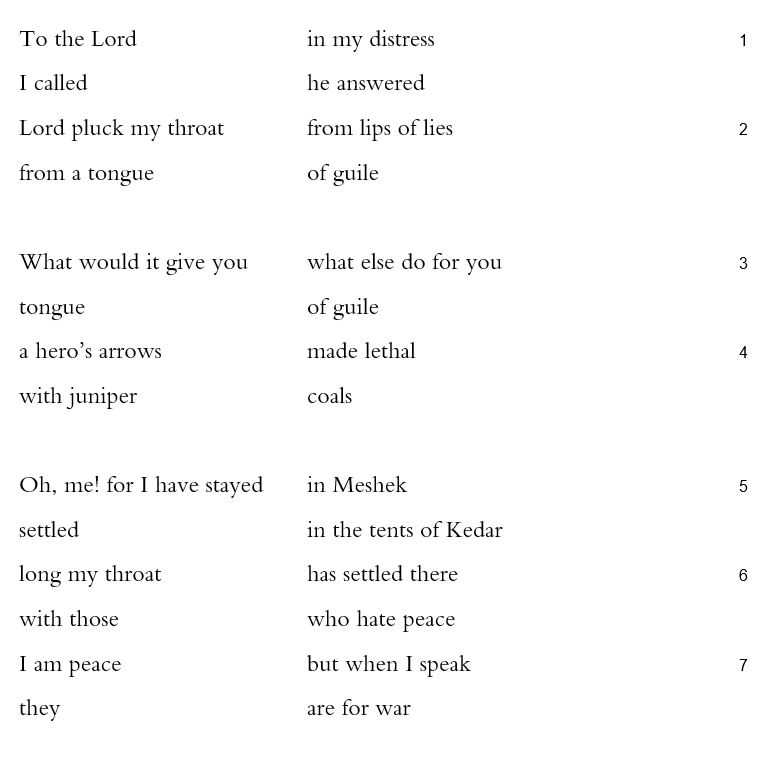
Lyrics pulse between the exacting specificity of a poem’s occasions and the possibilities that open it as an experience for others. Juniper coals and tents of Kedar are almost certainly not your lived experience nor mine, but they are a valuable, even necessary part of Psalm 120. They lock it in place. A “tongue of guile,” by contrast, and fellow citizens who hate peace are very much part of twenty-first-century life and death. They are the psalm’s unlocked wide open.
Any attentive reader will see how carefully Psalm 120 frames deceptive speech. Two “lips of lies” (2) and the doubled “tongue | of guile” (2, 3) are lodged between the paired life-breath “throat” of verse 2 and verse 6. Together, these the body’s means of speech are embedded between the call and response of verse 1— “I called | he answered”— and the contrastive failure to communicate of verse 7— “but when I speak / they | are for war.” That the phrase “he answered” appears so early in the psalm, already in verse 1, has confused readers who expect all laments to be completed by consolation. Instead of celebrating the personal liberation that results from divine response, however, the speaker presents a pair of questions (3) and a puzzling composite metaphor (4) followed by actual words of lament, “Oh, me!” (5).
The speaker’s call for help seems clear, at least on a literal level. Being engulfed as a migrant or sojourner among neighbors to the north (Meshek) and south (Kedar), the speaker feels unable to trust the dominant cultures, whose speech is unlikely to be in a native tongue. The speaker asks to be freed, “Lord pluck my throat | from lips of lies” (2). This much any reader can see as well.
What no reader can determine or lock in place is the psalm’s middle stanza, the questions and metaphor of verse 3 and 4, which widen with options not least because they leave unclear who speaks to whom. Free discourse like this, speech unattributed to a speaker, constitutes one of lyric poetry’s greatest tricks of unlocking. In verse 2, the speaker asks the Lord for rescue. But in verse 3, does the speaker continue: “What would it give you | what else do for you / tongue | of guile”? Even if we parse mah-yitten differently, as “How does he give to you” or “Would that he gives you” or “what will he give you?” we still cannot tell if the questions of verse 3 are asked of someone (or something) else by the speaker, or of God, or by God to the speaker, or by God to the liars who surround the speaker. The question might wonder how deceptive speech works, or marvel that it does, or it might threaten to punish such speech. The arrows and implied fire of verse 4 are similarly layered in meaning. Are they figures for speech—tongues are whetted or made murderous by deceit the ways arrows are made red-hot by coals? Or are they the Lord’s threats? Or, in yet another possibility, are the questions and metaphors themselves the Lord’s answer to the speaker’s call? That is, to the speaker’s cry for liberation from deceptive speech, does the questioning, riddling response at the center of this psalm function as the divine equivalent of asking, “what would you have me do?”
No matter who speaks in verses 3 and 4, in the psalm’s final verses we return to the “distress,” the conundrum that no speech, not the speaker’s, not the Lord’s, can solve: hemmah lammilchamah, “they | are for war” (7b). Speech is easily corruptible, Orwell famously argues in “Politics and the English Language.” He even claims that this process is reversible, that purifying the language of the tribe can revise awful politics out of existence. Psalm 120 and some years among the tents of Meshek suggest otherwise.
***
120:1 song of steps There are three common explanations for the superscription of Psalms 120-134. The steps or “stairs” or “ascents” might be literal, which could mean that these are pilgrim songs, collected by or for or about devotees climbing to the temple in Zion (see especially 122). Alternatively, the “ascents” might be musical, fingers moving up strings or voices modulating pitch or singers increasing volume. Finally, the lyrics, which do show some repetition and anaphora, might, according to some readers, rely on a kind “staircase” patterning. Together, Psalms 120-136 do permit a liturgical reading, so even worshippers and officiants besides pilgrims could be indicated by the term “steps.”
My name is Mark Minster. I’m an English and Comparative Literature professor with a background in ministry and in poetry. I teach courses on writing, reading, religion, and nature.
Psalm 119 turns and turns in a kind of rondelet. The longest of psalms, it clicks around and around through images and keywords like an old slide projector carousel. To some it’s a slog. To others, in keeping with its themes, an obsessive’s delight.
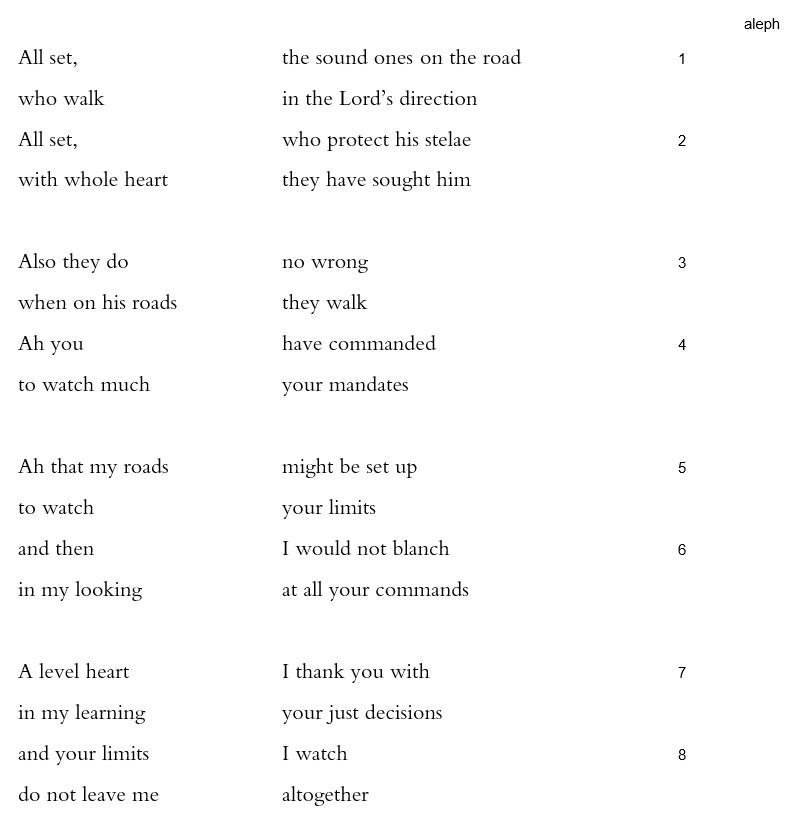
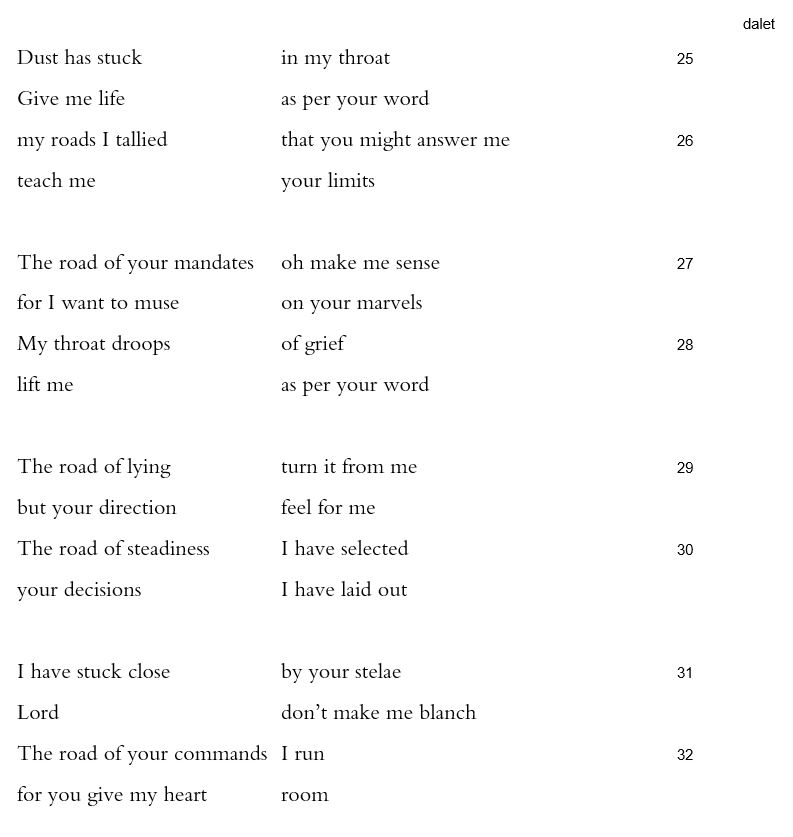
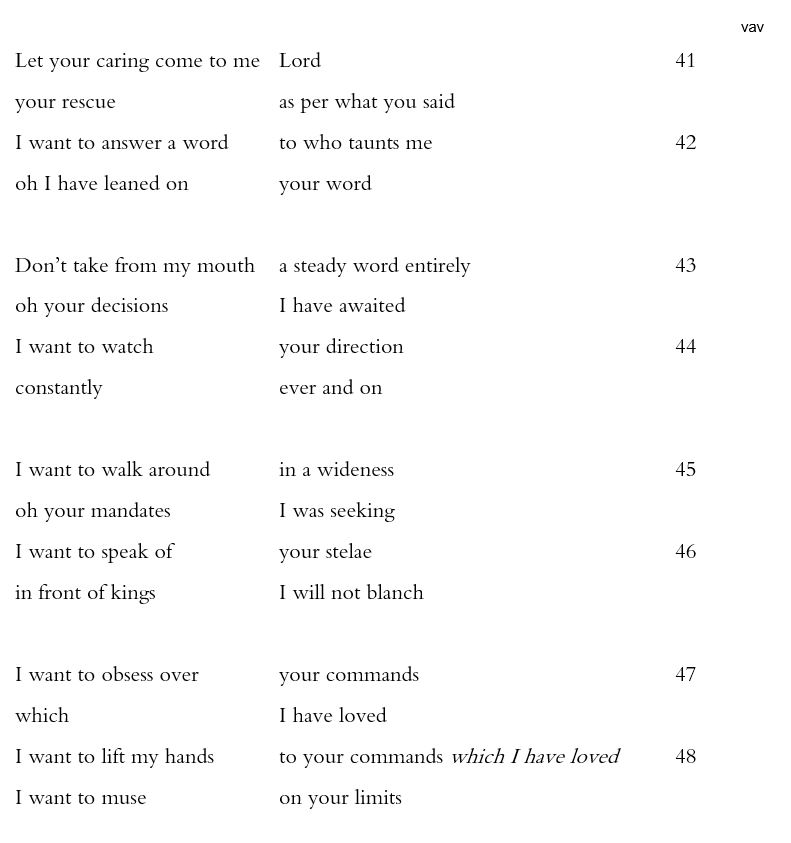
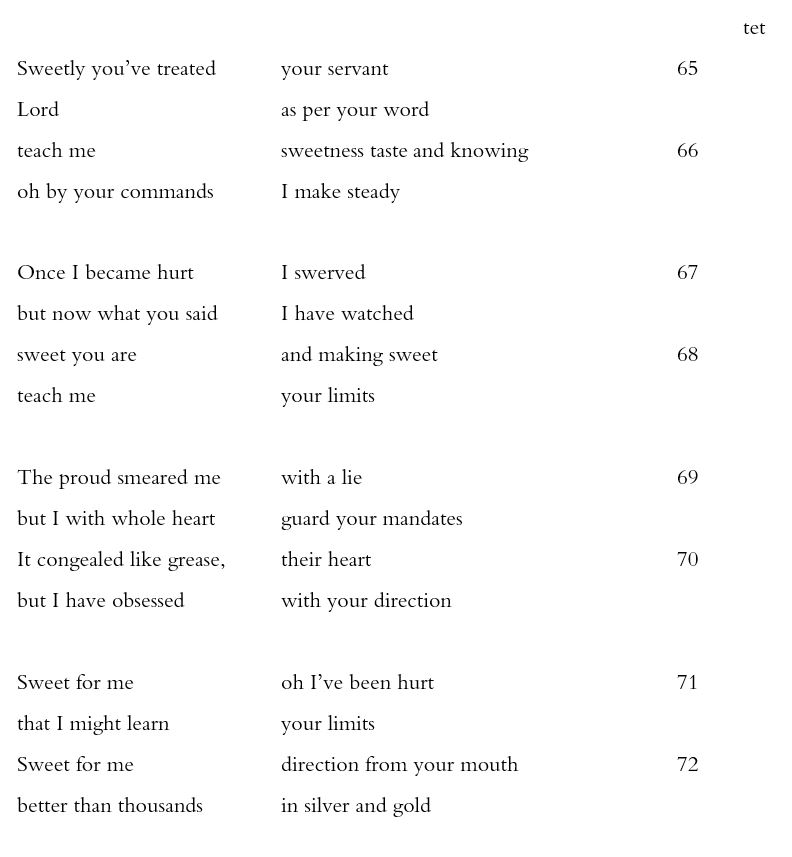
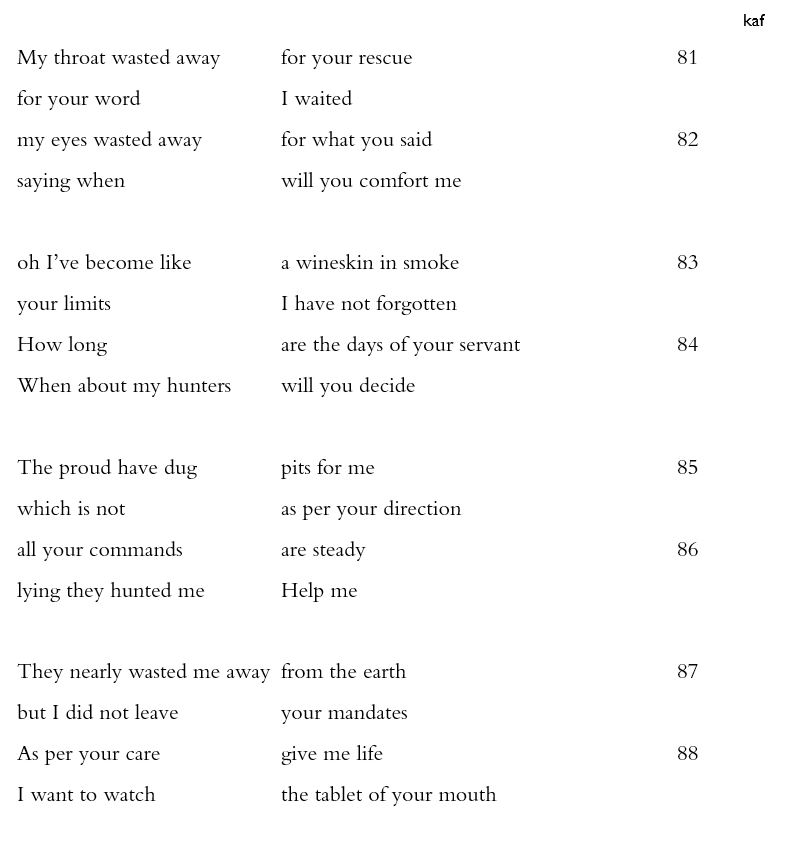
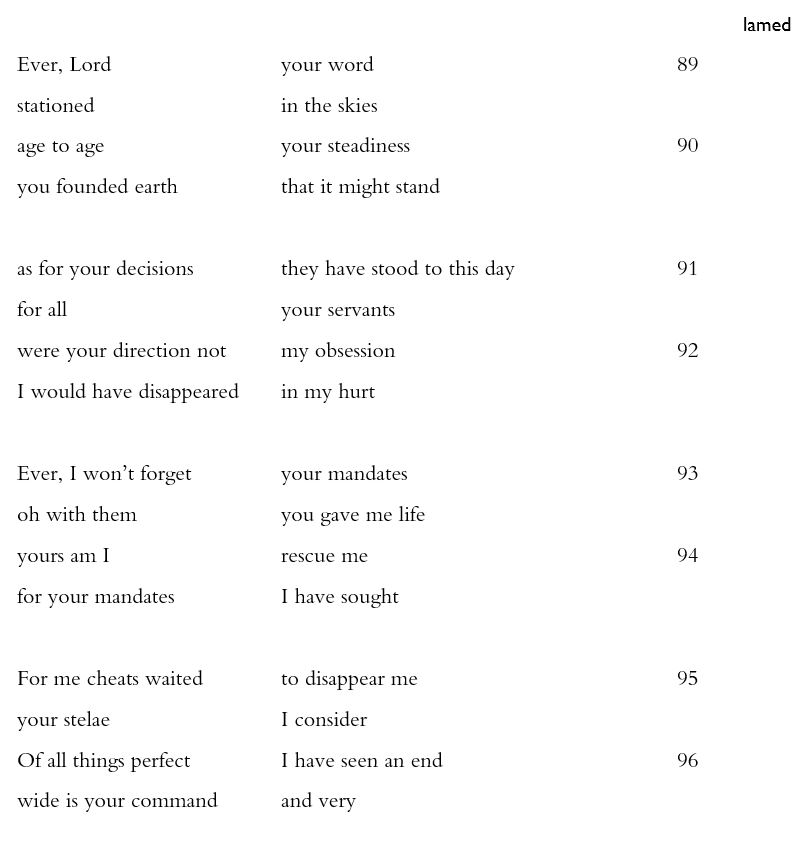
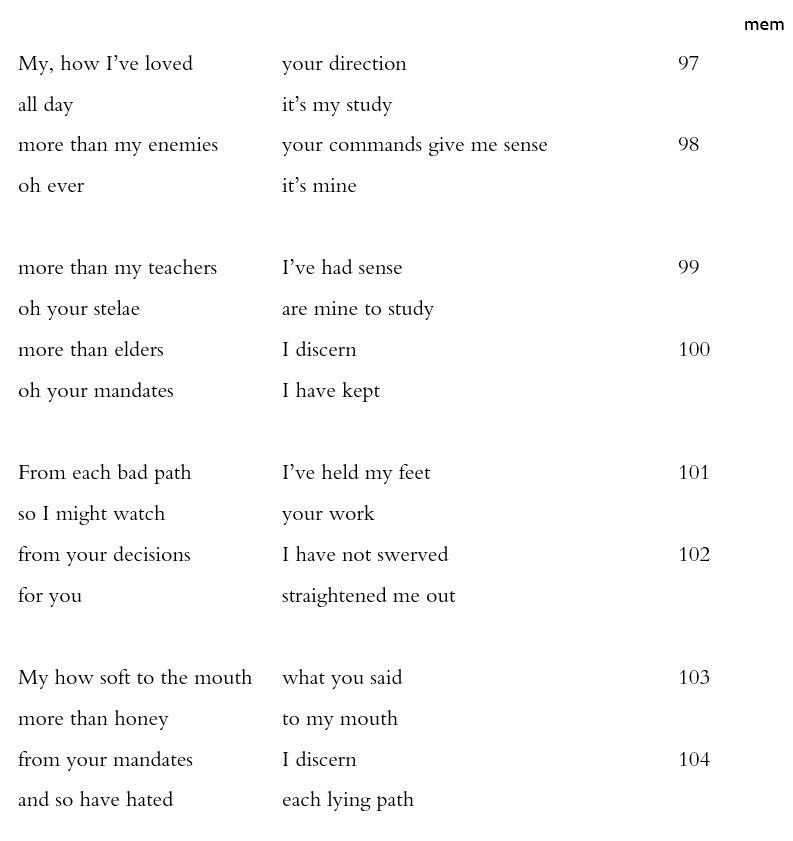
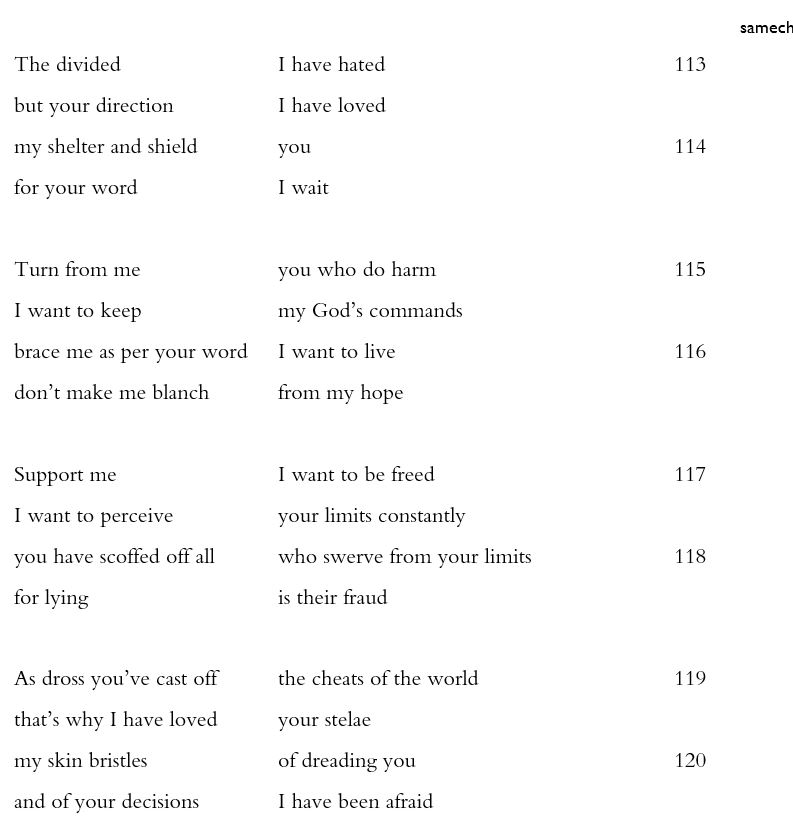
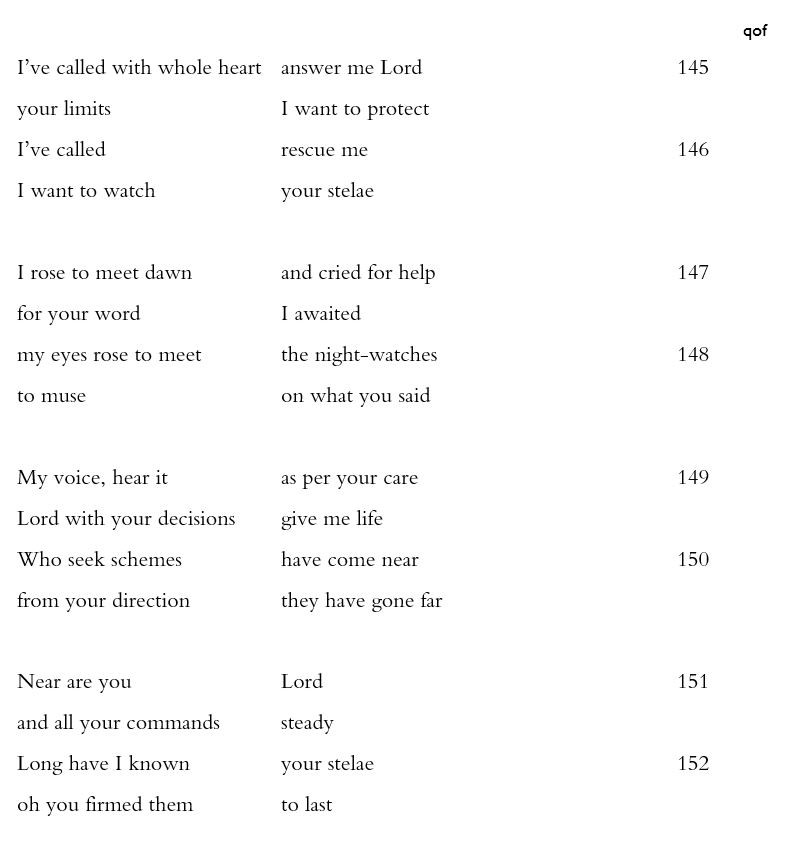
To read a psalm like this, stamina, patience, and particular kinds of attention are needed. It’s a discipline, really, this octupled acrostic, a poetic form whose compulsive control mirrors both the control described by its contents and the control required by the process of reading. (Only aleph and bet are preserved in this English translation, the a-led and b-led lines of verses 1-16.) The most sweeping implication to be unfolded from attending to Psalm 119 is that whatever else we mean when we talk about religion, aesthetics and epistemology must take pride of place over metaphysical or even ethical claims. “Teach me | sweetness taste and knowing,” the psalmist insists, centering the good and beautiful between the cultural and biological experiences of education and sensory perception (66).
At the psalm’s core is instruction, torah or Torah, “direction” (sometimes the plural “directions”), which appears twenty-five times across the psalm’s twenty-two sections (1, 18, 29, 34, 44, 51, 53, 55, 61, 70, 72, 77, 85, 92, 97, 109, 113, 126, 136, 142, 150, 153, 163, 165, 174). Around this core whirl in orbit seven metonyms. Two of these orbiting terms accentuate the verbal scene of instruction: “word” or “words” (16, 17, 25, 28, 42 x2, 43, 49, 57, 65, 74, 81, 89, 105, 107, 114, 116, 130, 139, 147, 160, 161, 169) and “what you said” (11, 38, 41, 50, 58, 67, 76, 82, 103, 133, 140, 148, 154, 158, 162, 170, 172). The other five are legal words, legislative and judicial synonyms that emphasize the authority of the tradition. “Command” (6, 10, 19, 21, 32, 35, 47 48, 60, 66, 73, 86, 96, 98, 115, 127, 131, 143, 151, 166, 172, 176) and “mandate” (4, 15, 27, 40, 45, 56, 63, 69, 78, 87, 93, 94, 100, 104, 110, 128, 134, 141, 159, 168, 173) stress codification. “Decision”/”decisions” (7, 13 20, 30, 39, 43 52, 62, 75, 91, 102, 106, 108, 120, 132, 137, 149, 156, 160, 164, 175) and “limit”/“limits” (5, 8, 12, 16, 23, 26, 33, 48, 54, 64, 68, 71, 80, 83, 112, 117, 118, 124, 135, 145, 155, 171) stress enforcement. The seventh metonym in the cluster of eight terms is the noun usually translated as “witnesses,” which looks related to the root word for standing. While a person testifying might stand, the term makes sense (to me, I should say) most concretely as “stelae,” those standing stones of the ancient world that marked boundaries and distances, as well as enacted the solidity and permanence of the law (2, 14, 22, 24, 31, 36, 46, 59, 79, 95, 99, 111, 119, 125, 129, 138, 144, 146, 152, 157, 167, 168). Together, these eight ways of naming direction occupy all but ten of the psalm’s one hundred seventy-six verses. One of these exceptions is the psalm’s central line, which powerfully figures instruction as both speech and writing: “the tablet of your mouth” (88).
In tension with the metonymic motion-in-place of the psalm’s abundant keywords, which name and rename and enact and re-enact order, there is the recurrent metaphor of the road, or roads, which constitute place-in-motion. If torah is direction, then derek, a road, a way, is direction in action, order mapped horizontally. The word derek in the singular or plural appears thirteen times (1, 3, 5, 9, 14, 27, 29, 30, 32, 33, 37, 59, 168) accompanied by its own cluster of synonyms: trails (15), footpath (35), footfalls (133), and path (101, 104, 105, 128). Four of those ten verses that lack a synonym for torah include either road or roads (3, 9, 37) or path (101). Though walking (1, 3, 35, 45) and running (32) do not show up often, an array of verbs appear for orienting oneself to the direction of the road: to turn or not (29, 51, 115), to stray or not (11, 21, 176), to swerve or veer or not (10, 67, 102, 110, 118, 157), to leave or not (53, 87, 121), to stay near (31, 150, 169) or go far (150). Sticking to the path, keeping the way clear for others, going somewhere: walking a road is a set of controls both solitary and social. The road itself is marked by instruction, with “commands” and “mandates” providing impetus, “limits” and “stelae” establishing alignment. Walking a road is a discipline of posture and movement, patience and stamina and attention. Off the road, you wonder where you’re going. On the road, you wonder right where you are. It is tempting to cite the Daodejing about the discipline of the way.
Speech (“mouth” 13, 43, 72, 88, 103 (x2), 108, 131; “lips” 13, 171; “tongue” 172; “voice” 149; “throat” 20, 25 28, 81, 109, 129, 175) and movement (“feet” 101, 105) are just two of the ways instruction is a bodily experience of discipline in Psalm 119. “Hands” (48, 59, 73) and “palm” (109) are involved, and especially vision—“eyes” (18, 123, 136, 148) that “look” (6) and “see” (96, 153) and “seek” (2, 10, 45, 94, 155, 157). The way that seeing becomes seeking implies an entire epistemology in which sensory perception, when practiced and attuned to and regulated by instruction, order, and commemoration, becomes the kind of heightened attention that devotion requires. This kind of knowing is a world away from what Emerson describes in “Nature” when he claims that the axis of vision is not coincident with the axis of things, requiring an “eye of Reason” to replace the animal eye. Emersonian transcendence, like its Kantian and Platonic forebears, arrives by angling vision away from things. In Psalm 119, by contrast, to walk and to see become “observe” (112), “perceive” (117), “attend” (15, 18), “sense” (27, 34, 98, 99), and “know” (66, 75, 79, 125, 152). Not by some metaphysical difference, but by recursion and alignment and by intensification— attention, but more of it— these forms of awareness beget culture, a process figured overwhelmingly in the psalm as study and as watchfulness. There is teaching (12, 26, 64, 66, 68, 108, 124, 135, 171) and learning (7, 71, 73) and study (97, 99). The speaker tallies (13), discerns (100, 105) and reckons (59), muses (15, 23, 27, 48, 78, 148), recalls (49, 52, 55) and works not to forget (16, 61, 83, 93, 109, 141, 153, 176). Most significantly, the speaker watches (4, 5, 8, 9, 17, 34, 44, 57, 60, 67, 88, 101, 106, 134, 146, 158, 167, 168), keeps (34, 100, 115), and guards (22, 56, 69, 129). To use my teacher Michael Fishbane’s term, what happens in this kind of religious experience is “sacred attunement.” Bodies attend.
Nevertheless, we aestheticize (and ironically anaesthetize) this psalm if we assume that attentiveness is its own reward. It is important to acknowledge both how purposive the aims of instruction are and how the speaker seems to obsess over harm. The psalm is stuffed full of cohortative verses that express wishes and purpose, often rendered in this translation by “so that” or “I want”:
By your mandates | I want to muse
I want to attend to | your trails
By your limits | I want to obsess
I want not to forget | your word (15-16).
While the “heart” in the Bible has as much to do with thought as with feeling (2, 7, 10, 11 34, 36, 58, 69, 70, 80, 111, 112, 161), the psalm bursts with feeling. There is love (47, 48, 97, 113, 119, 127, 132, 140, 163, 165, 167) and hate (104, 113, 128, 163), but also pining (131) and craving (20, 40, 174) and passion (139) and obsession (24, 47, 70, 77, 92, 143, 174). Reading the entire psalm straight through, however, leaves one with the impression that the speaker’s obsessiveness has done little to alleviate pain.
Straits and stress | converged on me
your commands are | my obsession
the justice of your stelae | is lasting
give me sense | I want to live (143-44).
Even after a dozen dozen verses, the speaker still suffers. Why? Because the psalm’s form is not narrative but recursive. What can be seen as the disciplining of attention and celebration of the law can thus also be seen as exactly what Freud said religion was, an obsessional neurosis. Fittingly, just as four of the psalm’s ten verses that do not name a synonym for teaching use the metaphor of the road, another four of those ten allude to the speaker’s suffering: “How long | are the days of your servant / When about my hunters | will you decide” (84) and
I have done | what’s right and just
don’t leave me | to those who oppress me
Assume your servant’s debts | for good
don’t let the proud | oppress me
My eyes have wasted away | for your rescue
and for what you said | of your justice (121-23).
And yet, because in the psalm the axis of vision is coincident with the axis of things, what the psalmist yearns for is not anything that Freud could dismiss as illusion. The speaker craves consolation (52, 82) and rescue (41, 94, 123, 146, 155, 166, 170, 174), yes, but also justice (40, 123, 142), care (41, 64, 76, 88, 124, 149), and steadiness (30, 75, 86, 90, 138, 142, 151, 160).
Most importantly, who wouldn’t want what the speaker of Psalm 119 wants? “Give sense,” she repeats (73, 98, 125, 130, 144, 169). And “give me life” (25, 37, 40, 50, 88, 93, 107, 149, 154, 156) “that I might live” (77, 116, 145).
My name is Mark Minster. I’m an English and Comparative Literature professor with a background in ministry and in poetry. I teach courses on writing, reading, religion, and nature.











 The Book of Psalms