• Page list
    • Posts
    • The Book of Psalms

The Book of Psalms

  • July 6th, 2023

    Psalm 118

    * * *

    Something happens over the course of this psalm, a remarkable change that’s easy to miss by those who know only excerpts. “The Lord is on my side,” untold millions say, seeking soothing, quoting the King James translation of Psalm 118:6, “I will not fear.” Verse 22, “The stone | the masons scorned / has become | the cornerstone,” is similarly recited in one version or another at countless services, the image of the cornerstone showing up especially in evangelical Christian communities. Likewise, verse 24 is well-loved by liturgists with its tetrameter and slant rhyme in English, and it appears on t-shirts, tote bags, and coffee cups: “This is the day that the LORD has made; let us rejoice and be glad in it,” according to the ESV. Psalm 118 itself, however, is not a compilation of hits, but a ceremony, or at least part of one, and marks an important transition.

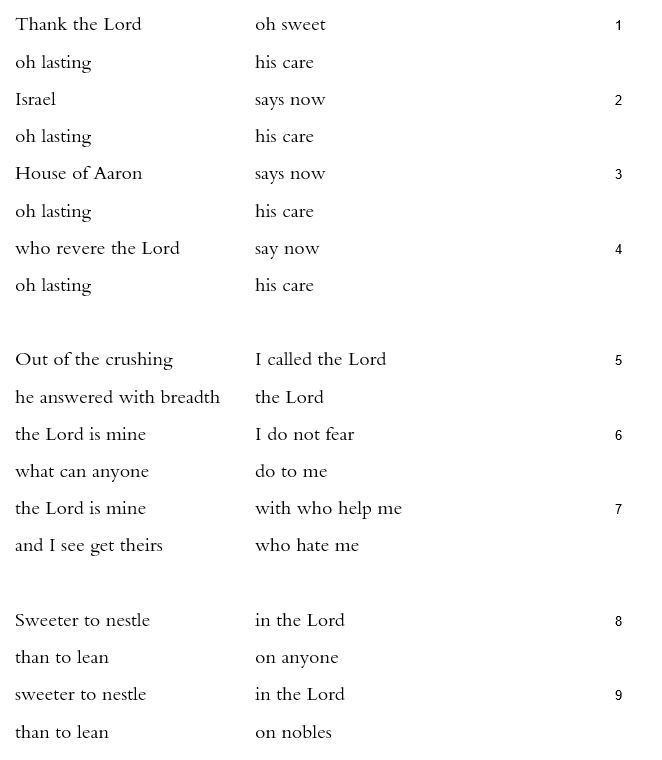
    The exact nature of the transformation is harder to pinpoint, though the psalm’s contours show pivotal moments in the rite. After the fourfold beginning, “oh sweet / oh lasting | his care” (1-4), a first-person speaker testifies to having called for help (5), demonstrating her allegiance to the Lord rather than to anyone else:

    The Lord is mine | I do not fear

    what can anyone | do to me                 

    the Lord is mine | with who help me

    and I see get theirs | who hate me (6-7).   

    Here and in the verses that follow, she distances herself from these others, from “anyone” (6, 8), from “who hate me” (7), from “nobles” (9), and from “all the others” (10). She affirms instead her loyalty to the Lord, whom she names nine times in eight verses (5-12). Her separation from the others marks a pivotal moment, punctuated by the fourfold repetition of “circled me” (10, 11 x2, 12) and the tripled refrain, “oh I cut them off” (10, 11, 12). For readers and reciters, these refrains underscore significance. For the speaker, they seem more like a present-tense performance than a promise of future parting. The verb “to cut off” is the word for circumcise, suggesting a ritual of joining and separating as well as an apotropaic rite (cf. Exod 4:24-26).

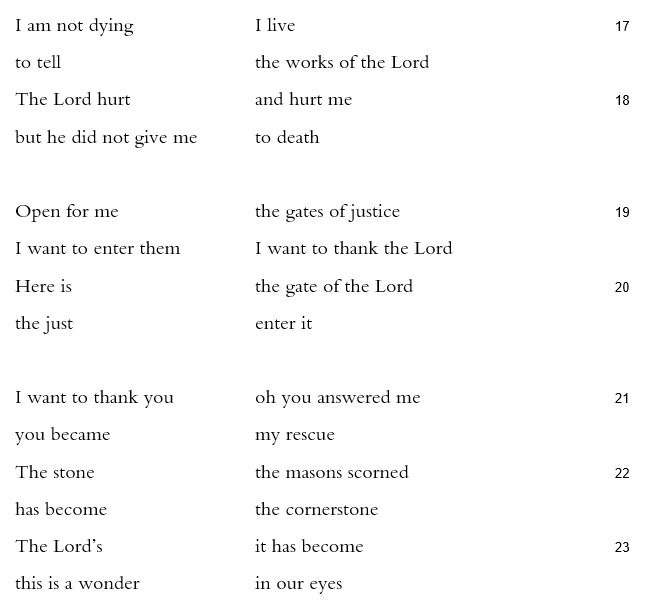
    Not that Psalm 118 necessarily originated from a context that included actual circumcision, though Hermann Gunkel argues persuasively that the psalm’s earliest context may have been a conversion practice, a liturgy for proselytes. It’s valuable, at least temporarily, to read the speaker’s voice in this psalm as the voice of a convert, someone underdoing a painful but valued change. This reading makes sense of the psalm’s next major section, verses 13-18, which begin and end with the same grammatical structure and violence: “You shoved and shoved me | to fall” (13a) and “The Lord hurt | and hurt me” (18a). This violence is repeated and underlined, but it is not lethal: “but the Lord helped me” (13b), “I am not dying | I live” (17a), “but he did not give me to death” (18b). Here, at the center of the psalm, there is ritual simulation of violence: “sounds of shouting and rescue | in the tents of the just / the right hand of the Lord | showing force” (15). Whether this is a convert’s transformation, or a collective ceremonial commitment, the pattern is clear: brutality marks the movement from outsider to insider, marking the moment when the speaker quotes the Song of the Sea, Israel’s most important collective celebration of separation: “my strength and song | the Lord / he has become | my rescue” (Ps 118:14, Exod 15:2). Thus the “gates of justice” and “the gate of the Lord” in verses 19 and 20 become the historical threshold from Egypt to Sinai to the land, as well as the doorway of allegiance from “them” to “us.”

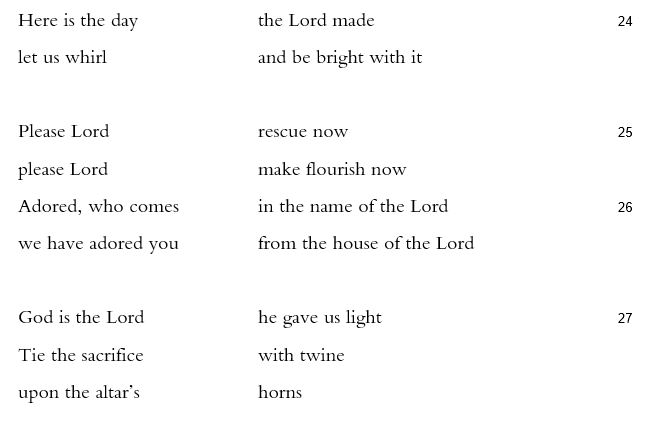
    Verses 20-24 feature three demonstrative pronouns/adverbs: zeh (20), zot (23), and zeh again (24). Each use points to something in the present tense; “Here is | the gate of the Lord” (20), “This is a wonder | in our eyes” (23), “Here is the day | the Lord made” (24). In these same verses significant verb hayah, “to become,” appears three times. This series began in verse 14 (“he has become | my rescue”), and continues with “You became | my rescue” (21). It culminates with the refused stone that “has become | the cornerstone | the Lord’s | it has become” (22b-23a). Together, these gesturing words and the verb of becoming mark another pivotal movement, a movement of becoming that is as fleeting as a day and solid as stone, as emphatically present tense as it is historical, “this is a wonder | in our eyes.”          

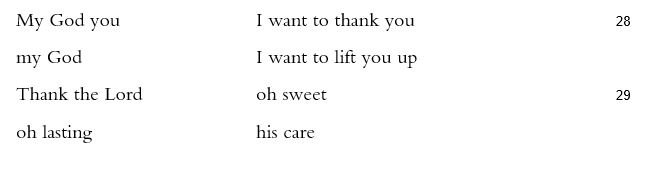
    Again, the exact parameters of the speaker’s experience are unclear. So are any number of specific questions about the ending of the psalm. Who speaks which lines? Who all or what all is the Lord being asked to “rescue now… make flourish now” in verse 25? Are the stage directions in verse 27, to “tie the sacrifice | with twine,” to be sung as well? When the first-person singular speaker’s voice returns in verse 28, she quotes the second part of Exodus 15:2, but transforms those lines into direct address. Instead of “this my God | I want to dwell with him / God of my father | and I want to lift him up,” she says, “My God you | I want to thank you / my God | I want to lift you up.” An atom of the Song of the Sea has been split. The first half of Psalm 118 seems to precede the powerful moment in which the Lord “has become | my rescue” (118:14, Exod 15:2). The second half of the psalm, then, reenacts in liturgy the powerful moment between the two halves of one verse of Israel’s most famous ancient poem, that moment between rescue and thanks, filling it with the cornerstone of the temple, with the altar, and with the wonder of the present tense.

    Share:

    • Share on X (Opens in new window) X
    • Share on Facebook (Opens in new window) Facebook
    Like Loading…

    About Me

    My name is Mark Minster. I’m an English and Comparative Literature professor with a background in ministry and in poetry. I teach courses on writing, reading, religion, and nature.

    Recent Posts

    • Psalm 150
    • Psalm 149
    • Psalm 148
    • Psalm 147
    • Psalm 146

    Newsletter

  • July 5th, 2023

    Psalm 117

    * * *

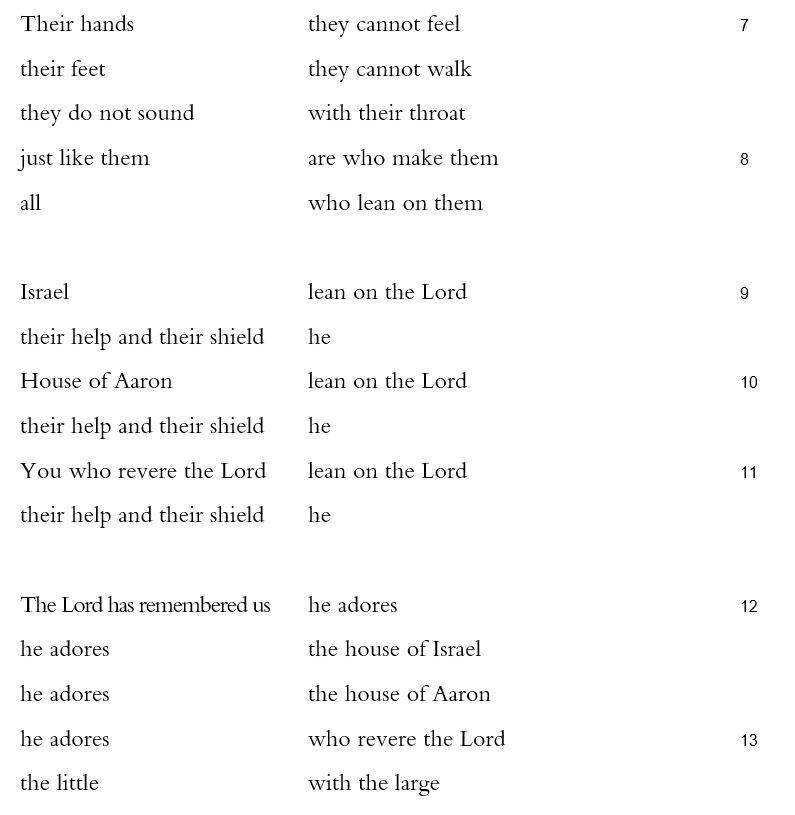
    Within the sequence of liturgical psalms that runs from Psalms 113 to 118, now practiced as the Hallel, Psalm 117 offers a fleeting counterpoint. Psalms 113 and 116 emphasize the inclusion of the poor with the wealthy, an inclusiveness shared in the rest of these chapters only by Psalm 115:13, “he adores | who revere the Lord / the little | with the large.” Psalm 114, most of Psalm 115, and a key section of Psalm 118, by contrast, pit the people of Israel against their neighbors, the “vulgar people” (114:1), the people who say “where pray tell | is their God” (115:2), those others who “circled me” (118:10, 11 x2, 12) and ritually expelled: “I cut them off… I cut them off… I cut them off” (118:10, 11, 12).

    Here in Psalm 117, however, outsiders are invited to take part in praise: “Laud the Lord | all others / commend him | all peoples.” Why? The psalm answers at the beginning of verse 2: “for it prevails over us | his care.” What could be more ambiguous than this? These other nations and cultures, races and ethnicities, they are invited to worship because the Lord’s care has been strong for us. Is that invitation literal or ironic? Literally, the line celebrates the Lord’s strength, care, and fidelity for the us of the psalm, which it sees as cause for everyone to give praise. Ironically, however, the verb gebor points to a victory as well as strength, asking enemies to celebrate what is stronger than they are, what is stronger even than the singers themselves. Certainly, in context, even a literal reading is made ironic by the psalms that surround this, which make a point of disinviting others. This is not the same kind of universalism seen in some other psalms or in the book of Isaiah. On its own like this, the irony is amplified. Other people are just verses away from being cut off entirely.

    Share:

    • Share on X (Opens in new window) X
    • Share on Facebook (Opens in new window) Facebook
    Like Loading…

    About Me

    My name is Mark Minster. I’m an English and Comparative Literature professor with a background in ministry and in poetry. I teach courses on writing, reading, religion, and nature.

    Recent Posts

    • Psalm 150
    • Psalm 149
    • Psalm 148
    • Psalm 147
    • Psalm 146

    Newsletter

  • July 4th, 2023

    Psalm 116

    * * *

    Psalm 116 is less disjointed than might seem on a first or fifteenth reading. It begins with fractures and quotations, but by the end becomes something its own, the way crumbs gather to a short crust. Its main concern is to pay the Lord the liturgical price owed for his rescue. Instead of the typical pairing of “calling” (qra’) with “answering” (`anah), which appear together in more than a dozen psalms (e.g., Pss 3, 4, 17, 86, 102, 118, 120), Psalm 116 links “I call,” ’eqra’ (116:2, 4, 13, 17) with both “please,” ’anna’ (4, 16) and “now,” na’ (14, 18), insistent words that show up again soon in Psalm 118:25 when the Hallel sequence culminates (“Please Lord | rescue her now / please Lord | have her flourish now”). The point of this wordplay seems to be either that the Lord has already answered the petitioner’s call, or that the appropriate place for both call and response is worship, “in the yards | of the house of the Lord / in your center | Jerusalem” (116:19).

    The end of the psalm is cohesive enough. Verses 15-17b move from the claim that the death of his loved ones costs the Lord (15) to the speaker’s plea for special pity, “oh I am your servant | I am your servant” (16), to immediate unshackling and gratitude (17a-b). Verses 17c-18 constitute a refrain, repeating verses 13b-14 almost exactly: “So on the name of the Lord | I call / my vows to the Lord | I make good / right now | before all his people.” This refrain reaches back to a shorter version, “on the name of the Lord | I call” in verse 4, which shapes the whole psalm as increasingly immediate, expansive, and performative: I call, I call now, I call now in the temple.

    Three preceding sections, verses 1-4, 5-9, and 10-14, seem somewhat similar to 15-19. Verses 10 and 11 witness a kind of crisis of confidence in others, while verses 12-13a turn to gratitude and the refrain of 13b-14 marks a public declaration of loyalty. Somewhat less cohesive, verses 5-6a make claims about the Lord’s traits of pity, fairness, and compassion, before verses 6b-9 turn from pleas to rescue: “I was sunk low | but he rescues me” (6b). Verses 7-9 express detailed thanks. Even less cohesive is the psalm’s opening. Verse 4 certainly ends with the speaker calling the Lord’s name, as the third and fourth sections do. But verses 1-3 appear to invert the sequence of trouble-call-response. Already in verse 1, “the Lord hears / my voice | my pleas,” a hearing that precedes the speaker’s repeated statement, “I call” (2b, 4a). Unlike the psalm’s later calls, which follow gratitude, this section’s two calls surround the speaker’s dire situation: “They have cordoned me | the cords of death” (3), a verbatim quotation of Psalm 18:4. Perhaps the function of this inversion, and of the quotation, is to make the entire psalm enact a transformation of the speaker’s call from complaint to necessary response. The speaker calls. The Lord rescues. The speaker calls in worship.

    Other quotations signal that Psalm 116 is attempting something allusive or revisionary. Psalm 111:4b (“feeling and tender | the Lord”) and 112:4b (“feeling and tender | and just”) are blended in 116:5a: “Feeling is the Lord | and just / and our God | is tender.” Psalm 31:22 (“for I said | in my panic / I’m severed | from before your eyes”) is modified in 116:11a (“I said | in my panic / all mortals | are lying”). The paying of vows in 116:14 and 116:18 calls to mind Psalm 22:25 (“my vows I make good | before those who revere the Lord”) and even more clearly Psalm 56:12-13 (“Over me God | are your vows/ I make good| thanks for you / For you have freed | my neck from death / not letting my feet | trip”). Even the very first word of Psalm 116, “I love,” may be an echo. It is a strange word to begin a psalm, ’ahavti, not terribly common, with no clear object— loved what? The ki-clause that follows it may be its object: “I love that the Lord hears my voice, my pleas.” Or the object could be “my pleas”—“I love, for the Lord hears my voice, my pleas”—though the sense is stranger. It’s just as likely that the Psalm quotes either Psalm 26:8 (“Lord I love | the nest of your house”) or Exodus 21:5-6:

    “But if the servant indeed says, ‘I love my lord, my wife, and my children, I cannot go free,’ his lord will have him approach the gods and approach the door or doorpost and his lord will pierce his ear with an awl and he will serve him ever.”

    Both possible references are relevant. Psalm 116 ends by pointing to the temple in which the psalm takes place. Even more compelling, if Psalm 116 does begin by alluding to the law in which a slave with a family renounces his freedom for the sake of love, the entire psalm is grounded and gains significance, especially verses 16 and 17: “Please, Lord | oh I am your servant / I am your servant | the child of your female servant // You have opened | my cuffs.” The experience of the psalm becomes a testimonial, a freed slave quoting snippets of psalms “right now | before all his people.”

    Share:

    • Share on X (Opens in new window) X
    • Share on Facebook (Opens in new window) Facebook
    Like Loading…

    About Me

    My name is Mark Minster. I’m an English and Comparative Literature professor with a background in ministry and in poetry. I teach courses on writing, reading, religion, and nature.

    Recent Posts

    • Psalm 150
    • Psalm 149
    • Psalm 148
    • Psalm 147
    • Psalm 146

    Newsletter

  • July 3rd, 2023

    Psalm 115

    * * *

    For all its shifts of perspective and varied liturgical work, Psalm 115 coheres around a pair of emphatic oppositions: the horizontal separation between “us” (1, 18) and “others,” the goyim (2) who worship appearances; and the vertical poles of skies (3a, 15b-16a) and earth (15b-16). These oppositions cross, creating quadrants: we under our God; they under, what? Nothing? Or under the God who is not theirs but ours?

    The psalm begins and ends with the first-person plural. This “we” at first opposes not “the others,” but the Lord: “Not to us Lord | not to us / oh only your name | give a glow” (1). Only then do the goyim, other cultures, appear. “How long | must the others say / where pray tell | is their God” (2). From these others’ perspective, the “we” of the poem are a “they,” which allows the line “where is their God” to work in both directions, as their foolish, stated question and our wise, unstated one. At the end of the psalm, “they” are aligned with “the dead” and “all | who sink to silence” (17), whereas “we | adore the Lord / from now | on till ever” (18). Our quadrant, opposed to theirs and differentiated from the Lord’s by the work of adoration, lasts.

    The Lord, by contrast, sees “us” as “you.” The psalm’s implied speaker gives a benediction, a blessing, in verses 14-15: “May the Lord | add to you / to you | and to your children / may you be adored | by the Lord.” The lines before this have just clarified the vertical relationship between “us”/”you” and “the Lord” through the triple imperative, “lean on the Lord” (9-11), and the quadruple declarative, “he adores” (12-13). Though “we,” too, “adore the Lord” (18a), the others, “they,” “lean on them,” their totems”: “just like them | are who make them / all | who lean on them” (8). The Lord’s quadrant, we learn, includes “the skies | the skies of the Lord,” in contrast to “the earth he gave | to mortals” (16). All the skies, theirs and ours, are the Lord’s. All the earth is ours, though we share it with them, who are as inanimate as their totems.

    At first glance, the psalm seems a collage. Its parts do different things. If liturgy is, as its etymology suggests, the ergos of the leios, the work of the people, the pieces of Psalm 115 do different work, make different things happen. Verse 1 performs subservience by abnegation. Verse 2, “How long,” calls for revelation as proof against others. Verse 3 affirms allegiance and claims superiority. Verses 4 through 8 adore the Lord by denigrating alternatives. Verses 9-11 adjure; verses 9-13 proclaim. Both proceed by tightening the circle of the faithful, from “the house of Israel” to “the house of Aaron” to those “who revere the Lord.” Verses 14-15 bless and pronounce. And verses 16-18 carve out space for the people’s demonstration of commitment. Unlike the Lord in the skies, unlike those “who sink to silence” (17b), “we | adore the Lord” (18a.)

    It takes little imagination to see these segments of the psalm as originating in the experience of worship, as patterning a service. After all, Psalm 115 is part of the Hallel sequence. And it is the Christian hymn “Non nobis.” The lines do not just resemble liturgy; they are liturgical. But the work of the people that these lines accomplish goes beyond their recitation and their being sung. The work these lines do is division. The psalm protects these people from the others’ questioning by relocating the Lord to the skies, away from the earth. It preserves the Lord’s glow, away from the people, by the work of adoration. Most importantly, dangerously, it works to value both the Lord and the people by devaluing all others as senseless, hollow, speechless, as good as dead.

    Share:

    • Share on X (Opens in new window) X
    • Share on Facebook (Opens in new window) Facebook
    Like Loading…

    About Me

    My name is Mark Minster. I’m an English and Comparative Literature professor with a background in ministry and in poetry. I teach courses on writing, reading, religion, and nature.

    Recent Posts

    • Psalm 150
    • Psalm 149
    • Psalm 148
    • Psalm 147
    • Psalm 146

    Newsletter

←Previous Page
1 … 7 8 9 10 11 … 37
Next Page→

Blog at WordPress.com.


Loading Comments...
 

    • Subscribe Subscribed
      • The Book of Psalms
      • Already have a WordPress.com account? Log in now.
      • The Book of Psalms
      • Subscribe Subscribed
      • Sign up
      • Log in
      • Report this content
      • View site in Reader
      • Manage subscriptions
      • Collapse this bar
    %d