Unlike the psalms that precede it, Psalm 79 centers on not remembering: “Don’t remember at us | our prior wrongs / hurry, let come at us | your tendernesses / for we have been so | abased” (8). The curious irony is that these three lines are preceded by two lines— indeed, most of the first seven verses of the psalm— that do just the opposite, helping God remember the destruction of Solomon’s Temple in Jerusalem: “oh they feasted on | Jacob / and razed | his home” (7). Remember the destruction, the psalm says, but forget “our prior wrongs.” It’s a history that asks God to remember only those wrongs done by “the others” (1, 6, 10 x2). And as the second half of the psalm turns from trauma to revenge, it’s that partiality of memory that becomes so dangerous.
The psalm is a careful chiasm. The structure highlights its logic of provocation met by hawkish disproportionate response. The psalm’s first imperative, “spill your fury | on the others / who haven’t known you | and on the realms / who haven’t called | in your name” (6), is paralleled in the second half by a burst of imperatives and jussives:
hurry, let come at us | your tendernesses
for we have been so | abased
help us | God of our rescue
for the honor of your name | free us
overlook our mistakes | for the sake of your name (8-9).
The failure of “the others” to call “in your name” (6) is contrasted with “the honor of your name” and “for the sake of your name” (9). These name-motivated imperatives that appeal to God’s vanity are preceded and followed by the poem’s three questions, arranged, as with the word “name,” with one (`ad mah) in the first half and two in the second half (lammah and ayyeh): “How long Lord” (5) and “Why let the others say | where’s their God” (10).
Nearly half of the poem takes place in verses 2-4 and 10-12, the psalm’s two main panels. The early part points to the bodies, “your servants’ corpses… your caring ones’ flesh” (2). It points to the blood, “they’ve spilled their blood | like water / all around Jerusalem | and no one to bury them” (3). And it points to the people’s loss of esteem in the eyes of their “neighbors”: “we’ve become a joke… a jape and a jest/ to those who surround us” (4). The bodies and blood return in the later part: “let it be known | among the others in our sight / the vengeance of blood | of your servants spilled” (10). The passive participle “spilled” refers both to the blood that was spilled and the blood of vengeance that is about to be spilled. The word “joke” (or “taunt”) from verse 4 returns twice in verse 12: “pay back | our neighbors / seven times | in the chest / their joke | they joke at you my lord.”
Sevenfold revenge for mockery in verse 12 is one thing. “Vengeance of blood” in verse 10 is something else. The psalm clearly advocates for both. Others can continue to debate the ethics of these kinds of retribution. But verse 11, which stands between the other two calls for revenge, stands apart: “Let come to your face | the prisoner’s scream / from the force of your arm.” At first glance, that scream seems to come from one of the Lord’s caring ones, whose deaths the first half of the psalm relives. But the completed syntax makes clear that God is being invited to relish the sound of prisoners suffering “from the force” of God’s own arm. And the last line of verse 11 is truly haunting: “make more than enough | the children of death.” While the imperative hoter is admittedly ambiguous in its meaning, given that the root yatar means to leave a remainder or to be left, its use in other places clearly indicates abundance to the point of excess (vehoter Exod 36:7 and 2 Kgs 4:43; vehotirekha Deut 30:9). So although it is possible that this line may be read as a plea for God to hear his own people’s screams and to preserve his children from death, this reading seems secondary in the context of other lines calling for blood. The more likely reading is the darker, more dangerous one, that God is encouraged to revel in brutality.
At its beginning and end, in verses 1 and 13, the psalm returns to the scene of the temple. What at the beginning had been profaned, by the end seems to have been restored. At the same time, a psalm that appeals to God’s vanity as well as his loyalty ends with the promise of praise, which seems close to dependent upon the longer, more detailed fantasy of revenge.
My name is Mark Minster. I’m an English and Comparative Literature professor with a background in ministry and in poetry. I teach courses on writing, reading, religion, and nature.
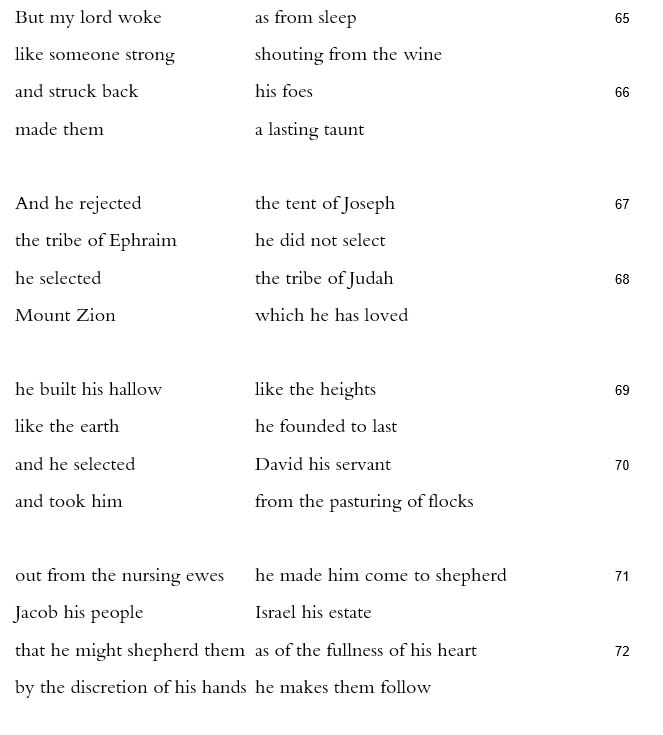
That Psalm 78 is a grand psalm concerned with history is clear. As always, we readers have to ask whose history, told how, told when and for whom, and to what ends? Every story does things as it chooses beginnings, middles, and ends. This story-psalm in particular chooses explicitly. It begins with a long reflection on the stories that parents tell their children (3-8) and ends (67-72) with the psalm’s ostensible point: “the tribe of Ephraim | he did not select / he selected | the tribe of Judah… and he selected | David his servant” ( 67b-68a, 70a). Its story of God’s selection is itself a highly selective history, tendentious and teleological, designed to explain how the lineage of Ephraim, traced back to Joseph and on back to Jacob/Israel, struggling so hard throughout the second half of the book of Genesis to win the blessing and the line of descent then came to lose that blessing, and how the northern tribes who claimed descent from Israel and Joseph and Ephraim lost everything.
It’s not at all clear when this psalm was written or to what extent it’s the product of major or minor revisions. In a 2017 essay called “Psalm 78: A Case Study in Redaction as Propaganda,” the biblical historian Oded Tammuz wrote,
“Suggestions on the date of the text include the united monarchy in the tenth century BCE, immediately after the division of the united monarchy, the divided kingdom, the eighth century BCE, between the fall of the northern kingdom (722 BCE) and the fall of Judah (586 BCE), the time of Hezekiah, the time of Josiah, the late preexilic period, the late exilic and postexilic period, the Second Temple period, and the Maccabean period” (206-207).
Tammuz himself goes on to argue for a specific date during the reign of Hezekiah. But his more defensible, more important point lies in this series of possible dates scholars have advanced. It covers the better part of a millennium, about as long as biblical Hebrew lasted as a living language. The point is not that every scholarly conjecture has equal merit, nor that none of them do— their work is fascinating and differentially valuable— but that the matter remains unknowable. Thinking otherwise perpetuates the tendentiousness of history and historiography.
More, the range of possible dates shows that the psalm’s explanation of God’s favoritism would have had contemporary relevance in so many historical moments over such a long period of time. “He abandoned the shrine | at Shiloh / a tent he had enshrined | for mortals” (60). Assuming this verse was always—or early— part of the psalm, as it is now, its explanation for the loss of a center of power justifies the centralization of worship and capital in Jerusalem any time from the reign of David on, in either the ark of the covenant or Solomon’s Temple or the Second Temple, and it accounts for the destruction of the northern kingdom before, during, and after the fall of Jerusalem, and it accords with strictly monotheistic practice and political satrapy. Centers are always making peripheries measure their distance.
The histories in this psalm—and there are several—are braided purposively. Psalm 78 opens with four-part sequence from “my direction” and “the words of my mouth” to “a parable” and “puzzles of old” (1-2). What kind of parallelism is this? A list of synonyms? A declension history, from what was perfectly clear, transmitted long ago, to a proliferation of riddles? The pronoun that starts verse 3, “which” (’asher), does not decide. Rather, a body of knowledge is similarly reduplicated, from “which we have heard | and we have known/ and our parents | have recounted for us” (3) to the “stele | in Jacob” and “directions | in Israel / which he commanded | our parents / for them to make known | to their children” (5). Knowing and retelling are not just doubled but tripled here: “we have known/ and our parents | have recounted for us… recounting praises…” (3-4); “he commanded our parents/ for them to make known | to their children/ so that the next age | might know… and recount | to their children” (5-6).
The threefold repetition of “parents” (literally, “fathers,” 3, 5, 8), “children” (literally, “sons,” 4, 5, 6), and “age” (dor, 4, 6, 8 x2) similarly emphasizes continuity over time, while the fourth use of “children” and “parents” is contrastive:
The children of Ephraim | armed and bearing bows
turned around | on the day of battle
they did not keep | God’s pact
and in his directions | they refused to walk
they forgot | his doings
and his marvels | which he had made them see
in front of their parents (9-12).
Whatever irresponsibility or cowardice is meant by the children of Ephraim’s “turn[ing] around | on the day of battle” (9), the backwards posture clearly opposes the marvels that were right “in front of their parents” which “he had made them see” (12,11)
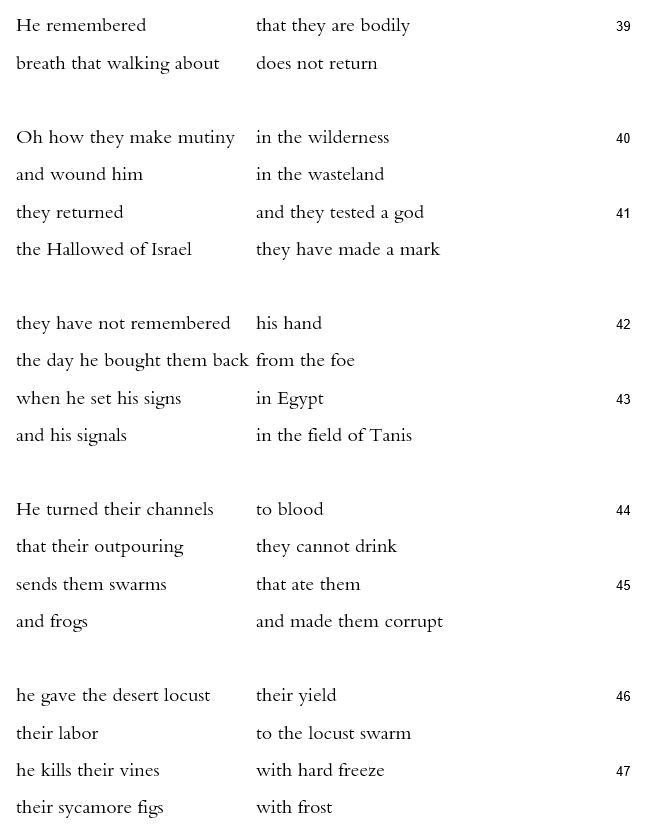
From Ephraim’s failure, set in the psalm’s more immediate past, the psalm turns to events from the story of the Exodus, set in the more distant past. In verses 13-20, the splitting of the sea and details from Exodus 13-17 are blended with each other and with authorial inventions—“can a god set a table | in the wilderness” (Ps 78:19) is not literally the Israelites’ question, for example. In verses 23-31, more details of the Exodus are added, mostly from Numbers 9-11, most of them concerning God’s raining down deluges of manna and quail, glutting the hungry wanderers to the point of killing many of them (Ps. 78:31, cf. Num 11:33-34). After two verses of summary (78:32-33) and the psalm’s central section 34-43, there are a third (43-57) and fourth historical section (60-66). The third section names seven plagues (44-51) before quickly leaping forty years ahead to “the edge of his hallow / this mountain | his right hand obtained” (54) to narrate a second generation’s rebellion: “they tested and made mutiny | at God the Highest… they recoiled and balked | like their parents” (56-57; cf. 17-18, 40-41). Just like the first and second sections, the third and fourth historical sections are punctuated by God’s anger and rejection: “The Lord heard | he was beside himself” (21); “God heard this | and was beside himself” (59).
Given that we cannot tell when the psalm was written, it is unclear what events the fourth historical section returns to. Verse 61 could refer to any number of conquests and exiles, Philistine, Assyrian, Babylonian, or Hellenistic occupiers: “He gave his strength | to captivity/ his finery | to the hand of the foe” (61). Again, “he was beside himself” (62). The openness of this description— “captivity”— even allows for a dark undoing of the Exodus itself, a return to Egypt and the death of “his select young men,” leading to the loss of marriage, the death of the priests, and the failure of mourning itself (63-64). It is unclear when “my lord woke… and struck back | his foes” (66), though the striking calls back verses 20, 51, God’s striking of the cliff, an interesting revision, and the striking down of the firstborn.
So much of the work of the psalm takes place not just in its allusions, but in the meticulous verbal forms and the extensive repetitions of particular keywords. Bechor, which literally means “selected,” refers to the young men in their prime killed twice in the psalm (31, 63). Bachar is the verbal form, which associates the deselection of Ephraim (67) and the selection of Judah, Zion (68), and David (70) with God’s killing of his own. Bekhor, the firstborn killed in Egypt (51), takes part in this wordplay, which calls to mind similar meaningful kenning in the story of Jacob, which turns on relevant questions of birthright (bekhorah) and blessing (berakhah). The verb nachah, “to guide,” appears three times in Psalm 78 in its causative stem, “to make follow”: God “made them follow | with the cloud by day/ and all night | by firelight” (14) and again God “made them follow close | so they did not fear / their enemies | the sea swept over” (53) and most significantly as the very last word of the poem, though it is unclear whether the subject is God or David, “by the discretion of his hands | he makes them follow” (72). Not in the causative stem, nachah also appears in the final line of Psalm 77, “You led your people | like a flock / by the hand of Moses | and Aaron” (77:20), which the ending of Psalm 78 clearly revises. Powerfully, with its third-person plural suffix, the word yanchem evokes the root word nacham, for “comfort.” It even picks up the word nachalah, the word for inheritance (55, 62).
So many verbs in Psalm 78 are in the causative stem, rendered in this translation wherever possible by the word “made,” used as a modal or as a helping verb. “He made rise a stele,” for instance, would be more succinct as “he raised a stele,” but at the cost of something significant. Causality is a key point of the poem. Choices, whether to remember or forget, whether to stand firm and follow or to swerve, have consequences, the most recent of which is God’s own choice to remove the blessing from Jacob and Ephraim to Judah, the selection of David.
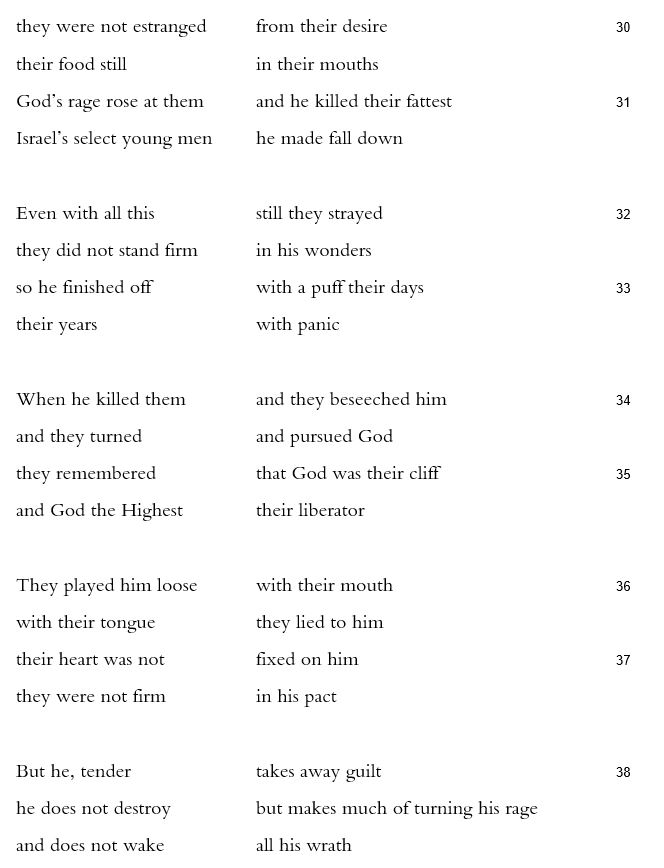
Finally, like the psalms that precede it and like the story of Jacob it claims as an ancestor, Psalm 78 centers on the act of remembering. Twice “they remembered” is predicated of the people, though neither instance is ideal (35, 42). The first time, remembering only occurs as part of a sequence that begins “when he killed them” and is followed immediately by “they played him loose | with their mouth / with their tongue | they lied to him” (34, 360. The second time, their remembering is actually negated: “they have not remembered | his hand”—another callback to Psalm 77, where God’s hand is absent.
Between these two failed acts of remembrance, near the very center of Psalm 78, is God’s own remembering: “He remembered | that they are bodily / breath that walking about | does not return” (39). The vav-consecutive construction vayyizkor allows God’s remembering to be read as completed action, part of history, or to be read in conjunction with the two verses that flank it, as incomplete, ongoing, imperfective tense:
But he, tender | takes away guilt
he does not destroy | but makes much of turning his rage
and does not wake | all his wrath
He remembered | that they are bodily
breath that walking about | does not return
Oh how they make mutiny | in the wilderness
and wound him | in the wasteland
The word “remembered,” in other words, may also be “remembers,” continuous with his continuing tenderness (38) and being wounded (40). Whether these profound lines are in keeping with the rest of the psalm— that may be the parable or puzzle that’s hardest to solve.
My name is Mark Minster. I’m an English and Comparative Literature professor with a background in ministry and in poetry. I teach courses on writing, reading, religion, and nature.
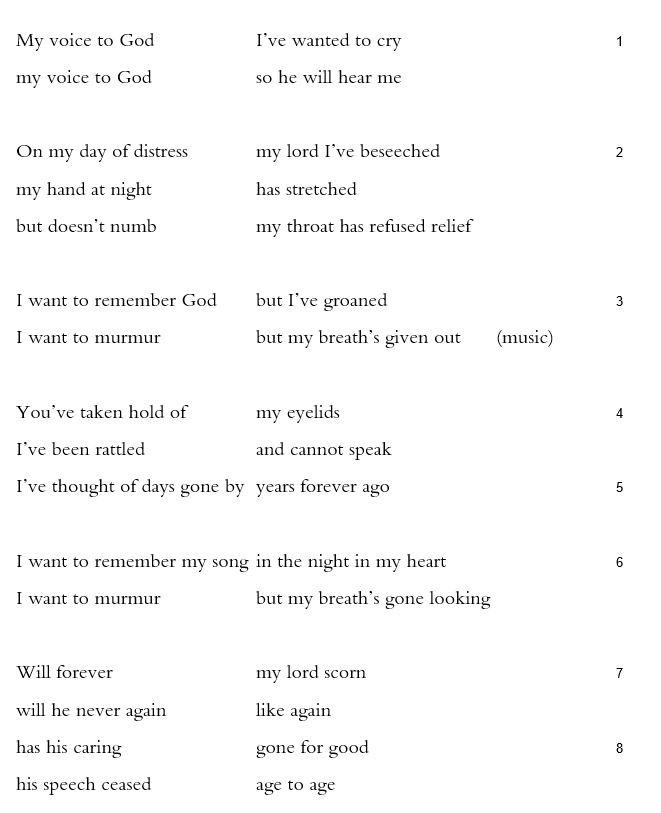
This is a sensational psalm. It is deft and layered, powerfully personal and embodied, and yet richly allusive. It transposes its first-person first half to a grand and mythic register. So much of the drama of the Asaph psalms that precede Psalm 77 is distilled here in the experience of a single speaker who wants. The cohortative mode, the “let me”/”may I” mode of wish, is crucial to the voice of the psalm. The speaker has wanted to cry out, but their body won’t let them. It won’t let them give up: “my hand at night | has stretched / but doesn’t numb | my throat has refused relief” (2); “You’ve taken hold of | my eyelids / I’ve been trembling | and cannot speak” (4).
Wants keep coming. “I want to remember,” the speaker says three times. “I want to remember God | but I’ve groaned” (3). “I want to remember my song | in the night in my heart” (6). Tellingly, right at the turn in the center of the psalm, the speaker says, “I remember | the works of Yah / oh I want to remember | your wonders gone by” (11). The desire to remember lingers even after the remembering itself. Wanting to remember keeps coming not because the speaker has forgotten, but because their desired remembering is an action, something that must be vocalized. After all, remembering in the psalm is always paired with “murmuring,” the verb used for low, meditative speech. “I want to murmur,” they say three times, twice pointing to a failure of breath: “I want to murmur | but my breath’s given out” (3); “I want to murmur | but my breath’s gone looking” (6). Murmuring, too, is at the psalm’s center:
I remember | the works of Yah
oh I want to remember | your wonders gone by
that I might mumble | all your work and your workmanship
I want to murmur God | in apartness your way
What began in verse 3 as the desire to remember God becomes in verses 12-13 the desire to murmur “God | in apartness your way.” The resolution is followed by the poem’s key question/exclamation: “Who is a god great as God | you the God who does wonders” (13-14, which are divided curiously in the Masoretic Text).
Only a few psalms earlier, it was God being asked to remember (74:2, 18, 22). Now, though God’s legendary interventions have been the subject of Psalm 74 (74:12-17), Psalm 75 (75:2-3), and nearly all of Psalm 76 (76:1-8), the speaker struggles to speak of this memory. The struggle to speak is caused by failing breath but also by God’s own silence, as verses 7-10 make clear: “has his caring | gone for good / his speech ceased | age to age” (8). The speaker’s own bodily discomfort comes from the absence of God’s body: “did he forget, God | how to feel / or shut in anger | his womb-love” (9). As always, the word for “compassion” names a part of the mother’s body, the womb, which is paired here as it is so many times, with the verb “shut.” God’s gone barren, perhaps—or the speaker just misses the womb. The speaker admits, “my sorrow is this / the sleeping right hand | of the Highest” (10). God’s sleeping hand contrasts with the speaker’s own hand, which was “stretched | but doesn’t numb” (2).
In the poem’s second half, the silence and absence of God are followed by memories. God’s arm is recalled as what ransomed “your people / the sons of Jacob | and Joseph” (15). God’s speech is recalled in deluge: “the voice of your thunder in the whirling | lightnings lit the world / the earth trembled | and it sways” (18). And, most enigmatically, hauntingly, God’s “way,” which the speaker had wanted to murmur in verse 13, is recalled as a pathway that waters erased: “by sea was your way | your winding by mighty waters / your footprints | were all unknown” (19). Did you miss God’s speech? Did you want God’s caring and womb-love, God’s tracks? These are they, the psalm says, such as they were. If it’s God’s hand you’re missing, consider this, the psalm concludes: “You led your people | like a flock / by the hand of Moses | and Aaron” (20).
The memorials of Jacob and Joseph and of Moses and Aaron are just the surface of the psalm’s allusions. The waters that erase footprints, together with the mention of clouds, the buying back of the people, all clearly gesture to the Exodus, as do close parallels between 77:13-14 and the Song of the Sea. Many scholars have cataloged these parallels and shown how they anticipate Psalms 78 and 81. But the waters and deeps of verses 16-19 allude not just to the crossing of the Reed Sea, but also the chaotic waters of creation (see also 74:12-17 and 75:3) and the story of Noah, all three of which are linked by inner-biblical reference, echo, and allusion. At the center of the story of Noah, attentive readers note, is God’s own remembering: “God remembered Noah” (Gen 8:1). Similarly, at the center of the cycle of Jacob stories, God remembers: “God remembered Rachel and God heard her and opened her womb” (Gen 30:22). This moment, too, is recalled by Psalm 77, which mentions Joseph and Jacob’s sons, and centers remembrance, and worries that a womb has shut.
Those stories of Jacob and his son Joseph are significant to this psalm as well. In verse 2, three words in a row allude to these two. The only biblical character to be “numb” (tapug) is Jacob, when he finds out Joseph is still alive (Gen 45:26). The only character to “refuse relief” (ma’anah hinacheim) is also Jacob, when he is told that Joseph has been killed (vayma’ein lehitnacheim, Gen 37:35). Later, Jacob “refuses” Joseph while reversing the blessings of Joseph’s sons, preferring Ephraim (Gen 48:19; see also Ps 78:9ff, 78:67). These allusions pinpoint key moments of father-and-son intimacy that also touch on the generativity of the family line— not just the two characters themselves but their lineage, and importantly, the lineage at the end of Genesis, which leads to the captivity in Egypt at the beginning of the book of Exodus. Even the wordplay in verses 7 and 8— both yosif, “he will (not) do again,” and he’aseif, “has it gone,” link Joseph (both roots are used multiple times in Genesis 37 and 47) and Asaph in their sound clusters— reminds readers that Joseph’s hopeful story, itself a story of remembrance, may have been followed by the terrible oppression of Pharaoh, but it was followed, almost immediately, by the hands of Moses and Aaron.
My name is Mark Minster. I’m an English and Comparative Literature professor with a background in ministry and in poetry. I teach courses on writing, reading, religion, and nature.
Once we admit that the selah notations in Psalms do not necessarily mark section breaks, as here in verses 3 and 9 of Psalm 76 (cf. Pss 4, 20, 46, 52, 55), it’s possible to see different structures. The twenty-four lines of this psalm yield either four six-line stanzas or six four-line stanzas (assuming that the word ’eshtolelu, “they were pillaged,” in the now-abbreviated verse 4 was sent off to verse 5, which was already long). All such decisions about stanzas are interpretative, clearly, but valuable for the parsing of the psalm or “song.” And while all such decisions might be misleading or wrongheaded, it is impossible to escape shaping the words on the page. What justifies the four-line stanzas in this translation? They make marginally more sense of the two thorniest passages in Psalm 76.
As with the Asaph psalms that immediately precede it, Psalm 76 works through scenes of ruin and explanatory theories of divine distance and ire. To “a waste in an instant/ done | wiped out with disasters” (73:9) and “what’s been ruined so long/ all that the enemy harmed | in the sanctuary” (74:3) and the cup of wine that “all the cheats of earth” drink dry (75:8), Psalm 76 adds more. Now there are battle scenes in Zion— “there he smashed | the archers’ fire / shield and sword | and war” (3)—and aftermath—“none of the men of force | could find their hands / out of your punishment | God of Jacob” (5-6)—and divine rage—“You | dread you / who could stand in your face | in your moment of wrath” (7).
The second half of the psalm is dominated by “dread,” framed by two uses of the participial adjective nor’a, first wedged between appellative pronouns in verse 7, then wedged in verse 12 between “princes” and “kings.” In different forms, dread appears in verses 8 (yar’ah) and 11 (lammor’a) as well. The nor’a form in particular is part of a sound cluster that organizes the whole psalm, from nod’a (“known,” 1) to na’or (“bright-lit,” 4) to nirdam (“knocked cold,” 6) to nidaru (“Make vows,” 11). Dread, repeated most often, thus links God, known and shining and feared, with three different human responses: fear, paralysis, and commitment.
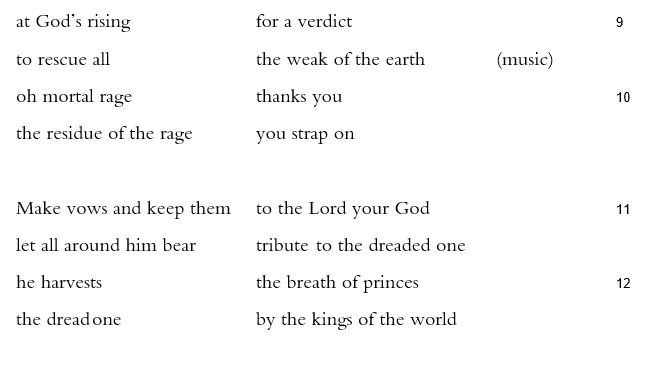
Seeing the psalm as six quatrains shows each half as having three sections. In the song’s second half, God’s wrath (7-8) is followed by God’s rising to judge and govern (9-10), followed in turn by the obligations of insiders— “Make vows and keep them”— and outsiders— “let all around him bear |tribute to the dreaded one / he harvests | the breath of princes” (11-12). The otherwise inexplicable verse 10, separated from verse 9 by the selah, is now part of God’s rising “to rescue all | the weak of the earth.” Mortal rage becomes thanks and praise. And with what is left of that rage, according to the strange figure of the psalm, God makes a belt. Read this way, outrage turns into gratitude, while its remainder becomes a garment of justice. May midrashim and therapists have ears to hear.
Similarly, in the first half of the psalm, three four-line stanzas can be seen. The first locates— nearly relocates— God in Zion, relating Judah and Israel in a gesture as likely to be a parallel as it is a tension between the northern and southern realms (1-2). The second stanza recollects battle (3-5a), while the third concentrates on a kind of slow-motion inability of warriors to respond (5b-6). The real puzzle, which neither a four-line nor a six-line structure completely resolves, is what to do with verse 4 and the first part of verse 5:
bright-lit, you | and lofty
out of mountains of prey | they were pillaged
Finding sense, however, is not impossible. God routed warriors, according to verse 3. Verse 4 turns the camera to God in a shift to the second person, where the “you” is lodged between two modifiers “bright-lit” and “lofty.” Mention of the mountains recreates the divine relocation to Jerusalem (at the Davidic centralization of the monarchy, and/or after the Babylonian exile) even as it characterizes God in battle gear as an apex predator. “They were pillaged” completes this stanza of description by looking forward to the next stanza of the warriors’ incapacity. “They were pillaged” looks back to the archers and ahead to “the valiant of heart.”
My name is Mark Minster. I’m an English and Comparative Literature professor with a background in ministry and in poetry. I teach courses on writing, reading, religion, and nature.






 The Book of Psalms