

* * *
The Book of Psalms concludes with a coda of five psalms of Hallelujah (lit. “laud the Lord”), Psalms 146-150. Five books of the psalter, five final psalms, and in Psalm 146, five lines in a row that name and describe the Lord with noun + participle phrases, phrases simultaneously adjectival and absolute, with verbs not bound by time:
the Lord | loosing the bound
the Lord | eye-opening the blind
the Lord | lifting the stooped
the Lord | loving the just
the Lord | guarding migrants (7c-9a).
Such pentads mirror the five books of the Torah, seeking to borrow authority and implicitly claiming similarity of design and purpose, defining a people, defining the law. Pairing liturgy with a law that is embedded in a narrative of liberation lends the songs legal and liberatory significance, deepening and thickening the work of praise.
Most importantly, Psalm 146 accentuates one of the Torah’s crucial implications: that, because each human life ends even as divine attention by definition endures, the work of liberation must cross generations. There is no subjective immortality, this psalm insists. The speaker wants to sing for “my God” “with my life” and “with my keeping going” (2), and so the psalm turns to verses that conclusively leave that first-person behind to elaborate on what “keeping going” entails. It’s not about some other world. The second stanza starkly reminds the speaker as well as the audience that all flesh is grass, everyone dies: “his breath leaves | he goes back to his soil / on that day | his thoughts vanish” (3). This is far from a vision of any individual’s eternal soul or personal resurrection, and yet far from nihilism as well. Instead, happiness accompanies the shift from “my God” to “the God of Jacob… the Lord her God,” the “help” and “hope” of anyone (5).
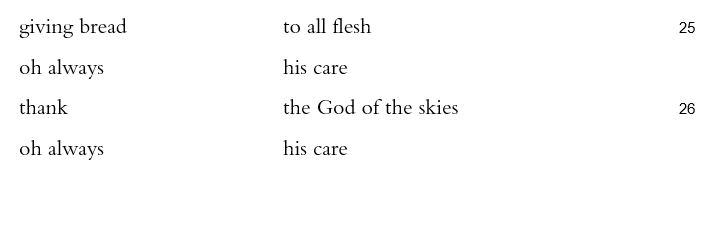
If “life” and “keeping going” are not at all about some private afterlife, neither is rescue or salvation merely individual. Help roots in the work of creation, which is participially continuous with the work of redemption. The bulk of Psalm 146 is a backbone of nine participial phrases that embody the timelessness of divine actions and identity: “guarding faithfulness | ever / making verdicts | for the oppressed / giving bread | to the hungry” (6b-7b).
Little parallels pull this list together. The “making” of sky, land, and sea (6a) is stitched to the “making” of the law, which is supposed to prefer “the oppressed” (7a). The “guarding” of fidelity, troth (6b), is linked to the “guarding” of that trio that stand in Deuteronomy for society’s most vulnerable: refugees and others bereft (9). And there are those five three-word lines that put “the Lord” grammatically first, the downtrodden third, a participle mediating between (7c-9a).
Immediately following this list, in 9b, the root of what is translated here as “keeps going” returns, now shorn of its first-person singular suffix (“my keeping going” in 2b). Both words are remarkable constructions. The first is doubtless shaped from the powerful adverb `od, which means “still” and “more” and “again”— thus, be`odi can be paraphrased as “while I still [am]” or “in my more than” or “with my continuity” (2b). The other, “orphan and widow | he keeps going,” conjugates the verb `ud to ye`oded, likely formed from `od, that seems in context to mean either to restore or to allow to continue.
The life perpetual, in other words– which frames the continuous rescuing that the Lord shows to the oppressed, the hungry, the captive, the injured, the just, and the vulnerable– does not mean one speaker’s individual life. God’s attentiveness is participial, Psalm 146 claims, making mortal life itself more-than. It does so not by tacking onto the length of one person’s days, but through the caring justice of continual help. The two “keeping going” constructions frame that divine help. More, they themselves are framed in turn by the poem’s shift, first verses to the last, from “my God | my keeping going” (2b) to “your God, Zion | age to age” (10b). The psalm begins, that is, in soliloquy: “Laud, oh my throat | the Lord” (1b). It ends by addressing others, with praise for a God who is not about being privatized.



 The Book of Psalms