(director: skilled, of David, when Doeg the Edomite went to announce to Saul that David had come to the house of Ahimelech)
* * *
Psalm 52 contrasts the politics of strength with an ethic of care. It opposes the “strong man” of verse 1 with the “just” of verse 6, with the “yours who care” of verse 9 and with the psalm’s speaker, who does all the right and caring things. By verse 7, that strong man (haggibor) has become a “strong-ish man” (haggeber), his “hunger” (havvot, 2; behavvatov, 7) his undoing. He is all tongue, this razor of guile, this fraud (2,4). His lust for might has a consequence, to be thrown down by being uprooted (5). By contrast, the speaker is “like an olive tree | green”: “in the house of God | I have leaned / on the caring of God | forever and on” (8).
The second line of the first verse crystallizes the opposition between care and strength: “the care for power | all day long,” chesed ’el kol hayyom. As elsewhere, the word chesed nearly always indicates a relationship of care, while ’el most often means God. But often enough, ‘el functionally means “power,” as when Laban tells Jacob, yesh-le’el yadai, “there’s power in my hand” (Gen 31:29, cf. Deut 28:32, Prov 3:27). Very rarely, chesed seems to mean a kind of taboo or scorn (Lev 20:17). If indeed Psalm 52:2 is one of those instances where one or both of these words slip their meanings, the whole first verse, first and third stanzas, and indeed the whole dialectic of the psalm all become clearer. Why is ‘el used twice in the psalm, connected with the strong man (1, 5), while ‘Elohim appears three times, opposed to the strong man (7), but linked to the speaker (8 x2)? The strong man misunderstands care even as he confuses power with God. The result of his twisted “care for power” is that it’s Power that undoes him: it “throws you down… picks you up… tears you from your tent/ uproots you” (5). As a coup de grace, the final verse’s line corrects the strongman’s error, in both God’s name and what care means: “I hold out | for your name / how sweet it is | to be right there with yours who care” (9).
In this reading, the psalm’s superscription makes perfect sense as an allusion. That “strong man” who will be upended by his own quest for power, is he to be figured as Doeg the Edomite, who does Saul’s dirty work of murdering at least eighty-five priests (1 Sam 22:6-23)? Or is the strong man Saul? Or even David? All three pursued power when what is needed is care.
My name is Mark Minster. I’m an English and Comparative Literature professor with a background in ministry and in poetry. I teach courses on writing, reading, religion, and nature.
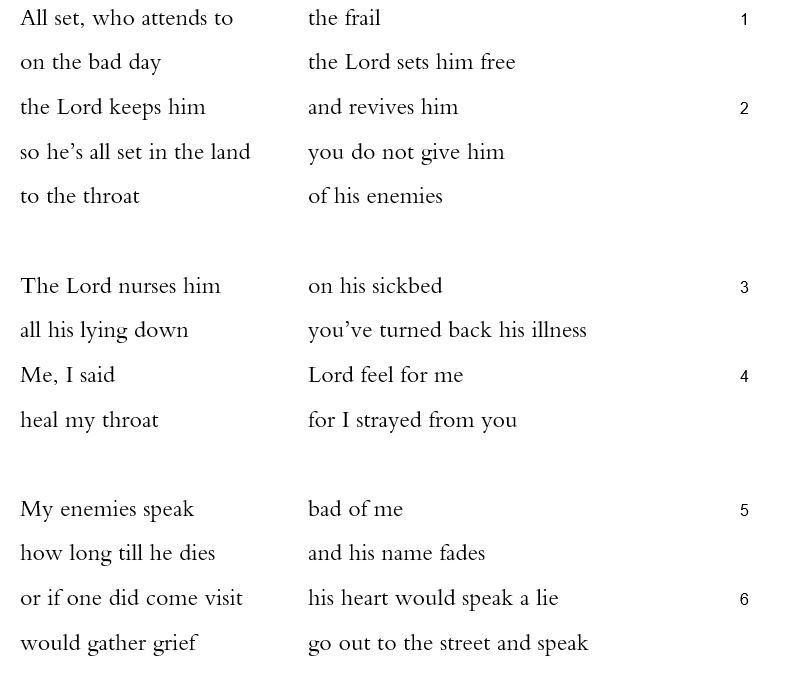
Psalm 41, the last psalm of the first section of Psalms, begins just as the first psalm did: ‘ashrei, “all set” (1:1, 41:1). Instead of simply opposing good and bad, however, the concluding psalm of this collection opposes sickness and health, good nursing of the sick versus terrible bedside manners.
The one who’s “all set,” blessed and happy both, is someone “who attends to | the frail” (1). This consideration for the weak aligns him with the Lord, who “nurses him | on his sickbed” (3). The repeated masculine pronouns blur the characters and types: the Lord, the sick one, the caregiver, and even, in verse 6, an enemy whose “heart would speak a lie” (6). The blurring amplifies the Lord’s role, divine care: “the Lord sets him free / the Lord keeps him | and revives him / so he’s all set in the land” (1-2). Who is this who is all set? “The frail” one? Or whoever looks after the frail one? By verse 3, all the blurring pays off, when the Lord’s own caring “on his sickbed” means healing the sick, present continuous, as well as healing, future tense, the one who has attended the sick.
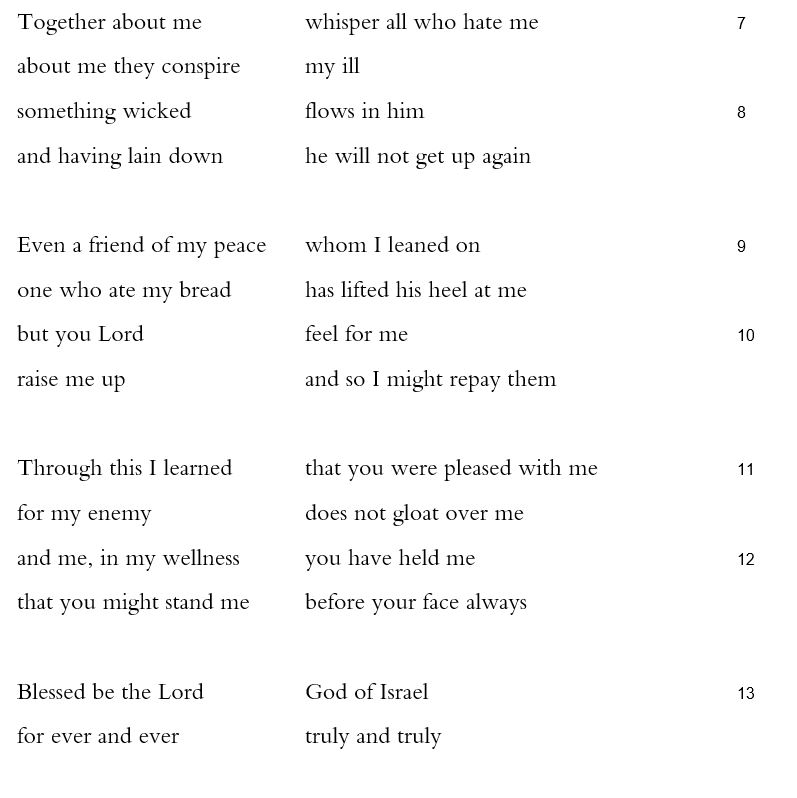
From its third-person overview, the psalm turns to first-person narration. It remains in first person for the rest of the psalm, verses 4-12. We learn that what makes the speaker’s enemies bad is not some immoral essence, but specific acts and failures. They “speak | bad of me” (5). They “speak a lie” beside the sickbed. And then they speak differently out in the streets (6), as they “whisper” and “conspire” (7).
Not even this speech of the enemies is simplistic. It starts by wondering “how long till he dies | and his name fades” (5). It ends with the wishful lie that “having lain down | he [the sick person] will not get up again” (8). But in between, in an imagined scene, the enemies’ speech transforms: “or if one did come visit | his heart would speak a lie / would gather grief” (6).
The syntax of that verse erupts with meaning. Does the heart speak? Does it gather grief? Does it do both? Or is it the visitor who gathers grief—or trouble—to himself, or does trouble gather him? Either way, this visitor with a deceptive heart heads to the streets and spreads lies: “something wicked | flows in him” (8). The line is a quotation, the liar publicly blaming the victim. But it works, too, as a characterization of the liar, one made even more incisive by the repeated use of the root word for speech in the word “something.”
Add to all of this slander the personal betrayal by a close friend, literally “a friend of my peace,” and the whole experience cuts deep. Verse 9 is particularly poignant: “one who ate my bread | has lifted his heel at me.” The lifting of a heel signals the actively passive act of walking away. It contrasts sharply with the Lord’s compassion and pity in verse 10: “feel for me / and raise me up | so that I might repay them.” The same word, shalom, marks both the friend and the root of the verb “repay.” It’s profoundly ambivalent: the repayment of peace for unkindness, the repayment of what’s deserved for unkindness. The peace that the friend of peace should have had—it comes back with a vengeance.
The final stanza, verses 11 and 12 (verse 13 is actually the benediction formula for each of the five collections of the book of Psalms), provides a fitting end for both the psalm and the first collection of psalms, Pss 1-41. The enemy no longer gloats. The Lord is pleased. And as for the speaker, “and me, in my wellness | you have held me / that you might stand me | before your face always.” Healing and reconciliation are achieved. There is a gesture of upholding, and of being-stood. All of these resolve both the specifics of this narrative and many themes of the first collection.
My name is Mark Minster. I’m an English and Comparative Literature professor with a background in ministry and in poetry. I teach courses on writing, reading, religion, and nature.
So much of the Bible—of every scripture, indeed of all art—is revisionary. Texts make sense of other texts, making meaning by difference. This psalm begins as praise but it becomes something else, “a new song” (3).
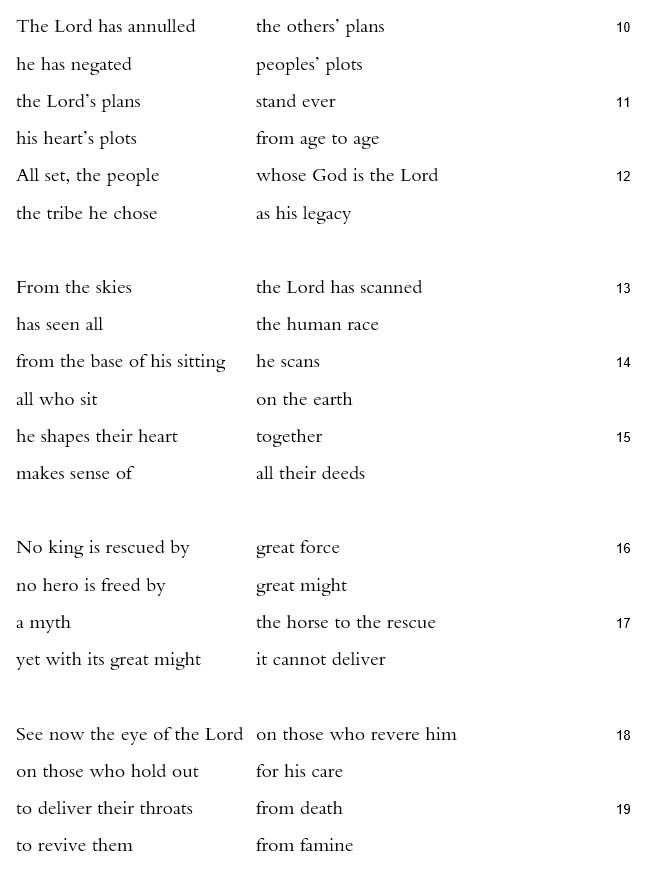
The first stanza conveys typical images of a laudatory psalm: “thank the Lord | with the lyre / with the ten-string | strum to him” (2). Melody and volume are encouraged twice. “A hymn is lovely” and “play nimbly” suggest craft, while “Shout” and “loud noise” imply gusto (1, 3). But the crucial terms are “a new song” and those who are singing and shouting and playing: the just (tsaddiqim), and the plumb or level or upright (yesharim) (1). These last two terms, frequently paired, convey alignment on two different axes. “Justice” is the horizontal fairness of the balance scales, while “uprightness” is the moral upstanding of the vertically plumb. The terms return in verses 4 and 5, interlaced with two other frequently paired terms, which are mappable on the same axes: the vertical emunah (4) and the arguably horizontal, arguably vertical chesed (5), the first based on firmly planted pillars, the second on a relationship of care.
It’s that care that this new song privileges. The morally upright are on the level because the word and work of the Lord are rooted sure and true. But the stanza emphasizes “the care of the Lord,” which fills the whole earth (5). Not just the stanza, either. The whole psalm culminates with chesed: “Let your care Lord | be upon us / just as we have held out | for you” (22). The very eye of the Lord is not only on “those who revere on him,” but on those “who hold out | for his care” (18).
What makes the song new is clear from its allusions to Psalm 1 and to Psalm 18. Like the first psalm, Psalm 33 describes who is “all set” based on where they sit and where they stand. Instead of the singular, “All set, she who” of Psalm 1, we have the plural, “All set, the people | whose God is the Lord” (12). Yet instead of standing and sitting being associated with the troubled and the wrong, as they are there, here sitting and standing convey rootedness on both the horizontal and the vertical: “All the earth | reveres the Lord / they stand amazed by him | all who sit in the world” (8). And why? Because he spoke and commanded, and “so it stood” (9); the Lord’s plans “stand forever” (11). In case the two axes aren’t clear, note how the Lord sees “from the base of his sitting… all who sit | on the earth” (14). The verticality is insistent. The horizontal is subtle. Unlike the older songs, the moral lesson is not for the lone individual, but for “all”— all the earth, all who sit, “all | the human race.”
To the same revisionary end, verse 13 calls to mind a different psalm, in which the Lord “from the skies | leaned down to see humans / to see if anyone’s smart… no one’s doing good” (14:2-3). Here, in Psalm 33, the Lord’s scanning leads to beautiful lines: “he shapes their heart | together/ makes sense of | all their deeds.” That’s not “no one doing good.”
To Psalm 18, which pairs cosmic history with the bellicose sanctioning of the king, Psalm 33 has a separate, related reply. Complementing a series of allusions to God’s creation in verses 6-9, verses 16 and 17 present a king who is not clothed in might. The statement is profoundly anti-militaristic.
No king is rescued by great force
no hero is freed by great might
a myth the horse to the rescue
yet with its great might it cannot deliver
Rescue is not smashing enemies’ teeth or making migrants cower at the borders. Psalm 33 supplants force with care.
*
33:1 you just… the plumb These two terms for the Lord’s devotees are explicitly paired. The verse moves from the immediacy of second-person plural address to a broader characterization in the third-person plural. But both moments emphasis the worshippers’ rectitude and propriety, drawing attention to their virtue.
33:2 with the ten-string Lit., “with a harp of ten”
33:5 of the care of the Lord This object phrase is emphasized because it precedes verb and subject (“the earth is full”). At the same time, the Lord’s care momentarily feels like an extension of the description of the Lord in the first half of the verse, “who loves the just | and the right.”
33:7 in the cellars The fanciful expression captures the underground location of “the deeps” as well as the actions of amassing and storing for later.
33:8-9 they stand amazed… all who sit… and so it stood The verb yaguru is the word for sojourning, but also for fear and amazement (cf. Ps. 22:23, where, as here, it parallels yira’). Because sitting and standing both imply dwelling, there’s a curious texture to this stanza. It literally describes the erecting of order out of the chaos of verses 6 and 7. At the same time, it moves from verbs for settling migration to settlement to rooting.
33:10 the others’ plans… peoples’ plots These possessive constructions pair common synonyms for intentions (the nuclei of the genitive phrases) and common synonyms for other ethnic and cultural groups (the modifiers). While sometimes the Israelites are included among the goyim (usually rendered as “the nations”), more often the term refers to peoples other than the Israelites, hence “the others.”
My name is Mark Minster. I’m an English and Comparative Literature professor with a background in ministry and in poetry. I teach courses on writing, reading, religion, and nature.
It is more wish than insight to call the whole of Psalms “great poetry.” I mean no disrespect. For their people and purposes, psalms are after more than power and precision or beauty and delight, more than the cleansing of perception. Reading the psalms may be an aesthetic and epistemological experience, but it is also an ethical act of participation and pragmatics—what one does with what one reads and recites. The Twenty-Third Psalm is all of these. Not just the most widely read and repeated of psalms, it may be the most tightly strung and it is certainly the most resonant. To use R.P. Blackmur’s terms, Psalm 23 is both buoyant and moored. Stretched on its canvas around a single conceit, it paints a kind of pastoral in which what matters is not the hick shepherd’s distance from urbanity, but the sheep’s proximity to both terror and care. There is politics in the country as well.
It’s a love poem between species, a love poem despite the unequal relationship. It begins in a bower, follows a walk, imagines a meal, and all throughout it overflows: “he lays me,” “he refreshes me,” “he revives| guides me” (2-3); “your crook and staff | still me,” “you set me a table” (4-5). Their love differs, the speaker’s from the beloved’s. The shepherd is attendant, all provision, full of “sweetness and care” (6). The sheep is dependent, made less of need than desire, led by the icons of masculinity and power, “your crook and staff.” Together, in the sheep’s imagination, they end by entering the shepherd’s house.
In the center of the psalm, while the sheep stays in the first-person, the Lord moves from “he” to “you.” This shift of person is common in Hebrew poems, and notes increasing intimacy (e.g., “Let him kiss me… for your kisses are sweeter than wine,” Songs 1:1). It’s the very center of this poem, the seventh of thirteen lines: “I fear no ill | when you are with me” (4b). In the original, there is such music and depth. Lo i’ra r`a means “I do not fear bad,” but its last two of four syllables sound like an echo—we are in a valley, after all—even as they actually do echo the syllables that start the psalm: YHWH ro`i, the Lord my shepherd. The word shepherd (ro`eh), the word friend (rei`ah), the word bad (r`a), the word fear (yir’ah), which also means reverence—all play off one another. “When you are with me” is also “for you are with me,” which sounds confident, and “if you are with me,” which registers doubt. Because there’s no copula in Hebrew, the phrase is just ki + ettah + immadi. When/For/If/Oh-how. You. With me.
The psalm’s popularity must have something to do with the simplicity of its claim, its abundant evidence of abundance, and with how lightly it wears its piety. Two of the Bible’s most important theological themes are here in tsedeq and chesed, justice (in the adjective form) and care. They are not hidden, either: “on tracks just right” and “Oh sweetness and care” show up near the culmination of each of the poem’s halves (3b, 6a). Yet both are completely integrated into the psalm’s motion, the sheep walking justly, evenly, in alignment, both caring and cared for, followed by the shepherd, who leads from behind, showing care. It’s how they walk the paths together, stopping together to eat and to drink, that joins justice and care with feeling full.
*
23:1 The Lord my shepherd | I’m not deprived The line is four words in eight syllables—nine if you substitute “Adonai” for “the Lord.” It’s usually translated as two independent clauses: “The Lord is my shepherd. I shall not want.” So rhythmic and potent, this translation bears the weight of time. But the line can also be parsed as an absolute phrase, noun + participle, followed by an independent clause, or even as direct address. That is, “The Lord being my shepherd, I have no needs.” Or, “Oh, Lord my shepherd, I don’t lack anything.”
23:2 by hushed waters | refreshes me Very literally, and roughly, “over the waters of stillness he watering-holes me.” The verb does very specific detail work by referring to the herder’s care of guiding to watering places. The adjective, for its part, does double-duty, conveying both quiet contentment and refreshment. Here, a dynamic approach is better than a formal one.
23:3 my throat he restores Doubtless some air-conditioned readers, expecting “soul,” feel let down by “throat.” Not sure how a soul can be restored without a drink of water. The nefesh is not some separable essence in the book of Psalms.
23:3 on tracks just right | it’s who he is Possibly the freest translation in this entire book of Psalms. Literally, the second (roughly) half of Psalm 23:3 has “in the encircling tracks of justice on account of his name,” a hideous mouthful. “The paths of righteousness” is relatively literal, but ironically it’s too allegorical. Hebrew idiom puts nouns in a genitive relationship (“in construct”) often to make the second, possessing noun modify the first: “the righteous paths.” “Tracks just right” emphasizes first the literal tracks and then their rightness, as does the original. As for the last two words, lema`an shemo, “for the sake of his name,” they are idiomatic for God’s being true to form, upholding a reputation and identity. “It’s who he is”: an idiom for an idiom.
23:4 the death-shade vale The word tsalmavet is also a portmanteau: “shade” plus “death.” It’s so much more taut in Hebrew than the beautiful, too-beautiful “valley of the shadow of death.”
23:6 Oh sweetness and care | chase me Instead of, say, being stalked by lions. The line is half-declaration, half-hope.
My name is Mark Minster. I’m an English and Comparative Literature professor with a background in ministry and in poetry. I teach courses on writing, reading, religion, and nature.





 The Book of Psalms