(lyric, of David)
* * *
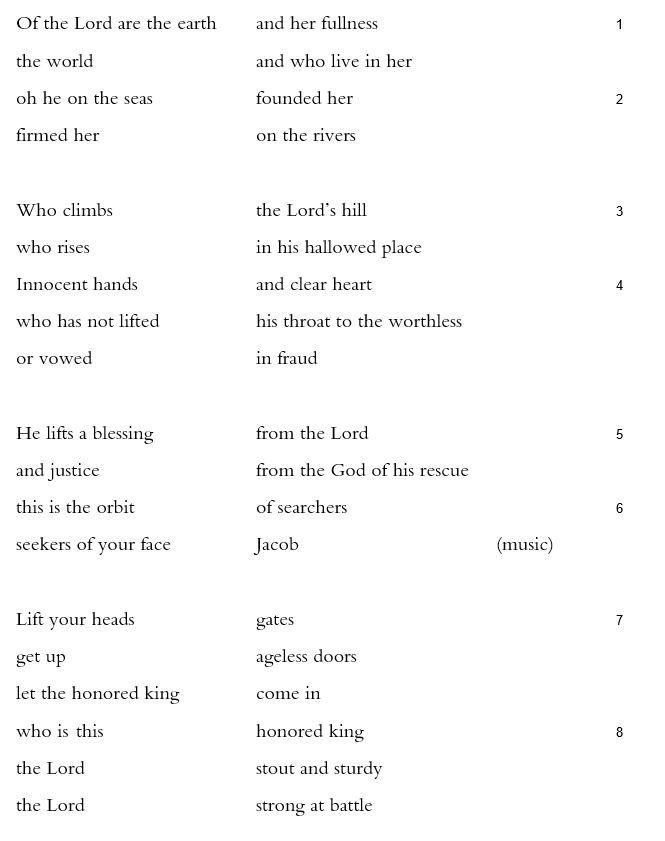
A reader is a seismograph, marking tremors of experience. “Who climbs | the Lord’s hill / who rises | in his hallowed place.” When we read this near the beginning of Psalm 24, we register familiarity (24:3). Attentive, we remember the questions that started Psalm 15: “Lord, who camps | in your tent / who lives on your hallowed hill” (15:1). Hearing that “who” chime twice, we observe how close the nouns are. Lord…your tent. Your hallowed hill. The Lord’s hill. His hallowed place. We tick and sequence the verbs: “camps,” “lives,” “climbs,” “rises.” From a sound that repeats, we link what’s new with what’s known and make a note.
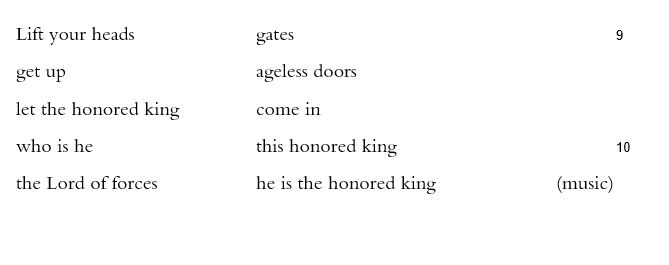
A reader is also a seismologist. She reads her own seismographs, circling patterns, noting anomalies. Psalm 24 asks “who” twice more: “who is | this honored king” and “who is he this | honored king” (8, 10). Four times, this psalm asks who. Two times the question concerns a person, a pilgrim to Jerusalem, a devotee; two times it concerns the Lord. We scan our graphs and see a pattern, way back in Psalm 18: “but who is the god | except the Lord / who is a rock | save our God” (18:31). Our camera zooms out to the whole unit, Psalms 15-24: eight times, this asking who. Twice of a person, twice of God, twice of a person, twice of God. Our index finger on our perforated accordion-fold printouts, scrolling between the first four and last four of those psalms, we find Psalm 19:12: “Failures— | who could perceive them? / of hidden things | acquit me….” A ninth “who”?
Zoom in. The word “acquit” there in Psalm 19:12, near the center of the Psalm 15-24 collection of psalms, is followed in Psalm 19:13 by the related verb “to be innocent”:
of hidden things acquit me
of arrogances spare your servant
may they not rule me then I will be whole
will be innocent of great crime
Twice in the verb form (naqah), innocence shows up in the middle of this larger unit of psalms. Zoom back. Does it appear elsewhere in Psalms 15-24? Yes! As a nominalized adjective, twice. It’s in Psalm 15:5 as the tenth and final trait of the person who is the answer to “who”: “a bribe against the innocent |she never took.” And it’s in Psalm 24:4, as the first trait of the person who’s the answer to “who.” Who climbs the Lord’s hill? “Innocent hands | and clear heart / who has not lifted his throat to the worthless.”
From here, reader, we can choose. There are many connections and patterns to catalog: the heart in Psalm 15:2, 19:8, 19:14, and 24:4; the word kavod, “honor” (or “heft” or “weight”) once in 15:4, and five times in 24 (24:7, 8, 9, 10 [x2]); the word qadosh, “hallowed,” in 15:1 and 24:3. Maybe most interesting in this list is the verb ns’a, “to lift,” which appears in 15:3 (“never lifted/brought shame”) and again in 24:4, 5, 7, 9. It’s a motif, really, in Psalm 24, the lifting of the head of the gates in verses 7 and 9, which matches the lifting of the blessing/gift in verse 5.
Instead of cataloging, at any point we can pause to ask the psalms we’re reading, why? Why ask questions about who qualifies to enter the sanctuary? Given the prompt and lengthy answers, the psalms’ questions seem rhetorical. And yet, what then are we to make of the “who” question in Psalm 19:12, centered between Psalms 15 and 24: “Failures— who could perceive them? / hidden things.” After—and before— all these character traits, what are these hidden things, these failures?
And why pair these questions about an ideal person with questions about God, who God is? These questions seem less rhetorical and more performative. Knowing the answer, we point: “this honored king,” “this honored king” (24:8,10). And we name: The Lord, three times: “stout and study… strong at battle… the Lord of forces.” Why?
Is the psalm a vertical map, the innocent at one pole, the Lord at the other? Or is the sweep of ten psalms a horizontal experience, temporal as well as spatial, a journey from outside the sanctuary to within? Or is there something else inside this particular psalm, pointed to by the “this” at its center, which could serve as a motto for our acts of attention: “this is the orbit | of searchers / seekers of your face | Jacob” (24:6). Does Jacob name the people of Israel? Or is it a figure for the Lord, “the God of Jacob”? Given all the parallel interrogatory questions “who,” how could the answer not be both? Both the face of the people and the face of God?
*
24:1 Of the Lord are the earth | and her fullness Both the word for “earth” or “land” (ha’arets) and its synonym “world” (tebel) are grammatically feminine. As with “of David” in the psalm’s superscription, the inseparable preposition l- in “of the Lord” can indicate possession or origin or direction.
24:3 Who climbs “Who” in Hebrew is nearly always a question rather than a relative pronoun, but the question can be rhetorical, so there is no need for interrogative punctuation here.
24:4 his throat to the worthless “The worthless” may imply emblems of other deities, as the word shav’ does in Jeremiah 18:15, or it may allude to the prohibition on “bearing false witness” in the Decalogue (Exod 20:7 x2, 23:1; Deut 5:11 x2, 5:20). The complete verse reads like a midrash on the commandment, mapping out honesty, integrity, and ritual and legal propriety from hands and heart to an injunction against perjury and hypocrisy, rather than a ban on taking any oaths at all or naming God.
24:6 this is the orbit… Jacob The word dor is virtually always temporal in the Hebrew Bible: “age” or “generation” (Isa 38:12 and 53:8 may or may not be exceptions; see Ps 14:5, “cohort”). But, as in the Latin passus or the English “pace” or, more closely, the Arabic word dawr, a temporal word can easily be a spatial word as well. If, as Benjamin Sommer has argued persuasively, this psalm— or whole series of psalms— shows evidence of having been part of a ritual procession, then both the “this” and the “orbit” take on practical significance, as does the double-duty term “Jacob,” a metonym for both the people and their God. See the too-modestly titled “A Commentary on Psalm 24,” Gazing on the Deep: Ancient Near Eastern, Biblical, and Jewish Studies in Honor of Tzvi Abusch, eds. Jeffrey Stackert, Barbara Nevling Porter, and David P. Wright (Bethesda, Md.: CDL Press, 2010), 495-515.
24:8 Who is this See the introductory note above. The most famous mi-zeh construction in the Bible is probably God’s question to Job from the tempest: “who is this who darkens advice with speech without knowing” (Job 38:2, misquoted by Job in 42:3). Note that the mi-zeh returns immediately in Psalm 25:12, where it may mark an inclusion with Psalm 34:12.
24:10 the Lord of forces The word tseba’ot has often been taken to be part of an epithet referring to the Lord in battle gear, the Lord of “hosts” or “armies.” Others read the term as a marker of majesty. It makes sense to preserve possibilities.


 The Book of Psalms