(director, to “the hushed dove of far away,” in stone, of David when the Philistines snatched him in Gath)

* * *
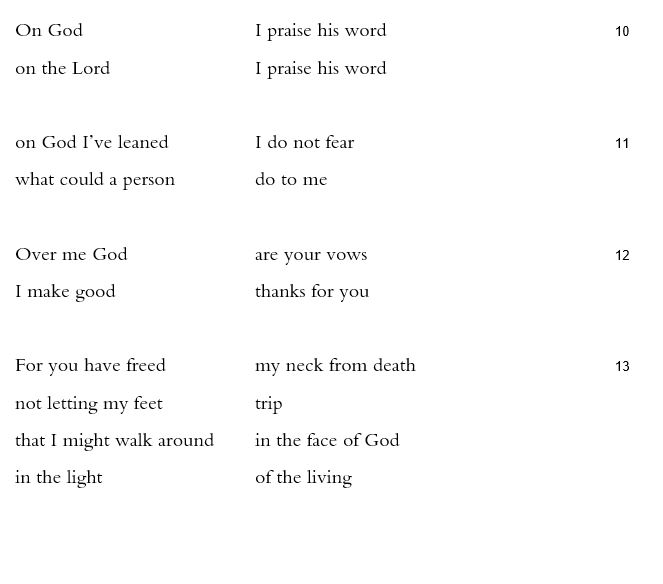
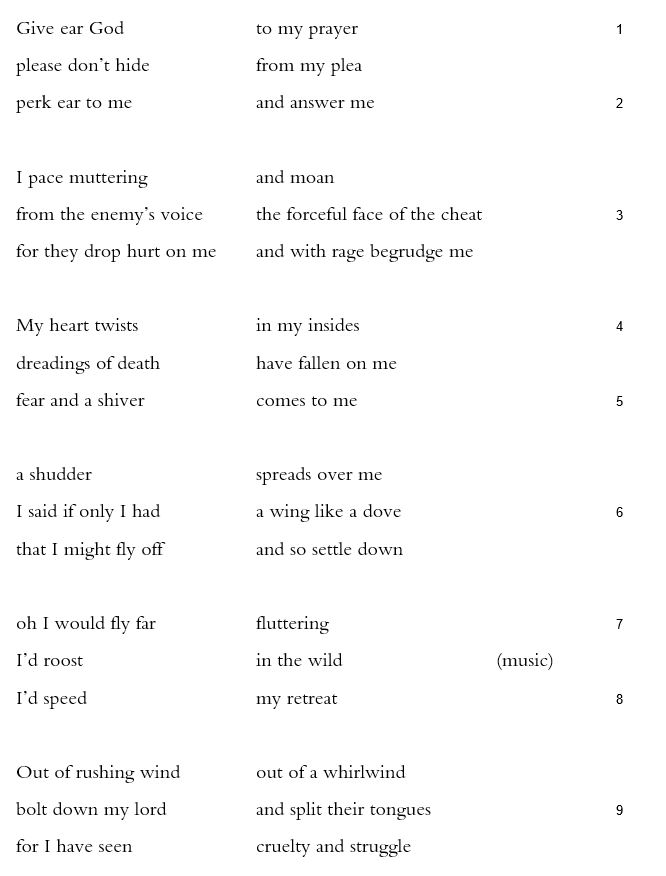
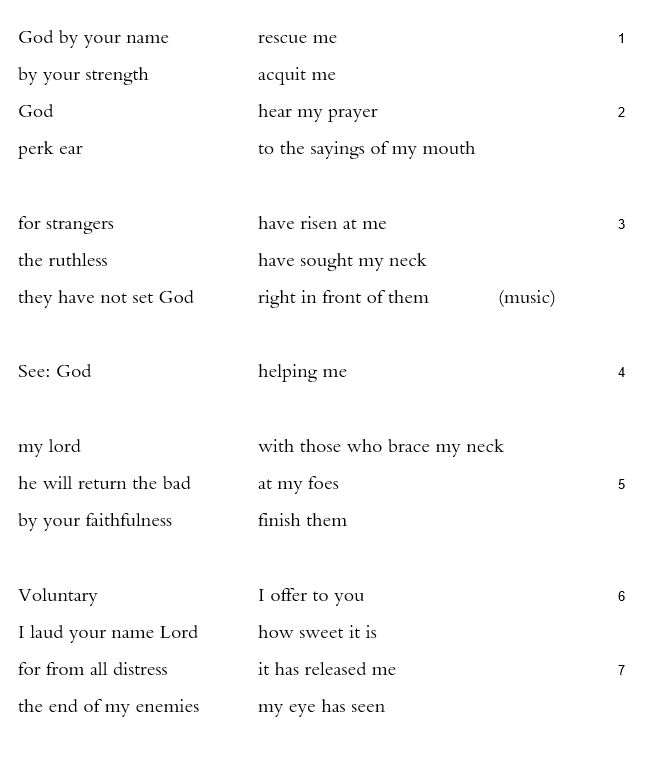
Though not the most original of psalms, Psalm 56 has interesting shape. Stanzas that beg for personal intervention and rescue from enemies are met with refrains that show confidence. The refrains in 3-4 and 10-11 share language and imagery. They both feature the leaning-on of the verb betach, the phrase “on God” (4a, 4b, 10a, 11a), and the statement/question “I do not fear / what could a person | do to me” (11; 4 has “a body” for “a person”). These refrains punctuate the psalm, setting off the opening and closing verses as narrative problem (1-2) and solution (13) while framing the narrative stanzas between (5-6 and 8-9).
At the center stands verse 7, which pairs the people’s wrong with God’s wrath. The concentric shape is tight, uneven only in verse 12, which like a musical bridge links chorus and verse: “Over me God | are your vows / I pay back | thanks for you” (12).
Two of the psalm’s moments are worth special attention. The first appears in the paratext, the superscription, that phrase that seems like it must have been the title of a tune, “the hushed dove of far away.” There’s the lyricism of the words themselves, such a lovely ache, the two long O sounds in yonat eilem rechoqim— and especially that second O, between the two guttural consonants ch and q, in the word for “far away.” And then there’s the fact that an ancient melody has been lost: music we don’t have, witnessed by lyrics we do. And then there’s our wondering about the poignant combination of silence and distance. Has the dove gone quiet because it’s gone away, or was it quiet already as it went?
In the poem itself, the movement from verse 8 to verse 9 is also touching:
My grief you have tallied | oh put my tears in your bottle
are they not | in your book
when my enemies turn back | then I will call
The word “grief,” nod, sounds like the word “bottle,” n’od. The two words literally enclose that first line, verse 8a, all the grief, all the tears, counted and captured in a bottle. Verse 8b has the quality of all questions in the negative, with some percent confidence, some measures of hope, of fear. Most powerful, however, is that after this mention of a book, a scroll in which all of the speaker’s suffering is recorded, there is that word “call,” which in Hebrew also means “read” (qar’a). Only after the enemies have turned back will the speaker be ready to read, to recite aloud a litany of sorrow.




 The Book of Psalms