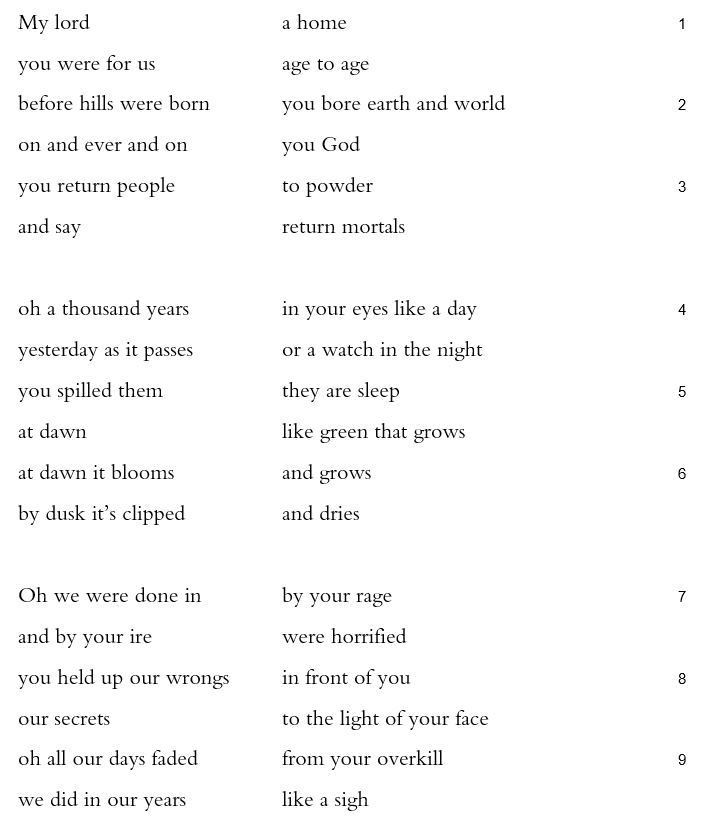
Ascribing Psalm 90 to Moses accentuates— or invents— its archaic feel. The psalm’s abiding interest in timelessness and transience comes to seem ancient, its voice and wisdom instructive, authoritative. More pointedly, however, the name of Moses invites readers to attend closely to the language of flooding, passing over, and the face-to-face imagery, all of which recreate a story of emancipation.
Curiously, this psalm so focused on ephemerality begins by invoking space. The first line nestles the word ma’on, a place to live, habitat, between “my lord” and “you,” before nesting “for us” between “you were” and “age to age.” The first two stanzas look to the ground, “the hills,” “earth and world” (2), “powder,” “mortals” (literally, “children of the soil”; 3), and “green that grows” only to be mown (5-6). But the rest of the poem is rootless, absent of places, an array of expressions for time, from “age to age” and “on and ever and on” (1, 2) to “how long” and “all our days” (13, 14). Four times, “years” and “days”/“day” are paired (4, 9, 10, 15), contrasting how God views time— “oh a thousand years | in your eyes like a day” (4)— with how humans view it— “like the days you hurts us/ the years | that we saw bad / let be seen by your servants | your doing” (15-16). God’s eyes shrink the years to a day. The eyes of human suffering instead see days stretching out to years. Here at the end of verse 15, “bad” (ra`ah) is lodged between two verbs for sight (ra’ah). Earlier, in verse 10, “the days of our years | seventy years” stretch to eighty years before being revealed as “trouble and harm” (10). Life is both too short and too long.
Within these competing conceptions of time, it’s easy to miss other repetitions and references to the Israelites’ journey from Egypt to the promised land. The root `eber has meanings that range from passing over (“yesterday as it passes,” 4; cf. “for I will pass over the land of Egypt” Exod 12:1) to an excess of wrath (“your overkill,” Ps 90:9, 11) to the word “Hebrew” itself, used seven times in the first two chapters of the book of Exodus. In Psalm 90’s second stanza, the passing of yesterday is followed by a loanword for flooding: “you spilled them” (5). The two uses of the word “overkill,” itself a kind of flooding, lie on either side of another loanword, gaz, “it is crossed” (10). Verse 14 presents saba`enu baboqer, “surfeit us | at dawn,” yet another kind of excess. Saba` is the root used memorably by Moses in the wilderness: “at dusk meat to eat and bread at dawn to surfeit” (Exod 16:8, cf. 16:12; note the repetition of “dusk” and “dawn,” cf. Ps 90:5-6). In Deuteronomy 6 and 8, Moses again uses the word to describe the promises of the land across the Jordan: “you will eat and you will be full” (Deut 6:11, 8:10, 12). As with so many biblical passages, the psalm reenacts the journey of liberation as a turning: God, who returns “people | to powder / and [says] | return mortals” (3), is asked to “return” and “feel sorry” (13). Even the image of God’s face involves a turning: the word “face,” panekha, in verse 8 is picked up in verse 9 by the verb panu, literally “they turn to face,” the idiom for the twilight failing of the light of day. The darkening of God’s face, the turning from day to night, the ending of one’s years, and the story of the forty years in the wilderness thus all are rhymed.
Three times, the psalm relies on a particular verbal ambiguity that results from the so-called vav-consecutive, a sequence of different verb forms: either a prefixed verb followed by a suffixed verb with a vav in front, or a suffixed verb followed by vav + a prefixed form. In terms of verb tense, the first sequence is imperfect/present followed by either the past/perfect tense or a second instance of the present tense. This construction appears twice in verse 6: “at dawn it blooms | and grows / by dusk it’s clipped | and dries.” The ambiguity means that the verse could also be rendered, “at dawn it blooms | and has grown / by dusk it’s clipped | and dried.” In verse 11, the second sequence appears: “oh it’s crossed fast / and we flit” could also end “and we flew.” In both cases, the effect underscores the transience of life: things grow and are grown all at once; life has been passed through quickly and quickly we fly and have flown. These routes of evanescence make one want to read Bishop’s “At the Fishhouses” again, or sing “I’ll Fly Away,” or kindle a candle in a medieval skull. Memento mori.
My name is Mark Minster. I’m an English and Comparative Literature professor with a background in ministry and in poetry. I teach courses on writing, reading, religion, and nature.
At two poles of interpretation, Psalm 81 is either a cohesive whole or disjointed pieces. Seeing it as unified, some scholars have argued that it must have part of an actual liturgical rite, actually recited at a specific time— the beginning of the month at the new moon, or the first of the year, or Passover. Others, doubtless bothered by its strange dialogical leaps, see Psalm 81 as at least two separate psalms, split in the middle of verse 5 and probably elsewhere as well. Some of these interpreters even perform reconstructive surgery with the most oblique lines, moving “Widen your mouth | I want to fill it,” for example, as if a different location might make more sense (10). Neither approach, however, fully appreciates the dark, associative wit of this psalm, its sardonic theology of a God ignored.
Aptly, this psalm that emphasizes God’s people’s failure to hear begins with their noise. The first stanza calls for typical sounds of praise, loud voices and a trio of instruments (1-2). The second stanza adds the ram’s horn to signal a special feast (3). The celebratory commotion is then commented on as the narrator says, “this is a rite… what’s right.. an edict,” tracing the festival back to Egypt (4-5b). And then, without warning, a first-person voice breaks into the ceremony. “I hear a tongue | I’ve never known,” says someone, though who is not clear (5c). It’s God’s voice from verse 6 through presumably the rest of the psalm, saying of Israel, “I have taken the load | off his shoulder.” So “I hear a tongue” might be God speaking. Or it might be someone speaking about God, and thus the line does double duty. If God here recalls meeting Israel “at his exit | from the land of Egypt,” then the “tongue | I’ve never known” emphasizes God’s encounter with his people’s language for the first time. Or if it’s a human speaker announcing the interruption of divine speech, then this hearing-without-knowing is exactly symptomatic of Israel’s problem. Both readings work; the psalm does not decide. Importantly, this line includes the psalm’s first use of the word “hear,” which will appear again four times, once as an imperative and three times as a counterfactual: “hear” (8); “I swear you won’t hear me,” ’im tishma` li, which looks like an oath formula, though it could could also mean “if you would hear me” (8); “and they did not hear,” velo’ sham`a (11), and “if only my people | hearing me,” lo `ammi shomei`a li (13). Despite, or because of, their festive music, the people don’t hear.
This voice that people don’t hear is layered with ambiguities and with deft movement. Verses 6, 7, and 16 rely— as does the entire passage from 11-14— on a shift from perfect-form verbs to imperfect-form verbs: e.g., “I have taken the load | off his shoulder / his grip on the basket passes over” (6). Imperfect verbs in biblical Hebrew can convey past action, but translations lose vital data when they leave out the shift. A load has just come off the people’s shoulder; their grip is still loosening. The people “called,” but God says, “I answer you… I try you” (7). In verse 8, God speaks legalese, though it is not certain whether he testifies or compels Israel to testify. “I want to take the stand with you,”ve’a`idah bekha, means both “I call to witness” and “I witness.” Having called to testimony, God says— or asks— ’im tishma` li, which means both “if (only) you (would) listen to me” and “that you won’t hear me,” the ’im a marker of an implied vow.
Through these layers are woven quotations. God’s speech is strewn with allusions and excerpts from passages the people should have heard. Verses 8 and 9 quote from the most important legal passages (’im tishma` li Ps. 81:8 = Exod 23:22; lo’ tishtachaveh Ps 81:9 = Exod 23:24, 34:14, and Deut 5:9). Many of the quotations are inexact. Verse 9’s line “there shall not be with you | any strange God,” lo-yihyeh bekha el zar is almost the more famous lo-yihyeh lekha elohim (Exod 20:3; Deut 5:7). Even God’s dramatic self-revelation on Sinai is quoted only partially verbatim: “I am the Lord | your God / lifting you up | from the land of Egypt.” “Lifting you up” is hama`alka (Deut 20:1) rather than ’asher hotsei’tika (Exod 20:2 = Deut 5:6, cf. Gen 15:7) What does this inexactness mean? Is it God’s point that hearing requires something other than exact recitation? Is it the psalmist actually misremembering crucial passages from Exodus and Deuteronomy, encouraging participants in a rite to take part in mishearing? Or is the misremembering purposive for some other reason? When, in verse 11, Israel “did not hear” and “did not agree,” the paired verbs shama` and ’abah call to mind both Pharaoh (Exod 7:13, 22; 8:15, 19; 9:12; and 10:27) and God (“But the Lord your God did not agree to listen” Deut 23:5). Verse 12, “so I sent them off | with their obstinate heart” also calls to mind both Pharaoh (whose own hard heart refuses to send off Israel) and God (bishrirut libbam echoes Deut 29:19, and more proximately Jer 7:24. Verse 13’s “if only” recalls both God’s complaint in the Song of Moses— “if only they were wise” (Deut 32:29)— and the people’s complaint in the wilderness: “if only we had died in the land of Egypt” (Num 14:2). Verse 16 also nearly quotes from the Song of Moses, both “sweet bits of wheat,” meicheilev chittah (cheilev kilyot hittah, Deut 32:14), and “honey from the cliff,” umitsur devash (devash missela` Deut 32:13). With all of these references, either God or the psalm is up to something, something less like liturgy and more like irony.
Fittingly, too, this psalm of allusive, ironic, layered divine speech spends its most curious verses on the figure of the mouth. The mouth is so important to both praise and complaint. It is the source of what must be listened to, a source of nourishment, and even of danger and death. Even stranger than the hearing of a language “I’ve never known” are the mouth-related line “Widen your mouth | I want to fill it” (10) and the psalm’s final verse, “He made him eat | sweet bits of wheat / and honey from the cliff | I want to satisfy you” (16). Both lines leap out of the texture of the psalm, distinct from what surrounds them. Both express divine desire, suggesting terror as well as tenderness. It is impossible to forget God’s response to complaints in the wilderness, literally stuffing people to death (Num 11), impossible to forget the lines on feeding from the Song of Moses:
He nourished him with honey from the rock
And with oil from the flinty crag
With curds and milk from herd and flock
And with fattened lambs and goats
With choice rams of Bashan
And the finest kernels of wheat (Deut 32:13-14)
The whole of that poem in Deuteronomy gets dark. The people forget this nourishment, which is richly ironic given that, “filled with food, they became heavy and fat” (32:15). They serve gods who eat the fat of sacrifices and drink poison wine (32:32, 38), which results in divine punishment, making arrows drunk on blood, his sword eats flesh (32:42).
But sure, the poem suggests. Play those instruments. Make noise.
My name is Mark Minster. I’m an English and Comparative Literature professor with a background in ministry and in poetry. I teach courses on writing, reading, religion, and nature.
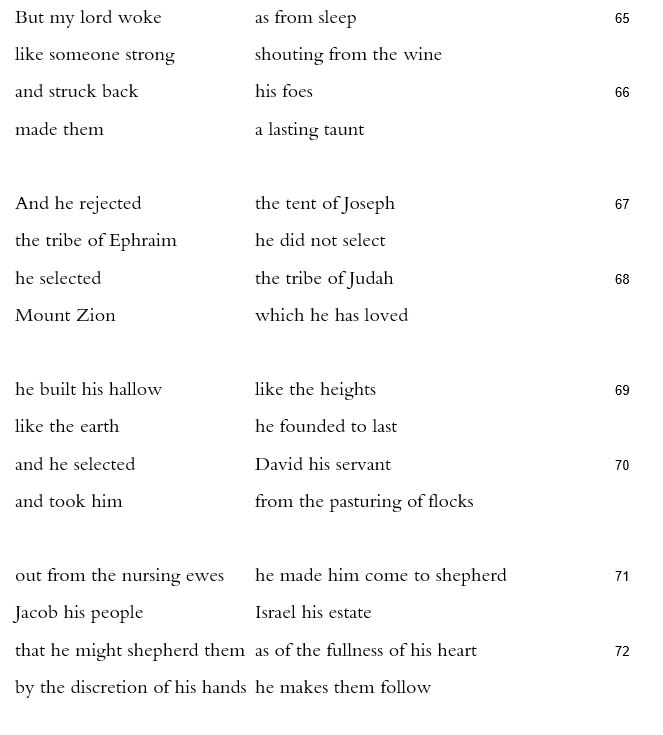
That Psalm 78 is a grand psalm concerned with history is clear. As always, we readers have to ask whose history, told how, told when and for whom, and to what ends? Every story does things as it chooses beginnings, middles, and ends. This story-psalm in particular chooses explicitly. It begins with a long reflection on the stories that parents tell their children (3-8) and ends (67-72) with the psalm’s ostensible point: “the tribe of Ephraim | he did not select / he selected | the tribe of Judah… and he selected | David his servant” ( 67b-68a, 70a). Its story of God’s selection is itself a highly selective history, tendentious and teleological, designed to explain how the lineage of Ephraim, traced back to Joseph and on back to Jacob/Israel, struggling so hard throughout the second half of the book of Genesis to win the blessing and the line of descent then came to lose that blessing, and how the northern tribes who claimed descent from Israel and Joseph and Ephraim lost everything.
It’s not at all clear when this psalm was written or to what extent it’s the product of major or minor revisions. In a 2017 essay called “Psalm 78: A Case Study in Redaction as Propaganda,” the biblical historian Oded Tammuz wrote,
“Suggestions on the date of the text include the united monarchy in the tenth century BCE, immediately after the division of the united monarchy, the divided kingdom, the eighth century BCE, between the fall of the northern kingdom (722 BCE) and the fall of Judah (586 BCE), the time of Hezekiah, the time of Josiah, the late preexilic period, the late exilic and postexilic period, the Second Temple period, and the Maccabean period” (206-207).
Tammuz himself goes on to argue for a specific date during the reign of Hezekiah. But his more defensible, more important point lies in this series of possible dates scholars have advanced. It covers the better part of a millennium, about as long as biblical Hebrew lasted as a living language. The point is not that every scholarly conjecture has equal merit, nor that none of them do— their work is fascinating and differentially valuable— but that the matter remains unknowable. Thinking otherwise perpetuates the tendentiousness of history and historiography.
More, the range of possible dates shows that the psalm’s explanation of God’s favoritism would have had contemporary relevance in so many historical moments over such a long period of time. “He abandoned the shrine | at Shiloh / a tent he had enshrined | for mortals” (60). Assuming this verse was always—or early— part of the psalm, as it is now, its explanation for the loss of a center of power justifies the centralization of worship and capital in Jerusalem any time from the reign of David on, in either the ark of the covenant or Solomon’s Temple or the Second Temple, and it accounts for the destruction of the northern kingdom before, during, and after the fall of Jerusalem, and it accords with strictly monotheistic practice and political satrapy. Centers are always making peripheries measure their distance.
The histories in this psalm—and there are several—are braided purposively. Psalm 78 opens with four-part sequence from “my direction” and “the words of my mouth” to “a parable” and “puzzles of old” (1-2). What kind of parallelism is this? A list of synonyms? A declension history, from what was perfectly clear, transmitted long ago, to a proliferation of riddles? The pronoun that starts verse 3, “which” (’asher), does not decide. Rather, a body of knowledge is similarly reduplicated, from “which we have heard | and we have known/ and our parents | have recounted for us” (3) to the “stele | in Jacob” and “directions | in Israel / which he commanded | our parents / for them to make known | to their children” (5). Knowing and retelling are not just doubled but tripled here: “we have known/ and our parents | have recounted for us… recounting praises…” (3-4); “he commanded our parents/ for them to make known | to their children/ so that the next age | might know… and recount | to their children” (5-6).
The threefold repetition of “parents” (literally, “fathers,” 3, 5, 8), “children” (literally, “sons,” 4, 5, 6), and “age” (dor, 4, 6, 8 x2) similarly emphasizes continuity over time, while the fourth use of “children” and “parents” is contrastive:
The children of Ephraim | armed and bearing bows
turned around | on the day of battle
they did not keep | God’s pact
and in his directions | they refused to walk
they forgot | his doings
and his marvels | which he had made them see
in front of their parents (9-12).
Whatever irresponsibility or cowardice is meant by the children of Ephraim’s “turn[ing] around | on the day of battle” (9), the backwards posture clearly opposes the marvels that were right “in front of their parents” which “he had made them see” (12,11)
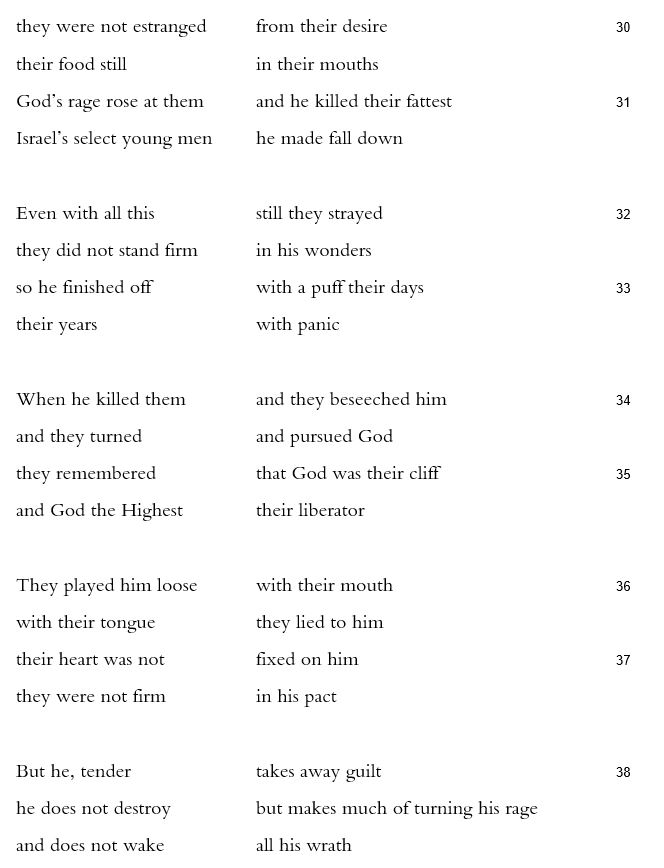
From Ephraim’s failure, set in the psalm’s more immediate past, the psalm turns to events from the story of the Exodus, set in the more distant past. In verses 13-20, the splitting of the sea and details from Exodus 13-17 are blended with each other and with authorial inventions—“can a god set a table | in the wilderness” (Ps 78:19) is not literally the Israelites’ question, for example. In verses 23-31, more details of the Exodus are added, mostly from Numbers 9-11, most of them concerning God’s raining down deluges of manna and quail, glutting the hungry wanderers to the point of killing many of them (Ps. 78:31, cf. Num 11:33-34). After two verses of summary (78:32-33) and the psalm’s central section 34-43, there are a third (43-57) and fourth historical section (60-66). The third section names seven plagues (44-51) before quickly leaping forty years ahead to “the edge of his hallow / this mountain | his right hand obtained” (54) to narrate a second generation’s rebellion: “they tested and made mutiny | at God the Highest… they recoiled and balked | like their parents” (56-57; cf. 17-18, 40-41). Just like the first and second sections, the third and fourth historical sections are punctuated by God’s anger and rejection: “The Lord heard | he was beside himself” (21); “God heard this | and was beside himself” (59).
Given that we cannot tell when the psalm was written, it is unclear what events the fourth historical section returns to. Verse 61 could refer to any number of conquests and exiles, Philistine, Assyrian, Babylonian, or Hellenistic occupiers: “He gave his strength | to captivity/ his finery | to the hand of the foe” (61). Again, “he was beside himself” (62). The openness of this description— “captivity”— even allows for a dark undoing of the Exodus itself, a return to Egypt and the death of “his select young men,” leading to the loss of marriage, the death of the priests, and the failure of mourning itself (63-64). It is unclear when “my lord woke… and struck back | his foes” (66), though the striking calls back verses 20, 51, God’s striking of the cliff, an interesting revision, and the striking down of the firstborn.
So much of the work of the psalm takes place not just in its allusions, but in the meticulous verbal forms and the extensive repetitions of particular keywords. Bechor, which literally means “selected,” refers to the young men in their prime killed twice in the psalm (31, 63). Bachar is the verbal form, which associates the deselection of Ephraim (67) and the selection of Judah, Zion (68), and David (70) with God’s killing of his own. Bekhor, the firstborn killed in Egypt (51), takes part in this wordplay, which calls to mind similar meaningful kenning in the story of Jacob, which turns on relevant questions of birthright (bekhorah) and blessing (berakhah). The verb nachah, “to guide,” appears three times in Psalm 78 in its causative stem, “to make follow”: God “made them follow | with the cloud by day/ and all night | by firelight” (14) and again God “made them follow close | so they did not fear / their enemies | the sea swept over” (53) and most significantly as the very last word of the poem, though it is unclear whether the subject is God or David, “by the discretion of his hands | he makes them follow” (72). Not in the causative stem, nachah also appears in the final line of Psalm 77, “You led your people | like a flock / by the hand of Moses | and Aaron” (77:20), which the ending of Psalm 78 clearly revises. Powerfully, with its third-person plural suffix, the word yanchem evokes the root word nacham, for “comfort.” It even picks up the word nachalah, the word for inheritance (55, 62).
So many verbs in Psalm 78 are in the causative stem, rendered in this translation wherever possible by the word “made,” used as a modal or as a helping verb. “He made rise a stele,” for instance, would be more succinct as “he raised a stele,” but at the cost of something significant. Causality is a key point of the poem. Choices, whether to remember or forget, whether to stand firm and follow or to swerve, have consequences, the most recent of which is God’s own choice to remove the blessing from Jacob and Ephraim to Judah, the selection of David.
Finally, like the psalms that precede it and like the story of Jacob it claims as an ancestor, Psalm 78 centers on the act of remembering. Twice “they remembered” is predicated of the people, though neither instance is ideal (35, 42). The first time, remembering only occurs as part of a sequence that begins “when he killed them” and is followed immediately by “they played him loose | with their mouth / with their tongue | they lied to him” (34, 360. The second time, their remembering is actually negated: “they have not remembered | his hand”—another callback to Psalm 77, where God’s hand is absent.
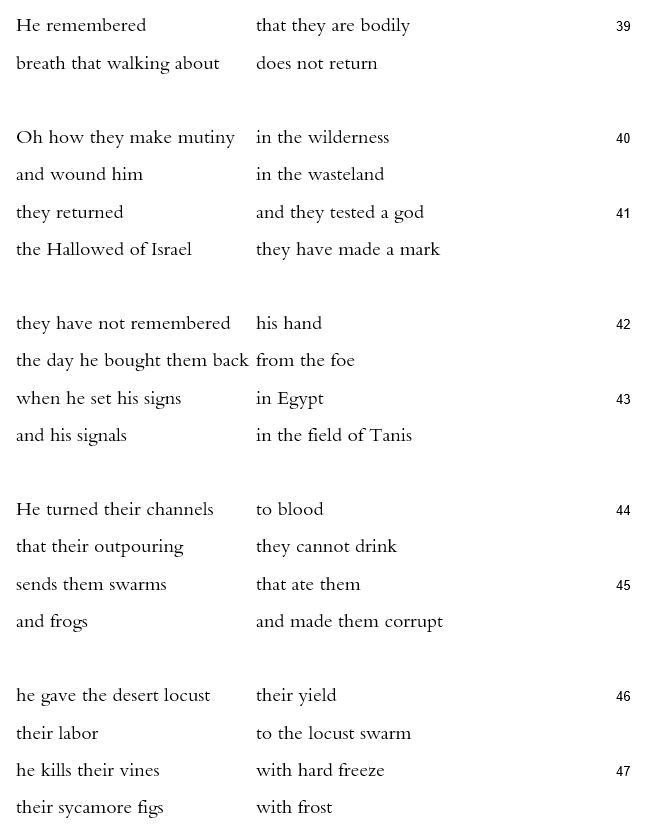
Between these two failed acts of remembrance, near the very center of Psalm 78, is God’s own remembering: “He remembered | that they are bodily / breath that walking about | does not return” (39). The vav-consecutive construction vayyizkor allows God’s remembering to be read as completed action, part of history, or to be read in conjunction with the two verses that flank it, as incomplete, ongoing, imperfective tense:
But he, tender | takes away guilt
he does not destroy | but makes much of turning his rage
and does not wake | all his wrath
He remembered | that they are bodily
breath that walking about | does not return
Oh how they make mutiny | in the wilderness
and wound him | in the wasteland
The word “remembered,” in other words, may also be “remembers,” continuous with his continuing tenderness (38) and being wounded (40). Whether these profound lines are in keeping with the rest of the psalm— that may be the parable or puzzle that’s hardest to solve.
My name is Mark Minster. I’m an English and Comparative Literature professor with a background in ministry and in poetry. I teach courses on writing, reading, religion, and nature.
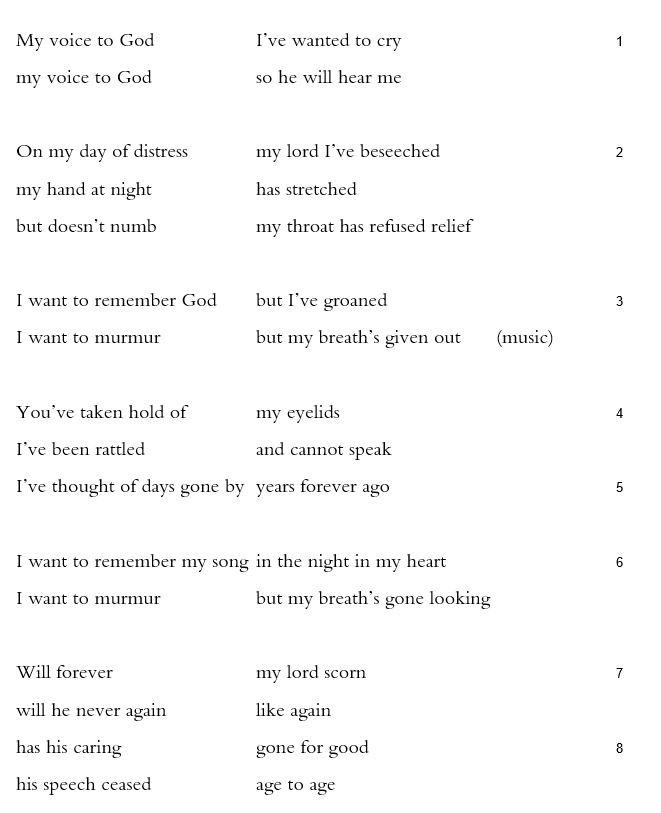
This is a sensational psalm. It is deft and layered, powerfully personal and embodied, and yet richly allusive. It transposes its first-person first half to a grand and mythic register. So much of the drama of the Asaph psalms that precede Psalm 77 is distilled here in the experience of a single speaker who wants. The cohortative mode, the “let me”/”may I” mode of wish, is crucial to the voice of the psalm. The speaker has wanted to cry out, but their body won’t let them. It won’t let them give up: “my hand at night | has stretched / but doesn’t numb | my throat has refused relief” (2); “You’ve taken hold of | my eyelids / I’ve been trembling | and cannot speak” (4).
Wants keep coming. “I want to remember,” the speaker says three times. “I want to remember God | but I’ve groaned” (3). “I want to remember my song | in the night in my heart” (6). Tellingly, right at the turn in the center of the psalm, the speaker says, “I remember | the works of Yah / oh I want to remember | your wonders gone by” (11). The desire to remember lingers even after the remembering itself. Wanting to remember keeps coming not because the speaker has forgotten, but because their desired remembering is an action, something that must be vocalized. After all, remembering in the psalm is always paired with “murmuring,” the verb used for low, meditative speech. “I want to murmur,” they say three times, twice pointing to a failure of breath: “I want to murmur | but my breath’s given out” (3); “I want to murmur | but my breath’s gone looking” (6). Murmuring, too, is at the psalm’s center:
I remember | the works of Yah
oh I want to remember | your wonders gone by
that I might mumble | all your work and your workmanship
I want to murmur God | in apartness your way
What began in verse 3 as the desire to remember God becomes in verses 12-13 the desire to murmur “God | in apartness your way.” The resolution is followed by the poem’s key question/exclamation: “Who is a god great as God | you the God who does wonders” (13-14, which are divided curiously in the Masoretic Text).
Only a few psalms earlier, it was God being asked to remember (74:2, 18, 22). Now, though God’s legendary interventions have been the subject of Psalm 74 (74:12-17), Psalm 75 (75:2-3), and nearly all of Psalm 76 (76:1-8), the speaker struggles to speak of this memory. The struggle to speak is caused by failing breath but also by God’s own silence, as verses 7-10 make clear: “has his caring | gone for good / his speech ceased | age to age” (8). The speaker’s own bodily discomfort comes from the absence of God’s body: “did he forget, God | how to feel / or shut in anger | his womb-love” (9). As always, the word for “compassion” names a part of the mother’s body, the womb, which is paired here as it is so many times, with the verb “shut.” God’s gone barren, perhaps—or the speaker just misses the womb. The speaker admits, “my sorrow is this / the sleeping right hand | of the Highest” (10). God’s sleeping hand contrasts with the speaker’s own hand, which was “stretched | but doesn’t numb” (2).
In the poem’s second half, the silence and absence of God are followed by memories. God’s arm is recalled as what ransomed “your people / the sons of Jacob | and Joseph” (15). God’s speech is recalled in deluge: “the voice of your thunder in the whirling | lightnings lit the world / the earth trembled | and it sways” (18). And, most enigmatically, hauntingly, God’s “way,” which the speaker had wanted to murmur in verse 13, is recalled as a pathway that waters erased: “by sea was your way | your winding by mighty waters / your footprints | were all unknown” (19). Did you miss God’s speech? Did you want God’s caring and womb-love, God’s tracks? These are they, the psalm says, such as they were. If it’s God’s hand you’re missing, consider this, the psalm concludes: “You led your people | like a flock / by the hand of Moses | and Aaron” (20).
The memorials of Jacob and Joseph and of Moses and Aaron are just the surface of the psalm’s allusions. The waters that erase footprints, together with the mention of clouds, the buying back of the people, all clearly gesture to the Exodus, as do close parallels between 77:13-14 and the Song of the Sea. Many scholars have cataloged these parallels and shown how they anticipate Psalms 78 and 81. But the waters and deeps of verses 16-19 allude not just to the crossing of the Reed Sea, but also the chaotic waters of creation (see also 74:12-17 and 75:3) and the story of Noah, all three of which are linked by inner-biblical reference, echo, and allusion. At the center of the story of Noah, attentive readers note, is God’s own remembering: “God remembered Noah” (Gen 8:1). Similarly, at the center of the cycle of Jacob stories, God remembers: “God remembered Rachel and God heard her and opened her womb” (Gen 30:22). This moment, too, is recalled by Psalm 77, which mentions Joseph and Jacob’s sons, and centers remembrance, and worries that a womb has shut.
Those stories of Jacob and his son Joseph are significant to this psalm as well. In verse 2, three words in a row allude to these two. The only biblical character to be “numb” (tapug) is Jacob, when he finds out Joseph is still alive (Gen 45:26). The only character to “refuse relief” (ma’anah hinacheim) is also Jacob, when he is told that Joseph has been killed (vayma’ein lehitnacheim, Gen 37:35). Later, Jacob “refuses” Joseph while reversing the blessings of Joseph’s sons, preferring Ephraim (Gen 48:19; see also Ps 78:9ff, 78:67). These allusions pinpoint key moments of father-and-son intimacy that also touch on the generativity of the family line— not just the two characters themselves but their lineage, and importantly, the lineage at the end of Genesis, which leads to the captivity in Egypt at the beginning of the book of Exodus. Even the wordplay in verses 7 and 8— both yosif, “he will (not) do again,” and he’aseif, “has it gone,” link Joseph (both roots are used multiple times in Genesis 37 and 47) and Asaph in their sound clusters— reminds readers that Joseph’s hopeful story, itself a story of remembrance, may have been followed by the terrible oppression of Pharaoh, but it was followed, almost immediately, by the hands of Moses and Aaron.
My name is Mark Minster. I’m an English and Comparative Literature professor with a background in ministry and in poetry. I teach courses on writing, reading, religion, and nature.






 The Book of Psalms