(an Asaph didactic)




* * *
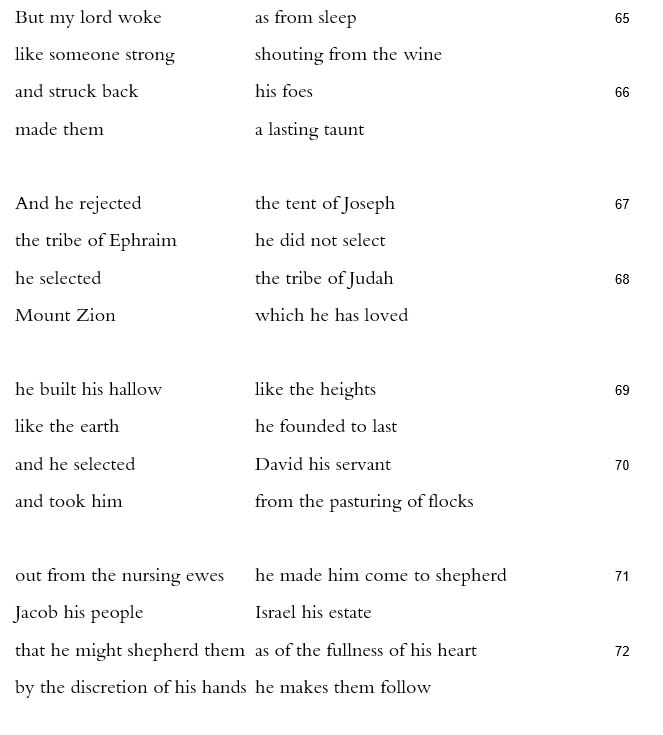
That Psalm 78 is a grand psalm concerned with history is clear. As always, we readers have to ask whose history, told how, told when and for whom, and to what ends? Every story does things as it chooses beginnings, middles, and ends. This story-psalm in particular chooses explicitly. It begins with a long reflection on the stories that parents tell their children (3-8) and ends (67-72) with the psalm’s ostensible point: “the tribe of Ephraim | he did not select / he selected | the tribe of Judah… and he selected | David his servant” ( 67b-68a, 70a). Its story of God’s selection is itself a highly selective history, tendentious and teleological, designed to explain how the lineage of Ephraim, traced back to Joseph and on back to Jacob/Israel, struggling so hard throughout the second half of the book of Genesis to win the blessing and the line of descent then came to lose that blessing, and how the northern tribes who claimed descent from Israel and Joseph and Ephraim lost everything.
It’s not at all clear when this psalm was written or to what extent it’s the product of major or minor revisions. In a 2017 essay called “Psalm 78: A Case Study in Redaction as Propaganda,” the biblical historian Oded Tammuz wrote,
“Suggestions on the date of the text include the united monarchy in the tenth century BCE, immediately after the division of the united monarchy, the divided kingdom, the eighth century BCE, between the fall of the northern kingdom (722 BCE) and the fall of Judah (586 BCE), the time of Hezekiah, the time of Josiah, the late preexilic period, the late exilic and postexilic period, the Second Temple period, and the Maccabean period” (206-207).
Tammuz himself goes on to argue for a specific date during the reign of Hezekiah. But his more defensible, more important point lies in this series of possible dates scholars have advanced. It covers the better part of a millennium, about as long as biblical Hebrew lasted as a living language. The point is not that every scholarly conjecture has equal merit, nor that none of them do— their work is fascinating and differentially valuable— but that the matter remains unknowable. Thinking otherwise perpetuates the tendentiousness of history and historiography.
More, the range of possible dates shows that the psalm’s explanation of God’s favoritism would have had contemporary relevance in so many historical moments over such a long period of time. “He abandoned the shrine | at Shiloh / a tent he had enshrined | for mortals” (60). Assuming this verse was always—or early— part of the psalm, as it is now, its explanation for the loss of a center of power justifies the centralization of worship and capital in Jerusalem any time from the reign of David on, in either the ark of the covenant or Solomon’s Temple or the Second Temple, and it accounts for the destruction of the northern kingdom before, during, and after the fall of Jerusalem, and it accords with strictly monotheistic practice and political satrapy. Centers are always making peripheries measure their distance.
The histories in this psalm—and there are several—are braided purposively. Psalm 78 opens with four-part sequence from “my direction” and “the words of my mouth” to “a parable” and “puzzles of old” (1-2). What kind of parallelism is this? A list of synonyms? A declension history, from what was perfectly clear, transmitted long ago, to a proliferation of riddles? The pronoun that starts verse 3, “which” (’asher), does not decide. Rather, a body of knowledge is similarly reduplicated, from “which we have heard | and we have known/ and our parents | have recounted for us” (3) to the “stele | in Jacob” and “directions | in Israel / which he commanded | our parents / for them to make known | to their children” (5). Knowing and retelling are not just doubled but tripled here: “we have known/ and our parents | have recounted for us… recounting praises…” (3-4); “he commanded our parents/ for them to make known | to their children/ so that the next age | might know… and recount | to their children” (5-6).
The threefold repetition of “parents” (literally, “fathers,” 3, 5, 8), “children” (literally, “sons,” 4, 5, 6), and “age” (dor, 4, 6, 8 x2) similarly emphasizes continuity over time, while the fourth use of “children” and “parents” is contrastive:
The children of Ephraim | armed and bearing bows
turned around | on the day of battle
they did not keep | God’s pact
and in his directions | they refused to walk
they forgot | his doings
and his marvels | which he had made them see
in front of their parents (9-12).
Whatever irresponsibility or cowardice is meant by the children of Ephraim’s “turn[ing] around | on the day of battle” (9), the backwards posture clearly opposes the marvels that were right “in front of their parents” which “he had made them see” (12,11)
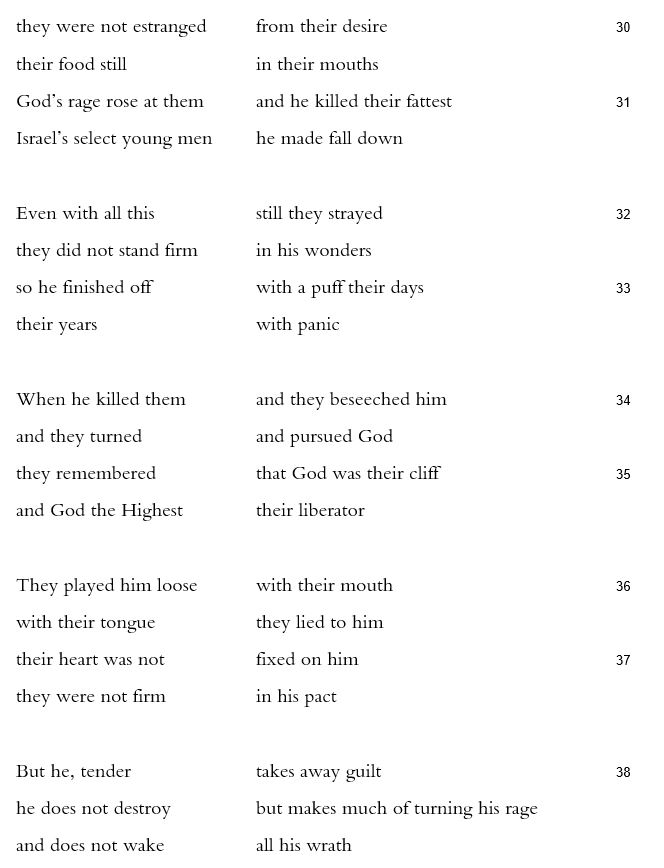
From Ephraim’s failure, set in the psalm’s more immediate past, the psalm turns to events from the story of the Exodus, set in the more distant past. In verses 13-20, the splitting of the sea and details from Exodus 13-17 are blended with each other and with authorial inventions—“can a god set a table | in the wilderness” (Ps 78:19) is not literally the Israelites’ question, for example. In verses 23-31, more details of the Exodus are added, mostly from Numbers 9-11, most of them concerning God’s raining down deluges of manna and quail, glutting the hungry wanderers to the point of killing many of them (Ps. 78:31, cf. Num 11:33-34). After two verses of summary (78:32-33) and the psalm’s central section 34-43, there are a third (43-57) and fourth historical section (60-66). The third section names seven plagues (44-51) before quickly leaping forty years ahead to “the edge of his hallow / this mountain | his right hand obtained” (54) to narrate a second generation’s rebellion: “they tested and made mutiny | at God the Highest… they recoiled and balked | like their parents” (56-57; cf. 17-18, 40-41). Just like the first and second sections, the third and fourth historical sections are punctuated by God’s anger and rejection: “The Lord heard | he was beside himself” (21); “God heard this | and was beside himself” (59).
Given that we cannot tell when the psalm was written, it is unclear what events the fourth historical section returns to. Verse 61 could refer to any number of conquests and exiles, Philistine, Assyrian, Babylonian, or Hellenistic occupiers: “He gave his strength | to captivity/ his finery | to the hand of the foe” (61). Again, “he was beside himself” (62). The openness of this description— “captivity”— even allows for a dark undoing of the Exodus itself, a return to Egypt and the death of “his select young men,” leading to the loss of marriage, the death of the priests, and the failure of mourning itself (63-64). It is unclear when “my lord woke… and struck back | his foes” (66), though the striking calls back verses 20, 51, God’s striking of the cliff, an interesting revision, and the striking down of the firstborn.
So much of the work of the psalm takes place not just in its allusions, but in the meticulous verbal forms and the extensive repetitions of particular keywords. Bechor, which literally means “selected,” refers to the young men in their prime killed twice in the psalm (31, 63). Bachar is the verbal form, which associates the deselection of Ephraim (67) and the selection of Judah, Zion (68), and David (70) with God’s killing of his own. Bekhor, the firstborn killed in Egypt (51), takes part in this wordplay, which calls to mind similar meaningful kenning in the story of Jacob, which turns on relevant questions of birthright (bekhorah) and blessing (berakhah). The verb nachah, “to guide,” appears three times in Psalm 78 in its causative stem, “to make follow”: God “made them follow | with the cloud by day/ and all night | by firelight” (14) and again God “made them follow close | so they did not fear / their enemies | the sea swept over” (53) and most significantly as the very last word of the poem, though it is unclear whether the subject is God or David, “by the discretion of his hands | he makes them follow” (72). Not in the causative stem, nachah also appears in the final line of Psalm 77, “You led your people | like a flock / by the hand of Moses | and Aaron” (77:20), which the ending of Psalm 78 clearly revises. Powerfully, with its third-person plural suffix, the word yanchem evokes the root word nacham, for “comfort.” It even picks up the word nachalah, the word for inheritance (55, 62).
So many verbs in Psalm 78 are in the causative stem, rendered in this translation wherever possible by the word “made,” used as a modal or as a helping verb. “He made rise a stele,” for instance, would be more succinct as “he raised a stele,” but at the cost of something significant. Causality is a key point of the poem. Choices, whether to remember or forget, whether to stand firm and follow or to swerve, have consequences, the most recent of which is God’s own choice to remove the blessing from Jacob and Ephraim to Judah, the selection of David.
Finally, like the psalms that precede it and like the story of Jacob it claims as an ancestor, Psalm 78 centers on the act of remembering. Twice “they remembered” is predicated of the people, though neither instance is ideal (35, 42). The first time, remembering only occurs as part of a sequence that begins “when he killed them” and is followed immediately by “they played him loose | with their mouth / with their tongue | they lied to him” (34, 360. The second time, their remembering is actually negated: “they have not remembered | his hand”—another callback to Psalm 77, where God’s hand is absent.
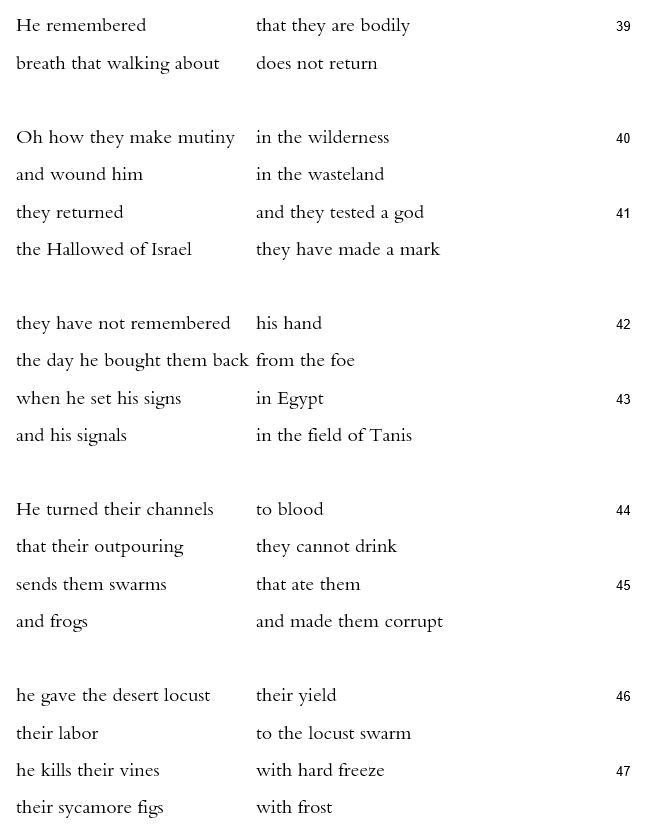
Between these two failed acts of remembrance, near the very center of Psalm 78, is God’s own remembering: “He remembered | that they are bodily / breath that walking about | does not return” (39). The vav-consecutive construction vayyizkor allows God’s remembering to be read as completed action, part of history, or to be read in conjunction with the two verses that flank it, as incomplete, ongoing, imperfective tense:
But he, tender | takes away guilt
he does not destroy | but makes much of turning his rage
and does not wake | all his wrath
He remembered | that they are bodily
breath that walking about | does not return
Oh how they make mutiny | in the wilderness
and wound him | in the wasteland
The word “remembered,” in other words, may also be “remembers,” continuous with his continuing tenderness (38) and being wounded (40). Whether these profound lines are in keeping with the rest of the psalm— that may be the parable or puzzle that’s hardest to solve.




 The Book of Psalms