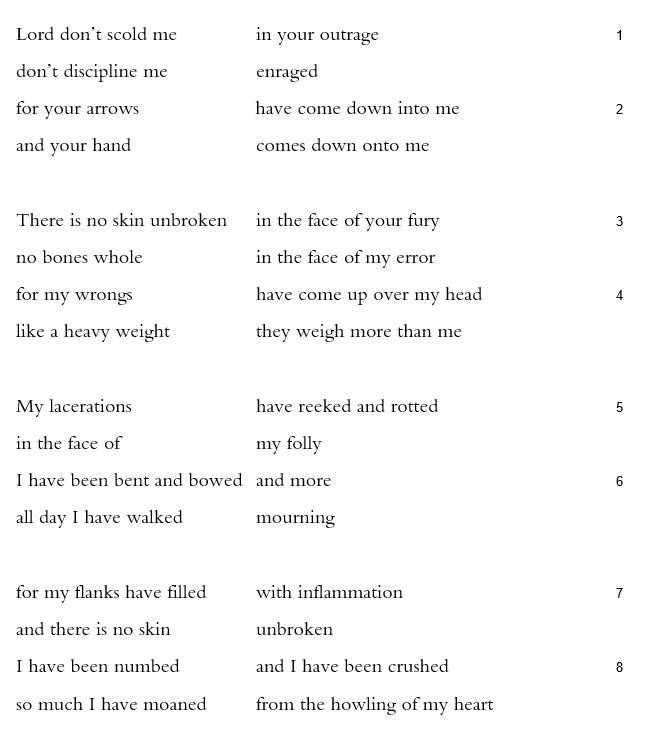
Psalm 38 is a lament as vivid in its depiction of bodily suffering as it is elusive about the causes. The speaker sees her pain first as a result of divine wrath: “your arrows | have come down into me / and your hand | comes down onto me” (2). In the second quatrain, most of the psalm’s themes arrive:
There is no skin unbroken in the face of your fury
no bones whole in the face of my error
for my wrongs have come up over my head
like a heavy weight they weigh more than me (3-4).
Paralleled, the Lord’s “fury” gives way to the speaker’s “error,” the word usually translated as “sin.” This unnamed mistake grows plural in “wrongs.” These wrongs themselves proliferate, continuing the downward movement from the punishment of the first two verses (“have come up over my head” in verse 4, see also 6 and 8) as they spread a contagion that dominates the psalm. Likewise, the repeated phrase “in the face of” recurs in the poem, both penei (3, 5) and its synonym neged (9, 17), creating an immediacy that is confrontational, face to face, even as it accentuates the speaker’s distance from her loved ones, friends, family, and God.
By far most of the psalm emphasizes the ache that spreads within, across, and beyond the sufferer’s body. “My lacerations | have reeked and rotted / in the face of | my folly” (5). But what folly? Even in verse 18, the crime she feels punished for goes unstated: “my guilt | I confess / I suffer | from my error.” Did the error cause the lacerations? When she describes how “there is no skin unbroken” (3, 7) and how “my flanks have filled | with inflammation” (7), are these injuries rather a consequence of the angry, physical “discipline” of Lord? Or are her wounds the work of those enemies who show up for the first time in verse 12: “those who seek my neck | struck me”? The outward movement of pain and its consequences reaches those who mock the speaker and beyond: “my foes are lively | they have grown strong / they have grown great” (19). These foes introduce another possibility, that the speaker’s pain comes less from divine punishment than from terrible people’s abuse: “they block me | for my chasing the good” (20). Maybe the speaker just suffers, period, certain the pervasive pain is real, and this suffering is compounded by uncertainty, and by worry about its causes as well as its effects.
The superscription indicates that this is a psalm for memorial purposes. But who is to keep what in mind? Are we supposed to agree with the sufferer’s supposition that her physical anguish stems from something she did or didn’t do, something she is or was? Are we to keep right there in mind the disappointing family and friends who distance themselves from the sufferer at the worst possible time? Or the reprobate foes who mock the sick? Or is the superscription a reminder to keep suffering itself in view, the sufferer closer to mind than anyone else in the psalm, God or family or friend or foes?
My name is Mark Minster. I’m an English and Comparative Literature professor with a background in ministry and in poetry. I teach courses on writing, reading, religion, and nature.
Psalms of lament are grounded in a number of ways. Having stated or cried out about a problem—lamented it— with more or less metaphor, the speaker calls for mercy or rescue or revenge, appealing either to abstract principles of justice (4:1, 5:12, 7:8-9, 11:7, 14:5, 17:1, 18:20) and moral opposition to wrong (5:4-6, 11:5, 18:23); or to a relationship of divine care (Ps 4:3, 6:4, 13:5, 16:1); or to feelings of compassion and pity (Ps 6:2, 9:13; 18:19); or to God’s identity and reputation (3:8, 6:5, 9:10-12, 12:5). As an argument, the lament has a claim (“help me”), evidence (“for I am in trouble”) and a warrant (“rescue | is the Lord’s” 3:8; or “you’ve never left | who seek you Lord” 9:12). I am just; my enemy’s a cheat; you hate injustice. I follow the rules; my foes are bad; rules are rules. I am hunted; these hunters are terrifying; you care for who shelter in you. I suffer; look at these bones; pity me. I might die; these haters won’t stop; how can I praise you if I’m dead (6:5)?
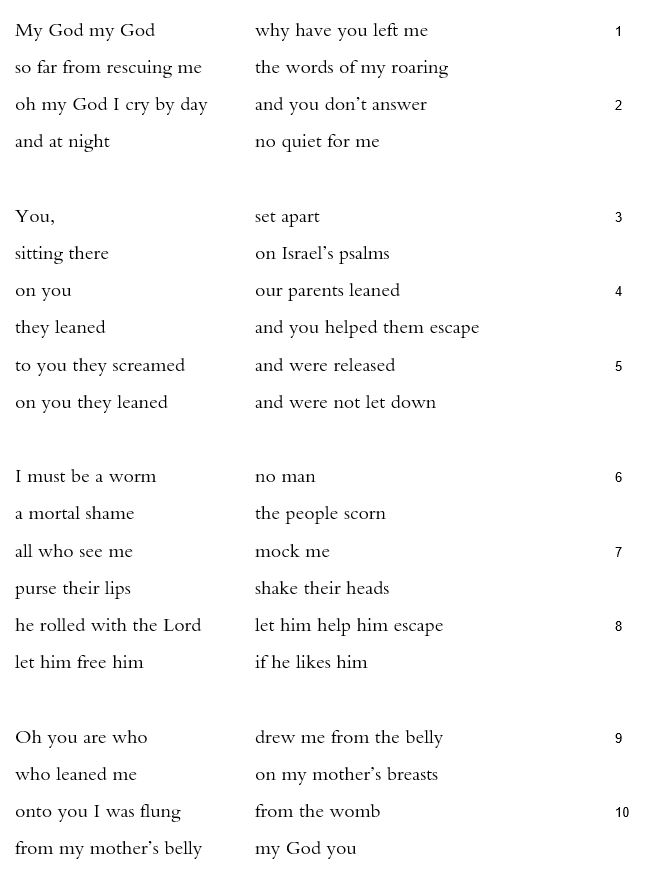
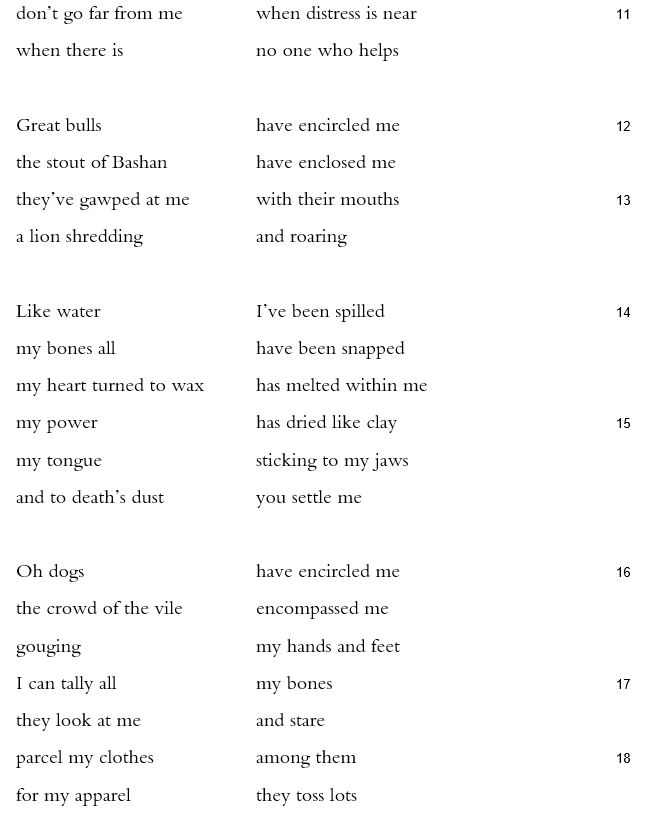
Psalm 22 is remarkable in all three of these areas, in claim, evidence, and warrant. Its complaint is elaborate and tart, the threat vivid and brute, the rhetorical appeal rich and generational, to who God was and will be. You have gone far away; the beasts are closing in; remember our past and imagine the generation to come. The speaker is distraught, even outraged, driven to “roaring” like an animal (1, cf. 13) at the Lord’s removal: “so far from rescuing me” (1). Distance is the problem: “don’t go far from me | when distress is near“ (11). These two poles, far (rachoq) and near (qerov) occasion a scramble of verbal dexterity. Several key words in the psalm pick up on their sounds: the dog/dogs (kelavim, 16, kelev 20), the sword (cherev, 20), my power (kochi, 15), my jaws (malqochai, 15), they divide (challequ, 18). The difference between here and there resonates.
Outraged, the speaker’s accusations broach sarcasm. In verse 3, a line that’s sometimes been read as an addition, the speaker declares God’s sanctity: “You, | set apart / sitting there | on Israel’s psalms” (3). The line reads as a celebration of the Lord’s holiness, which sets up the historical appeal of verses 4 and 5. It also reads as a barb, God’s set-apartness, the quintessence of qadosh, precisely the thing that keeps him far away. Again in verse 6, “I must be a worm | no man” reads as both self-abasement and ironic critique. Even verse 8, with its lines that seem to quote those who scorn the speaker, makes sense as denunciation: “let him help him escape / let him free him | if he likes him.”
Besides mockery, what actually threatens the speaker? It’s hard to tell. The psalm groans under the weight of its figures: lions and bulls and dogs, oh my. The imagery is arresting, but probably none of it is literal: “my bones have all | been snapped” and “I can tally | all my bones” are obvious hyperbole (14, 17). But the lack of a single clear referent or literal meaning is what makes this psalm so potent and adaptable, most notably by the writers of the gospels, who shape the passion narrative around allusions to it: (v.1, v. 8, v. 18).
Why does the speaker think God should care about such a censorious complaint, described almost entirely metaphorically? He looks first to the past and then to the present. The past is generational: “on you | our parents leaned / they leaned | and you helped them escape (4). Perhaps it’s the verb betach—to trust, to rely, but literally to lean—that triggers the noun beten—the belly. Or maybe it’s just thinking about parents—literally, verse 4 says “fathers.” But verses 9-11 return to the generational appeal in the psalm’s most intimate lines:
For you are who drew me from the belly
who leaned me on my mother’s breasts
onto you I was flung from the womb
from my mother’s belly my God you
don’t go far from me when distress is near
when there is no one who helps.
It’s not that long ago God rescued the speaker’s parents, who leaned, in dead metaphor, against the Lord. But when God was the midwife, the leaning was not abstract, but concrete, bodily, maternal: “who leaned me | on my mother’s breasts” (9b). The Freudian image of Anlehnung, the leaning-on of desire, comes clear to mind. Gender, too, is fascinating here. “I am no man,” the speaker says in verse 6, though the mockers use masculine pronouns in verse 8. And here, the speaker recalls being “flung | from the womb / from my mother’s belly | my God you” (10b). Is this a father delivering a child? Or is God the mother onto whom the newborn is laid, or the nursemaid? (The divine epithet “my protection” in verse 19, for what it’s worth, is grammatically feminine.) The generic fathers of v. 4 have become this speaker’s earliest caretaker.
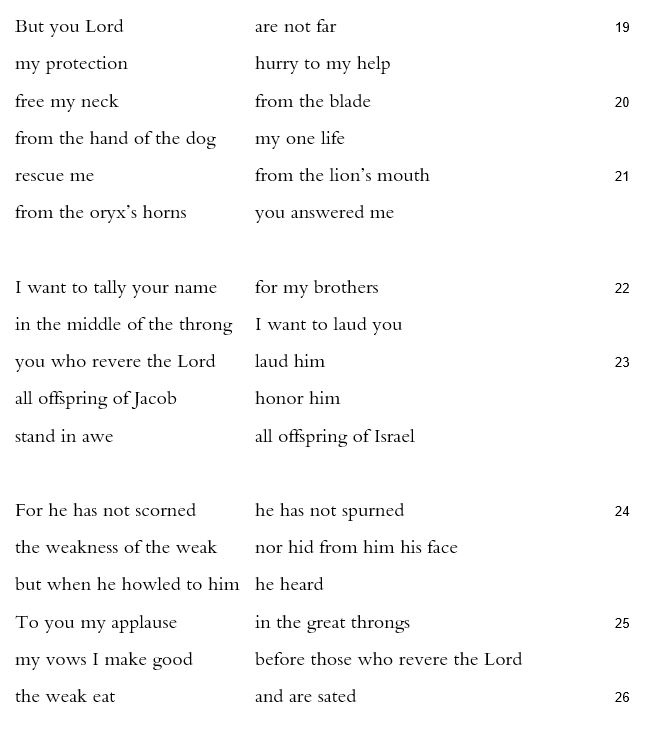
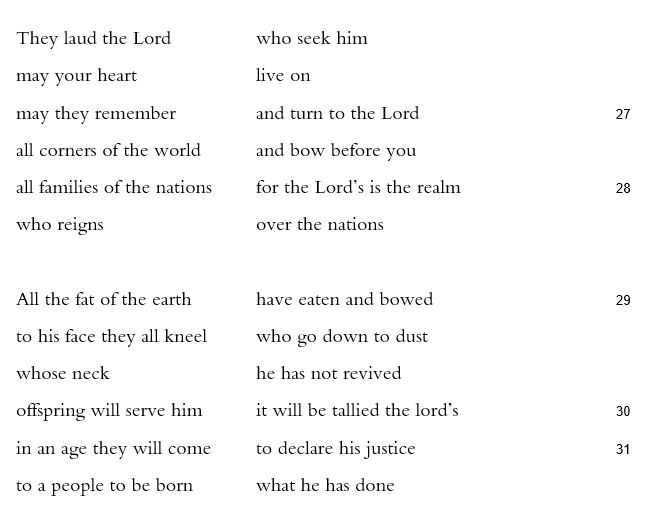
Only in its turn to thanksgiving is this psalm relatively common. The Lord responds—or, has responded, strikingly, in the middle of a verse (21b)—and the psalm become laudatory in traditional ways (“They laud the lord | who seek him,” 27). Still, the second half of the poem fits the first half in at least one way. It picks up the generational appeal as it turns to the future: “all offspring of Jacob… all offspring of Israel” (23). The psalm’s closure is explicit about this:
offspring will serve him it will be tallied the lord’s
in an age they will come to declare his justice
to a people to be born what he has done (30-31)
To many Christian readers, it’s the psalm’s afterlife in the gospels that make it memorable. Other readers relish those bestial images, worm and bulls, even an oryx, and those trippy bodily images of a melting wax heart and countable bones. Ending with “a people to be born,” however, snaps the reader back to the moments of birth and just after, skin-to-skin contact, an appeal not to generations but to generativity, to leaning on the mother’s body.
*
“Doe at Dawn” Beautiful in Hebrew, too, ’ayyelet hasshachar appears to be the name of a melody
22:1 My God my God | why have you left me The cry is rhythmic in the original, punchy two- and four-syllable words. This is the first of three parts of Psalm 22 borrowed by the gospel writers, who punctuate their Greek with the line in Aramaic or Syriac Eloì, Eloì, lemà sabachtháni (Mk 15:34), Elì, Elì,lemà sabachtháni (Mt 27:46).
22:1 the words of my roaring It’s the sound a lion makes.
22:3 You, | set apart Treating this as a clause with an implied copula (e.g., in the KJV: “But thou [art] holy”) misrepresents the tone. The speaker isn’t asserting a theological fact. The speaker speaks daggers—or darts, at least—while pointing out that God was there for the older generation.
22:6 I must be a worm Here, however, supplying a copula makes sense for the literal “I a worm” in the Hebrew. The addition of the modal “must” helps to register the tone of the original, more bitterly sarcastic hyperbole than actual self-abasement.
22:8 he rolled with the Lord | let him help him Biblical Hebrew idiom coincides with English idiom strangely well here in “roll with,” which suggests accompaniment and trust. Since the verse is clearly the reported speech of the cruel jeerers, informality seems appropriate. The verse is dramatized by the gospel of Matthew, where the mockery is spoken by Roman soldiers: “He relied on God. Let him free him now if he wants him” (Mt 27:43).
22:12 the stout of Bashan The phrase ’abirei bashan is rich. The first word, the plural “stout,” is a general descriptor of strength and a synonym for “bulls” or other strong animals, or powerful people. A northern region east of the Jordan River, Bashan with its bulls (and the lion of verse 13) likely figures the dangers of the Amorites and/or the Assyrians.
22:18 parcel my clothes… toss lots These images are so vivid that they become part of all four gospels’ passion narratives: implicit allusion in Mark 15:24 and Luke 23:34, explicit reference in Matthew 27:35 (“so that what was spoken by the prophet might be fulfilled”) and John 19:24 (“so that the writing might be fulfilled which told…”).
22:21 you answered me Such a strange place for this sudden perfect-form declarative verb, marked to indicate completed action, in the last half-line of a verse. A revision for logic would position this at the start of a new stanza, but there’s a potency to its location, interrupting a litany of imperatives.
22:22 I want to tally your name Compare verses 17 and 30. With the singular object “your name,” the verb saphar (here conjugated as ’asapperah, a first-person singular cohortative) tends to work better as telling than as counting, which makes more sense with plural objects, as in “telling” or “numbering” the stars (Gen 15:5). But “tally” conveys the speaker’s enthusiasm, while keeping transparent in translation the psalm’s movement from counting bones, to recounting of the Lord’s name, to accounting the children of the next generation as “the lord’s.”
22:29 All the fat of the earth… revived From verse 26 to this point, as the first-person singular speaker fades from view, the psalm’s logic seems to lurch. The overall drift seems to be that both the weak (26) and the rich (“the fat” 29) will eat and be satisfied and show gratitude, if not in their own lifetime, then in the generation of their “offspring” (30).
My name is Mark Minster. I’m an English and Comparative Literature professor with a background in ministry and in poetry. I teach courses on writing, reading, religion, and nature.
(rendition of David, which he sang to the Lord with the words of Kush the Benjamite)
* * *
While both can be classed as individual laments, Psalm 7 is a study in contrasts with Psalm 6. There’s less turning in this psalm, and no pleading for a change of heart or diversion of enemies. Instead of appealing to sympathy, the speaker names a threat (1-2), swears innocence (3-4), and calls on the Lord for legal intervention, a fair ruling (6-8). The rest of the psalm reflects on justice (the root tsadiq is used five times), a property it asserts is integral to God’s identity (6-11, 17). The psalm sees punishment as the fitting, even logical, outcome of meanness (12-16). Instead of begging God to be less angry, Psalm 7 demands God to remember who God is. Not “Lord don’t scold me | while you’re mad,” but “Rise, Lord | in your rage” (7:6a).
The psalm is at its most unique in the second half, from the end of verse 11 through verse 16, because of what looks like intentional ambiguity. From at least verse 8 to at least verse 11, the focus is on divine justice. By the time we get to verses 15 and 16, the focus shifts to the wrongdoer, who’s done in by the wrong he’s done. In between, however, in verses 12-14, there’s a remarkably blurred sequence of grammatically masculine verb forms and masculine noun suffixes with no named subjects: “If he doesn’t turn | his blade he whets / his bow he’s strung and readied” (12). If who doesn’t turn? Who sharpens whose sword? Who has prepared for whom “the tools of death” (13)? The English Standard Version tries to be helpful and clear: “If a man does not repent, God will whet his sword.” That’s a little like taping a photograph over a Cubist portrait. It misses the point. The bad man doesn’t turn. God doesn’t, either. The bad man sparks his arrows. God does, too. Double-duty pronouns depict the exact overlap of punishment and crime. The grammar may not be clear, but the significance is.
When I was in divinity school, I once misquoted a line from Elie Wiesel: “God made people because God loves stories.” I was trying not to use exclusionary language. My classmate Nina jumped in. “Yes, but you killed it. ‘God made man because he loves stories.’ We can’t tell who loves stories. It’s both/and.” It’s a cat and a vial of prussic acid, alone in a room for an hour.
*
7:1 rendition The word shiggaion is unknown and most often left in Hebrew. It might come from the root shagah, which has something to do with wandering off in one’s own direction. Some speculate that it means dithyramb. It could be an instrument, a style, any number of things.
7:1 Kush the Benjamite Not clear who this is. Kush is the name for Nubia and Ethiopia, Benjamin the tribal territory just north of Jerusalem (“between his shoulders he lives” Deut. 33:12), a region linked to David for being Saul country.
7:2 lest one slash my neck The slasher is unnamed but singular. As in other psalms, the word nefesh is often rendered “soul,” but refers to the vulnerable part of the front of the body.
7:4 stripped my attacker The word chatsal for stripping away means something similar to natsal, used in verse 1 and verse 2 (“whisk away”). “Attacker” is literally “one who binds me”
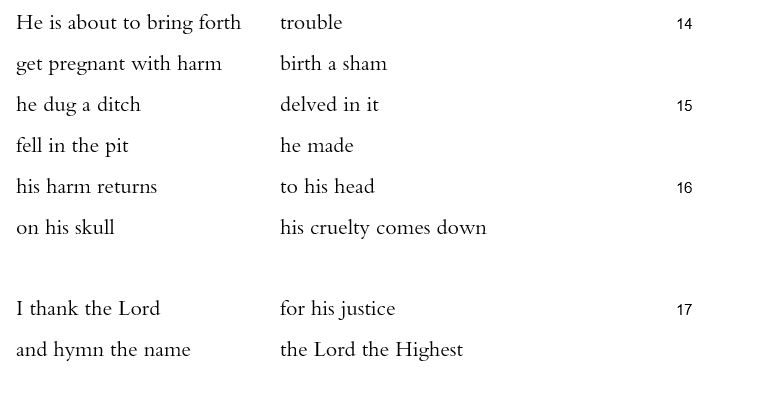
7:14 He is about to bring forth… The sequence is clear, and it’s vivid. He—more likely the bad man than God—is in labor: the hinneh-plus-verb formula generally yields a continuous tense. The verbs in the second half of the verse are in the vav + perfect form, which can result in either past or present tense constructions: “get pregnant with harm | birth a sham” is a leap that shows consequence as clearly as “sow” and “reap.” A wrongdoer is always in labor pains with trouble; impregnated by harm, he—that he is no she is the point—bears sham babies.
7:16 his harm returns This turning calls to mind Psalm 6, when read in sequence, but more immediately verse 12, “if he doesn’t turn.” If the villain doesn’t turn, villainy will turn on him.
7:17 Thank… hymn As an ending, the whole verse is kind of pat, but not necessarily added later. The verbs yadah and zamar are frequently paired.
7:17 The Lord the Highest The usual formulation of one of God’s names (or titles) is El Elyon, but YHWH Elyon works, too. This translation assumes that readers want to say something meaningful in English if they’re reading aloud or even mouthing these words. Saying the names in an old language has its own pleasures.
My name is Mark Minster. I’m an English and Comparative Literature professor with a background in ministry and in poetry. I teach courses on writing, reading, religion, and nature.




 The Book of Psalms