(of David)

* * *
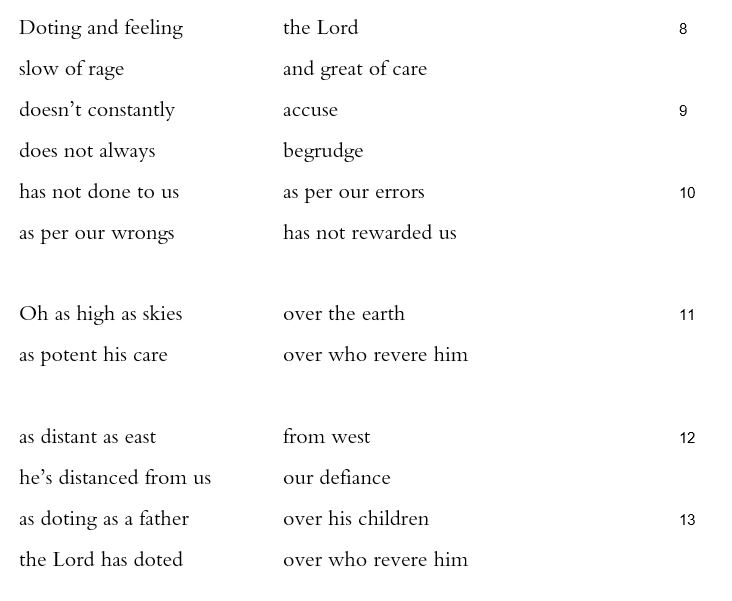
Like Psalm 102, to which it seems a response, Psalm 103 features a trio of similes. Instead of three lonely birds, however, the comparisons at the heart of Psalm 103 map distance in three dimensions: the maximal heights of the Lord’s care (11), the maximal horizons to which the Lord banishes evidence of rebellions from those who care (12), and the intimacy we assume is also maximal, the compassionate womb-love (“doting”) an ideal father has “over his children” (13). The Lord’s towering care, limitless generosity, and paternal tenderness—these are the core of the psalm.
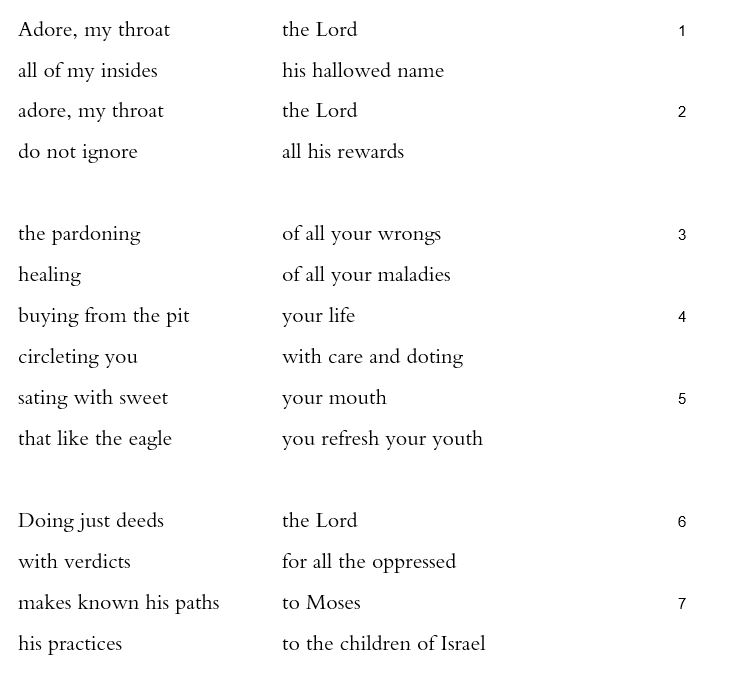
As in Psalm 102, what precedes the center forms a relatively cohesive unit. The Lord’s “rewards” (2) are listed in a six-line stanza as a tight series of participles that could be translated, as here, with gerunds that emphasize the deed (e.g., “the pardoning | of all your wrongs,” 3a) or with “who” clauses that emphasize the doer (who pardons | all your wrongs). The first five participles move narratively swiftly upward from bad to good, “pardoning… healing… buying from the pit… circleting you… sating with sweet” (3-5). The sixth participle, “doing,” gets its own larger syntactical unit in a four-line stanza:
Doing just deeds | the Lord
with verdicts | for all the oppressed
makes known his paths | to Moses
his practices | to the children of Israel (6-7).
This naming of Moses and the children of Israel, together with the paired terms “just deeds” and “verdicts” (6), “paths” and “practices” (7), clearly points to the origins of the law. And since the six-line stanza that follows this one mirrors important parts of the stanza that precedes it (“your wrongs,” 3, “care and doting,” 4; “doting… care,” 8, “our wrongs,” 10), the entire unit concerns the law. Its point seems to be that the law does not exist to introduce sin, as Paul will later cleverly claim in Romans. Rather, the law is what God does, part of the participial narrative of caring and liberating. It is who God is, “doting and feeling… slow of rage | and great of care” (8).
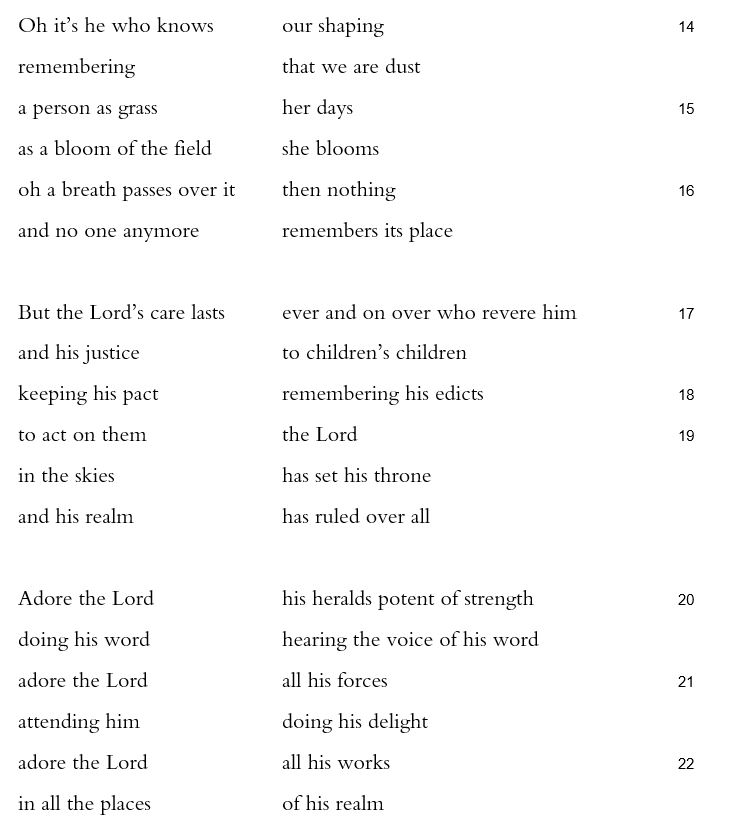
As in Psalm 102, what follows the center also forms a unit. This second unit shows not just structural, but thematic similarity with the previous psalm, contrasting human ephemerality (“we are dust/ a person as grass | her days” (103:14b-15a; cf. 102:11-12) with the perpetuity of the Lord’s care and justice (103:17; 102:12). And yet the participle sequence that began in the first half of Psalm 103 continues. As “doing” had its own stanza, now “remembering,” the seventh participle, has its own stanza (14-16). If the first half considers the Lord’s care as it relates to the law, what the Lord “does,” the second half concentrates on care as remembering: remembering human mortality. In the subsequent stanza, the law returns in a pair of plural participles that convey what “who revere him” and “children’s children” do: “keeping his pact | remembering his edicts” (18). Slyly, the Lord’s remembering in 14 and the people’s remembering in 18 surround the absence of remembering in verse 16—the image of a forgotten bloom as a figure for mortality.
Four more plural participles show up among the singular “adore” imperatives that frame the psalm. The Lord’s “messengers” are those “doing his word | hearing the voice of his word” (20); the Lord’s “forces” are those “attending him | doing his delight” (21). Among the psalm’s many repetitions— “all,” “over,” “adore, “Lord,” “doting,” and “care” all appear at least four times—perhaps none are as significant as “doing” and “remembering.” They indicate the efforts of both God and the people, balancing the psalm’s emphasis on tender care with an emphasis on responsibility. The overall psalm suggests that the law exists not to punish, and yet those messengers and forces at the end raise compelling questions.

 The Book of Psalms