Psalms of vengeance have range because revenge itself has range. It stretches from cries for rescue with very little interest in penalties (e.g., Pss 20, 22, 26) to the call for an ordered and just society (e.g., Pss 5, 11, 94), to the cool utilitarian logic that roots bad outcomes in bad deeds (e.g., Ps 52), to the calculated plotting of getting even (e.g., Pss 12, 64, 137), to that whetstone of the sword of Macbeth, rage, that blinding fire in the eyes (e.g., Pss 58:10-11, 69:22-28, 78:44-51, 78:58-64, 79:10-12). Speakers in the book of Psalms express all of these at times, from lines of retribution like “return to them | their recompense” (Ps 28:4), “let lips that lie be tied” (Ps 31:18), and “fight | who fight me” (Ps 35:1) to hoist-on-their-own-petard lines like “fell them | by their own schemes” (Ps 5:10), “his harm returns | to his head / on his skull | his cruelty comes down” (Ps 7:16), and “they dug me a pit / they fell inside” (Ps 57:6); from mild imprecations like “may they blanch | and blush” (e.g., Ps 40:14=70:2, and more) to curses couched in metaphors like “make them | like the whirlwind” (Ps 83:13) to terrible, murderous fury: “send them | down to the pit of the grave” (Ps 55:23), “you wipe out / their offspring | from the human race” (Ps 20:9c-10b), “let there be no one for him | to extend care / no one to feel | for his orphans” (Ps 109:12) and “let their base | be pillaged / in their tents / leave no one left” (Ps 69:25).
The second part of Psalm 139 presented, then startled back from, one of the more extreme retaliatory formulations in the book: “Oh let God kill | a cheat / you bloodthirsty | get away from me” (139:19). By contrast with its neighbor and with much of the rest of the volume, Psalm 140 shows extraordinary control. Here there is neither bloodlust nor protests of innocence nor avoidance. Three selah markers (140: 3, 5, 8) neatly divide the psalm in four sections, four six-line stanzas with a four-line coda. The first three stanzas focus on machinations, on villains’ plots and preparations for villainy, which makes the entire psalm strikingly less about retribution than about readiness. The intervention the speaker describes— or wishes for— in the fourth stanza is preventive, not punitive.
Badness and cruelty, paired explicitly twice (1, 11) have led the speaker to call for protection: “Free me, Lord” (1a) is matched by “Guard me, Lord” (4a), and each is followed by “from anyone cruel | protect me” (1b, 4b), followed by “they who’ve plotted” (2a, 4c). The first stanza features mostly intentions, “bad things in the heart” (4c) and a waiting for snakelike speech. The second stanza shows plans that have taken their first steps, “a trap and ropes… a net… snares” (5). The third stanza calls the Lord’s name four times (out of seven total in the psalm) to stop things before they can start: “don’t give, Lord | the rogue his passions / don’t permit his ploys | or they’ll take off” (8).
All of this is to say that the fourth stanza of Psalm 140 is not a call for indiscriminate slaughter or eternal punishment in a fiery or watery hell. One could be forgiven for reducing the entire book of Psalms to a four-word synopsis— “They surround us. Help.” Personal lamenting of siege mirrors the national fear of persecution by others. And so “the head of | who surround me” (9a) is as surely some foreign general, the Assyrian Rab-Shakeh, some satrap, some Herod, as it is the pate of one individual’s individual foe. The political is personal. Every other line in this stanza, in verses 9-11, can be parsed as either jussive or declarative in the imperfect form: that is, “let the harm of his lips | surmount him” could be “the harm of his lips | surmounts him” or “the harm of his lips | will surmount him.” The difference has everything to do with how actively one imagines God intervenes, which is to say, how automatically do bad consequences follow from cruel behaviors? Still, regardless of the translation, the stanza shows “coals aflame” and “trenches” (or whatever sodden pit is intended) not as figures for an afterlife of everlasting torment, but as the anticipatory flicking-off of a bug that might bite.
This point matters because there are plenty of readers who mistake this psalm as evidence of a conception of hell, which it decidedly is not. It is, rather, a vision of an ideal society in this world in which the poor and weak, the just and the level of heart, have found an advocate and a home, protected from anyone and everyone who would do or even wish them harm.
My name is Mark Minster. I’m an English and Comparative Literature professor with a background in ministry and in poetry. I teach courses on writing, reading, religion, and nature.
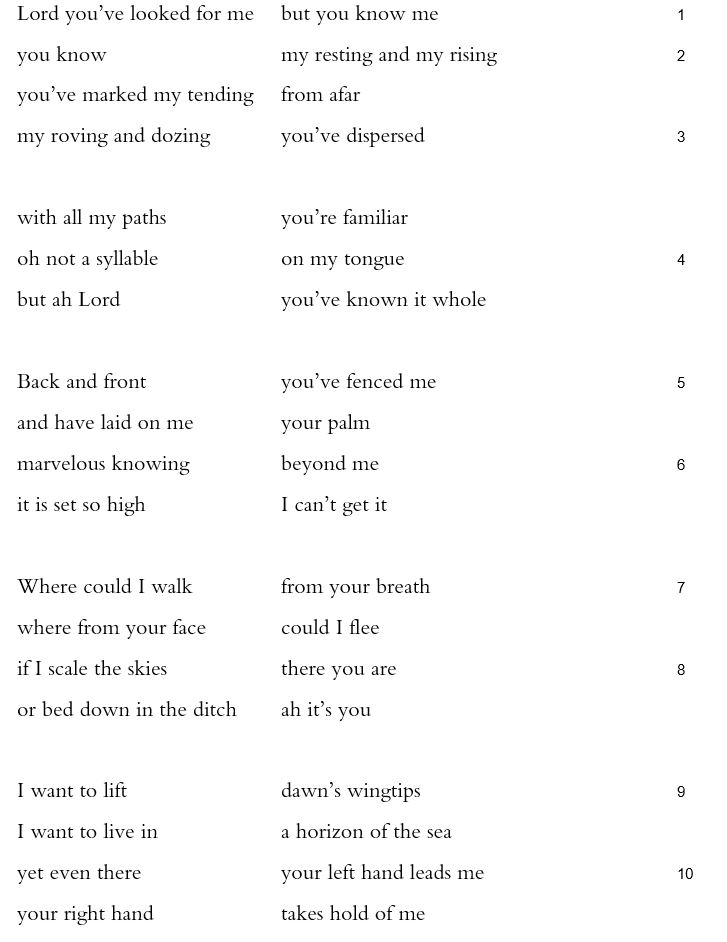
Whether authored by one person at once or by dozens over time, Psalm 139 coheres around a single broad theme— the inescapable length and breadth and depth and height of God’s knowing— and by a handful of stitch-words. Because its most confusing seams occur two-thirds to three-quarters of the way through the poem, in verses 16-19, the psalm feels like a whole that falls apart, making it tempting to excerpt powerful pieces, a verse or half-verse at a time. That temptation is a mistake. There are so many potent moments, it’s best to follow them through. More, the social and psychological cost, the human cost, of careless excerpting is in the case of this particular psalm immense.
At least two distinct pieces seem to have been sewn together, each with its own ways of thinking about what it is or at least what it’s like to be known and fully fathomed. The first piece, verses 1-16, works by merisms, mapping God’s complete familiarity with the speaker’s whole self by marking the maximal limits of space and time. These verses convey wonder (6, 14) and gratitude (14) for divine knowledge, which they present as already achieved.
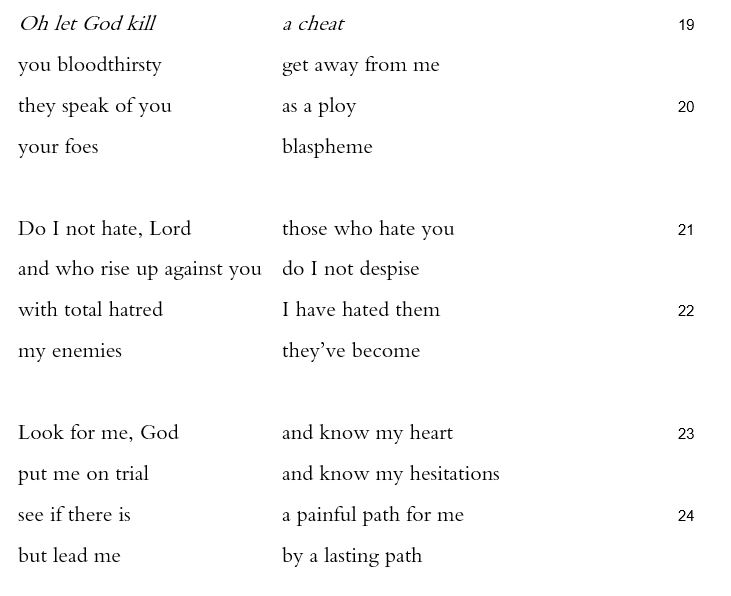
Verses 19-24 take the more common approach of appealing to one’s innocence: the speaker pleads contempt of enemies described as God’s foes (20) as well as their own (22). Instead of celebrating divine omniscience, this second piece asks for a special inquest to determine the future: “see if there is | a painful path for me” (24a). About morality, the main concern of the last six verses, the first sixteen verses say nothing.
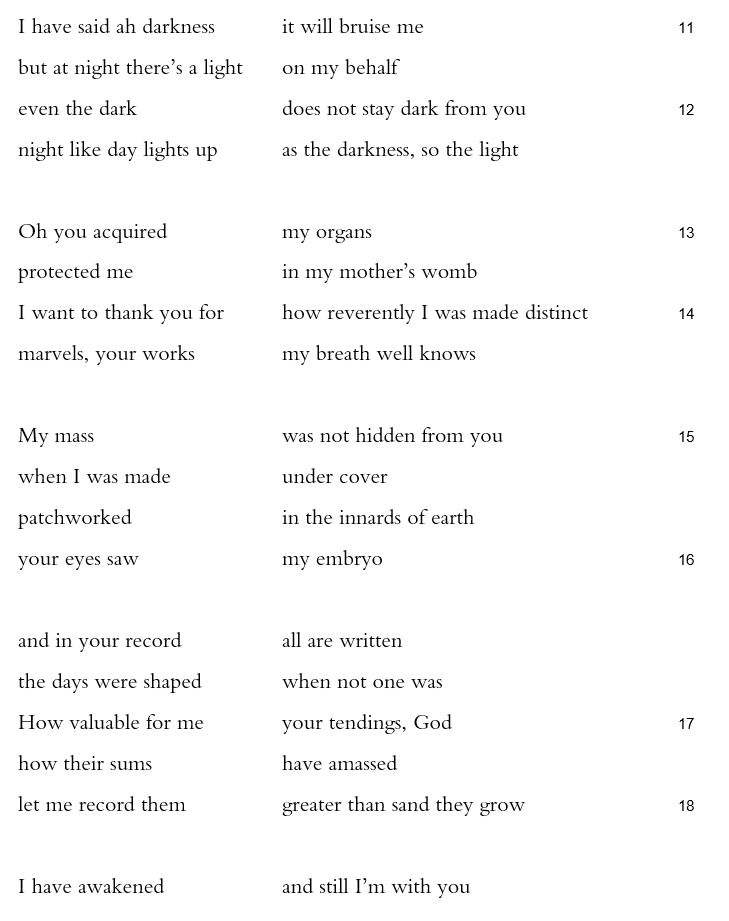
Between these two parts, verses 17-18 have a fabric that seems their own. They are less a bridge than another island. Verse 17 and the first half of verse 18 see God not as a knower but as unknowable. The second half of verse 18, “I have awakened | and still I’m with you,” is not easily assimilated to any of the other three parts, with no clear relationship to omniscience or ineffability or the hatred of the bad.
Nevertheless, persistent verbal connections tug the psalm’s parts together. Its beginning and end are linked by the pairing of the verbs “look for” (1, 23a) and “know” (1, 2a, 23a, 23b), the latter of which occurs three more times in the psalm for a total of seven appearances (4, 6, 14). The beginning and end are also framed by “rising” (2) and rising up against” (21), and by the common word derek (“all my paths” in verse 3; “a painful path” and “a lasting path” in verse 24), both of which reveal motion to be a key part of the psalm.
The word rei`ah, from a root (or roots) with enormous semantic range, appears in the singular with a first-person suffix in verse 2—“my tending”—and in the plural with a second-person suffix in verse 17—“your tendings.” Its precise meaning in both cases is unclear, unique in the Bible to these two verses, though derivation seems to suggest pasturing and grazing (ra`ah) or association and friendship (rei`eh) rather than badness (ra`a`), while the poem’s context implies something abstracted, even ideational: “you’ve gotten my drift,” a more colloquial draft of this translation once tried. Regardless of its meaning, the repetition of rei’ah stitches verse 17 back to verse 2.
Similar repetition of the root `atsam stitches verse 17 (“have amassed”) back to verse 15 (“my mass”), with another plural word, looping back to pick up its partner in the singular. In addition, in passing, note “your breath” (7) and “my breath” (14), “your record” (16b) and “let me record” (18a), and the pairing of indicative “leads” (10) and “saw” (16) with imperative “see” and “lead” (24). Cumulatively, these duplications and keywords show the effort of making the psalm cohere.
By contrast, the first sixteen verses hold together on their own. This is especially true when we track how much of the diction here is drawn from a pastoral register. That is, most of this psalm works remarkably well if it is understood, just as Psalm 23 is understood, to be the song of a sheep to her shepherd. Psalm 139 begins with the Lord searching for what the Lord already knows by familiarity: the speaker’s movements: “my resting and my rising… my roving and dozing” (2a, 3a). As noted above, the etymology of lerei`i in verse 2b, “my tending,” suggests a more literal meaning of “my herd instincts” or “my grazing intentions,” “my pasture tendencies,” which a shepherd could doubtless mark “from afar” from familiarity with sheep tracks. The word tsartani in verse 5 literally means “you put me in a paddock” or “fenced me in.” A pastoral reading reveals vividly and concretely the Lord’s palm (5), the “marvelous knowing | beyond me” (6), the sheep’s experience of proximity to the shepherd’s “breath” and “face” (7), the scaling of crags and napping in glens (8), the left hand that “leads me / your right hand | [that] takes hold of me” (10), and even the “light | on my behalf” (11).
If the speaker is understood as a well-known and cared-for sheep and the Lord a caring, knowing shepherd, verses 13-17 take on nuances most readings miss. Ever since the domestication of livestock, a shepherd knows a lamb well before its birth, from the ruddle of the ram that tups a ewe in heat, to the visual and behavioral cues of gestation on through to lambing, imprinting, and beyond. The verb “acquires” in verse 13 captures both ownership and generativity: Eve “acquires” Cain in Genesis 4:1 (almost as if she doesn’t know how it happened); in Genesis 25:10, Abraham “acquires” a plot to bury Sarah. A shepherd breeds ewes (13a), “protects” them (13b), helps during birthing by cutting the newborn lamb’s cord (“how reverently I was made distinct” 14a) and ensuring he can breathe his first breaths (14b). During gestation, a shepherd sees the mother’s belly swell, sees her colostrum, and sees and feels and knows the outline of the fetal lamb (“my mass… my embryo” 15a, 16a). Good shepherds write this all down, recording days and values (16b-17). Even a lamb might want to keep track in the only way it can: we count sheep in ledgers and late nights; sheep mark our attending with their hooves in the dirt (“greater than sand they grow” 18a). Understood this way, even the curious verse 18b makes sense as imprinting, a newborn lamb, eyes on its shepherd: “I have awakened | and still I’m with you.”
Not even this sheep-and-shepherd reading of Psalm 139 knows quite what to do with verse 19, however. If 18b is a leap, 19a is a lurch: “Oh let God kill | a cheat” comes so far out of nowhere it seems rather to belong in vocabulary and theme to Psalm 140. Dahood gamely celebrates verses 18b-19 as three varieties of wish, parsing the lines as “I want to awaken… Let God kill… may you bloodthirsty get away,” which is as grammatically wily as it is semantically weird. My solution here, dissatisfying though it may be, is nearly the opposite of Dahood’s, seeing 19a as a line of quoted speech, a curse uttered against enemies by “you bloodthirsty,” hateful not just because it takes the Lord’s name too lightly (20b echoes Exod 20:7 or Deut 5:11), but because it treats life and divinity too carelessly, with only partial knowledge (cf. Ps 16:4). Many other readers, however, barely register the rupture, as if sliding from meticulous perinatal compassion to lethal imprecation were common or made the slightest sense.
Squinting, however, or looking from afar, it is possible to reconcile the psalm’s parts by seeing the broadest of shared themes—the sublime unknowability of divine intentions, the infinitude of divine knowing, the fierce loyalty the lamb shows his shepherd. If Psalm 139 is turned, and its metaphor is not necessarily knowing pastures and each individual sheep over all terrain and through all time, but knowing by sounding deep waters, then maybe what happens in verse 19 is a kind of sinking down through innermost thoughts, until we come at last to such grim thoughts as killing and cheats and enemies. If so, verse 19 becomes an example of the trial the speaker asks for in the psalm’s last lines: “and know my heart…and know my hesitations” (23a, 24a).
The crucial takeaway of this psalm, however, is that the mortal first-person singular, the part, comes with hard epistemological limits in a way that the limitless second-person singular, you, the whole, does not. In 1 Corinthians 13:12, Paul asserts in a midrashic rereading of texts like Psalm 139 that “now I know in part, yet then I will know well, exactly as I have been known well.” What this psalm itself emphasizes is that first part, the partiality of human knowing.
This fact alone, the limits of knowledge, ought to radically curtail the use to which this psalm is too often put, in anachronistic claims that verses 13-16 argue against a woman’s right to choose what to do with her body. Jewish and Christian traditions have made any number of claims about the moment a life begins. Life only ever continues, according to this psalm, a psalm utterly disinterested in identifying a single point of origin. This is not a reasoned case that life begins at conception, nor that life begins at the breathtaking moment the umbilical cord is cut and in terror and wonder everyone waits for that first gulp of air. Woe to you, who clip prooftexts in bad faith! This is not a psalm of moments.
My name is Mark Minster. I’m an English and Comparative Literature professor with a background in ministry and in poetry. I teach courses on writing, reading, religion, and nature.
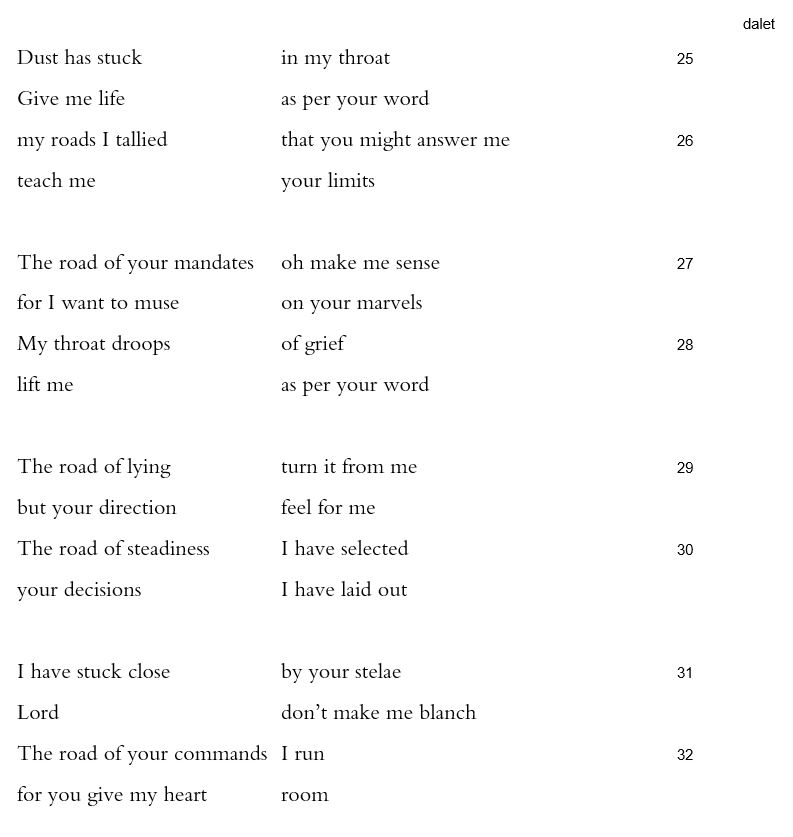
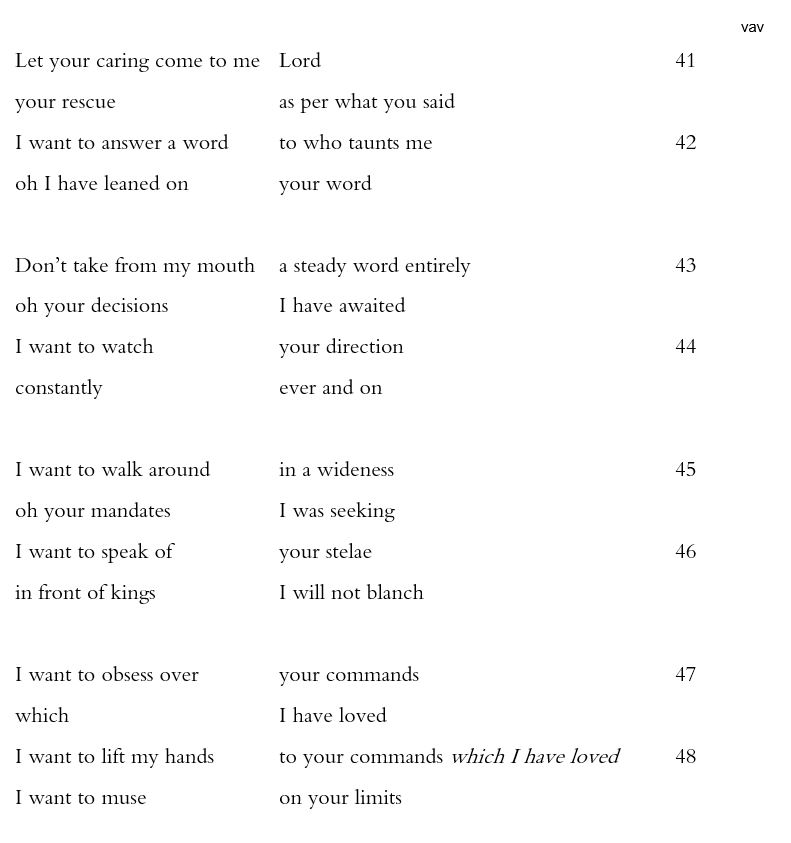
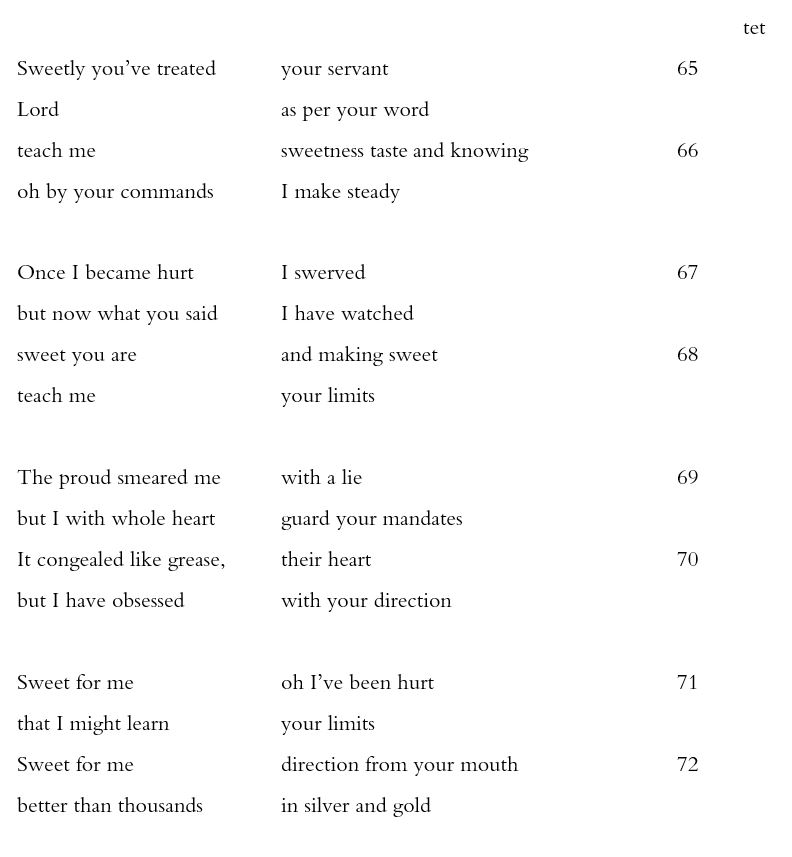
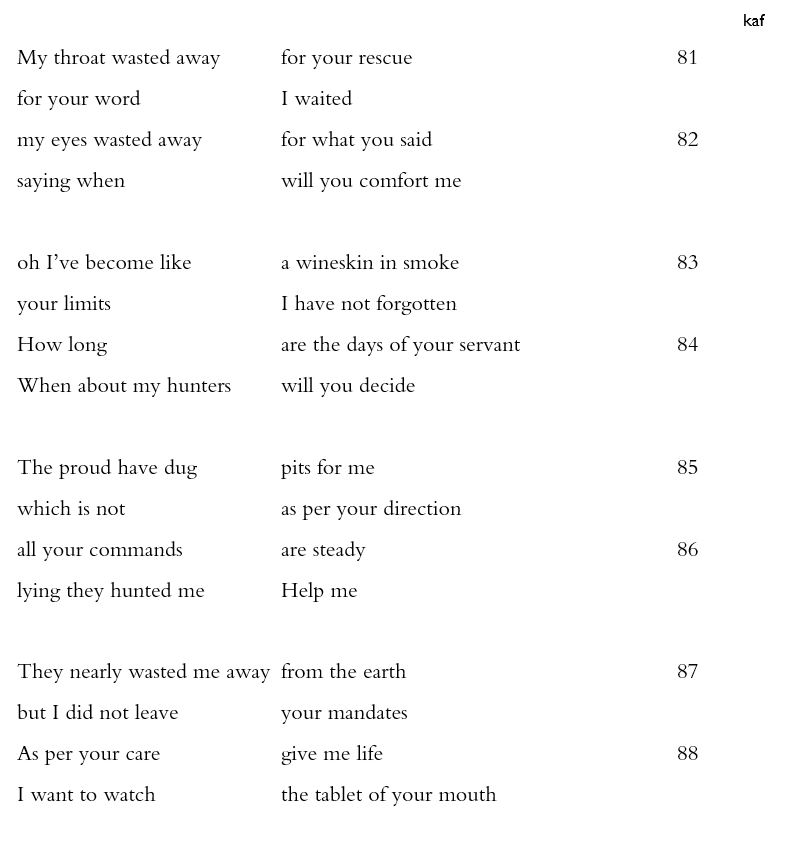
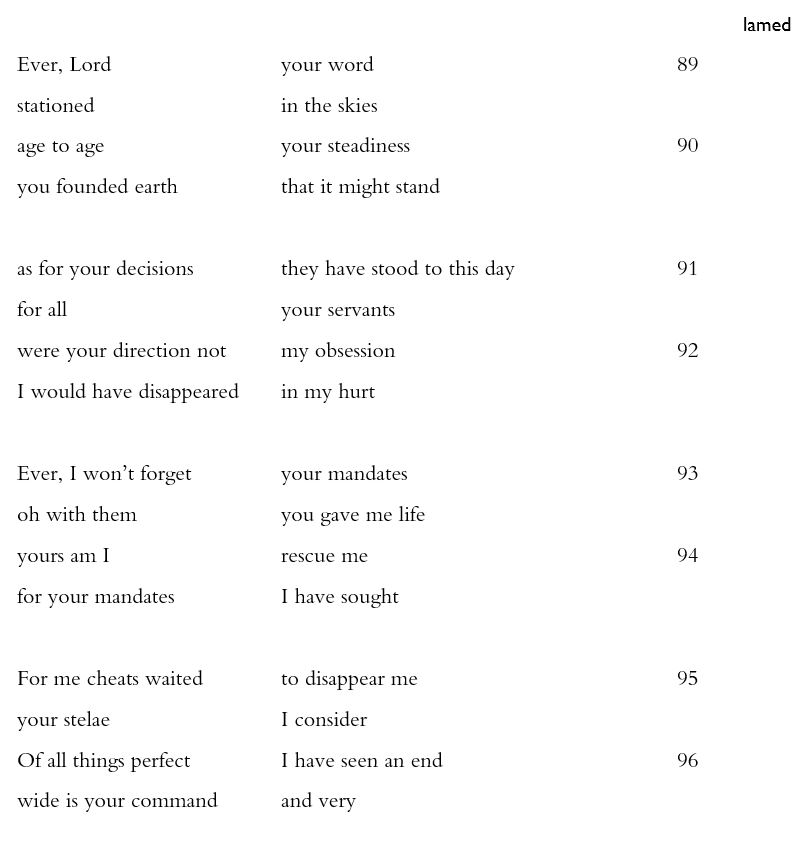
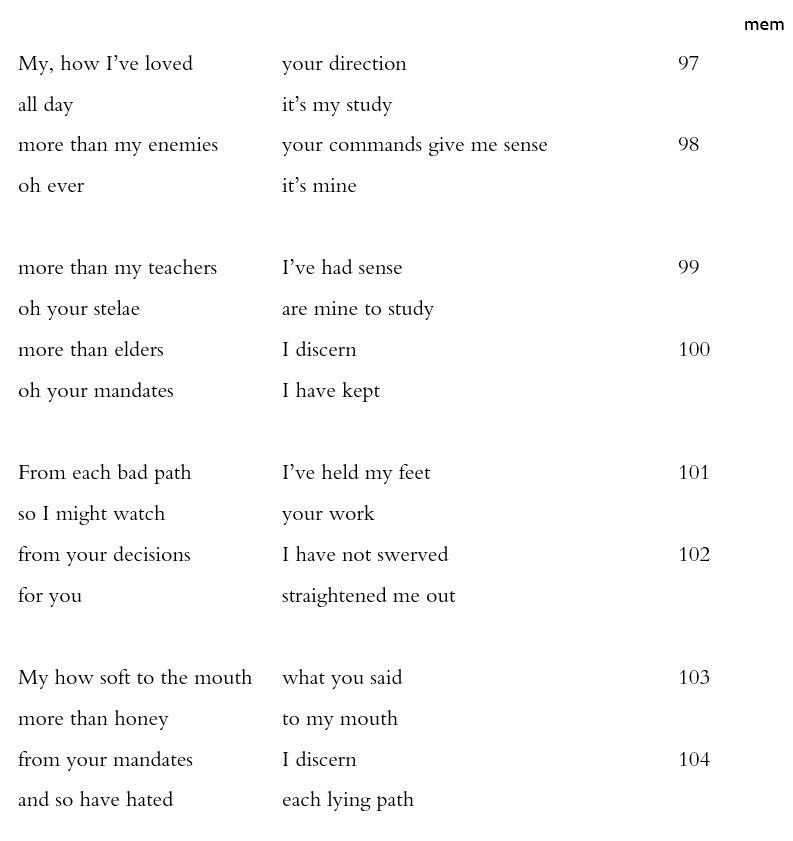
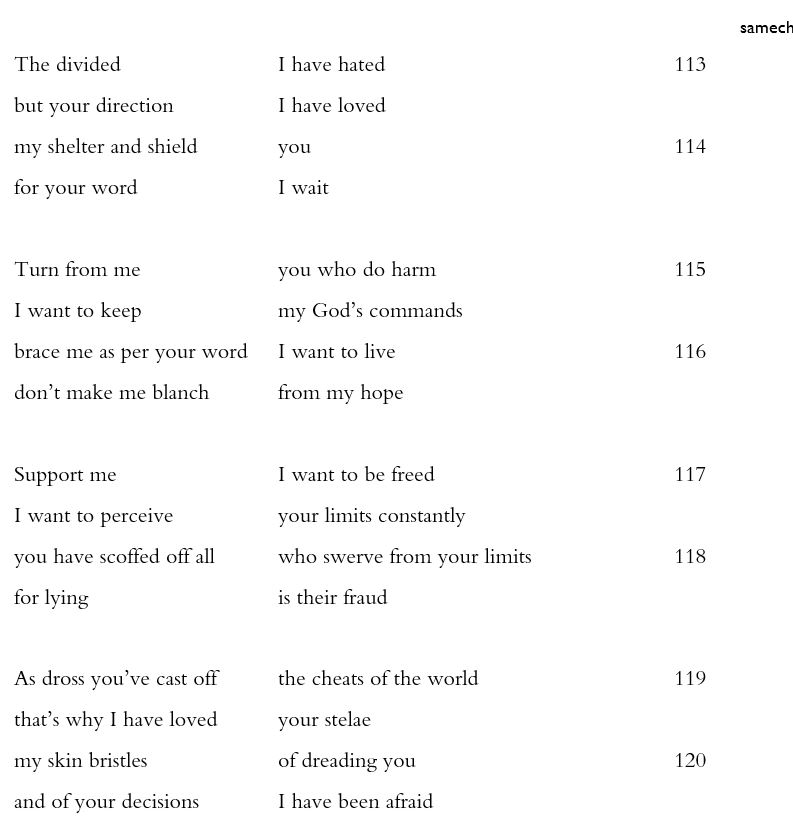
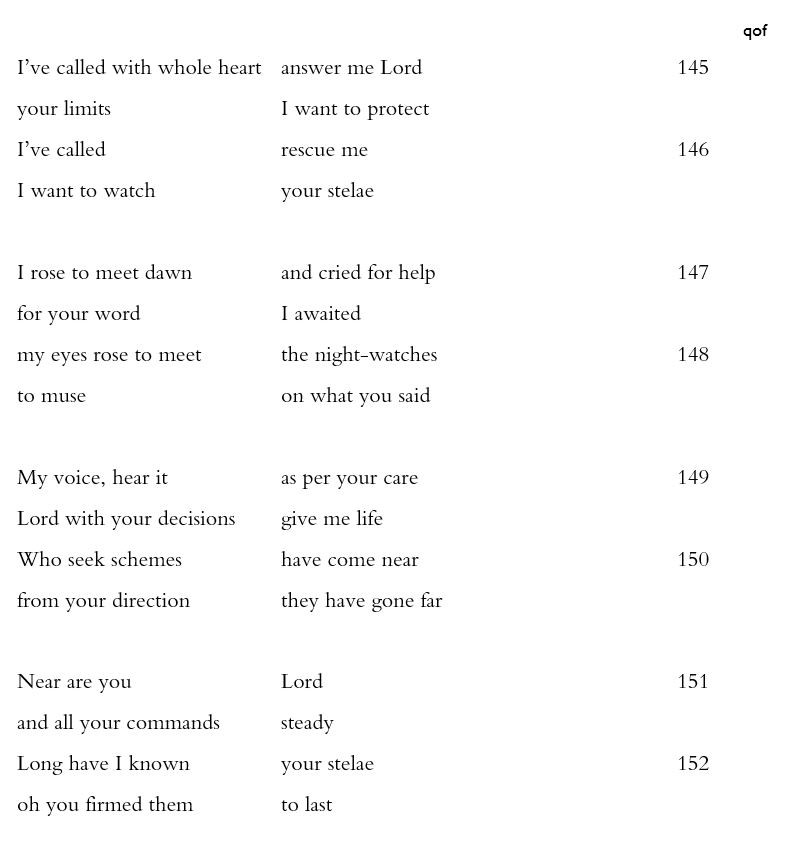
Psalm 119 turns and turns in a kind of rondelet. The longest of psalms, it clicks around and around through images and keywords like an old slide projector carousel. To some it’s a slog. To others, in keeping with its themes, an obsessive’s delight.
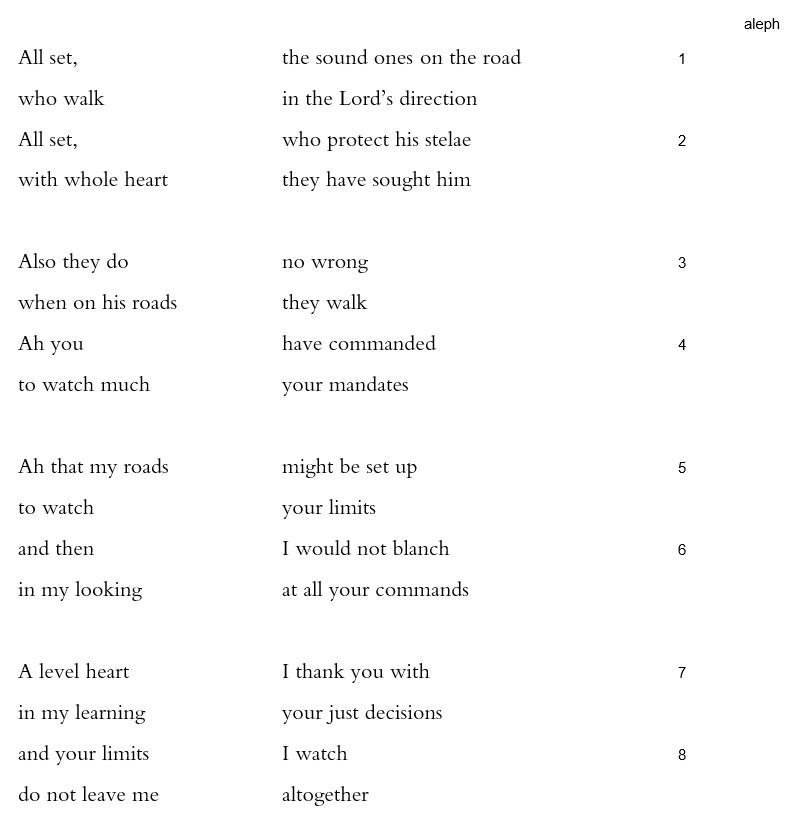
To read a psalm like this, stamina, patience, and particular kinds of attention are needed. It’s a discipline, really, this octupled acrostic, a poetic form whose compulsive control mirrors both the control described by its contents and the control required by the process of reading. (Only aleph and bet are preserved in this English translation, the a-led and b-led lines of verses 1-16.) The most sweeping implication to be unfolded from attending to Psalm 119 is that whatever else we mean when we talk about religion, aesthetics and epistemology must take pride of place over metaphysical or even ethical claims. “Teach me | sweetness taste and knowing,” the psalmist insists, centering the good and beautiful between the cultural and biological experiences of education and sensory perception (66).
At the psalm’s core is instruction, torah or Torah, “direction” (sometimes the plural “directions”), which appears twenty-five times across the psalm’s twenty-two sections (1, 18, 29, 34, 44, 51, 53, 55, 61, 70, 72, 77, 85, 92, 97, 109, 113, 126, 136, 142, 150, 153, 163, 165, 174). Around this core whirl in orbit seven metonyms. Two of these orbiting terms accentuate the verbal scene of instruction: “word” or “words” (16, 17, 25, 28, 42 x2, 43, 49, 57, 65, 74, 81, 89, 105, 107, 114, 116, 130, 139, 147, 160, 161, 169) and “what you said” (11, 38, 41, 50, 58, 67, 76, 82, 103, 133, 140, 148, 154, 158, 162, 170, 172). The other five are legal words, legislative and judicial synonyms that emphasize the authority of the tradition. “Command” (6, 10, 19, 21, 32, 35, 47 48, 60, 66, 73, 86, 96, 98, 115, 127, 131, 143, 151, 166, 172, 176) and “mandate” (4, 15, 27, 40, 45, 56, 63, 69, 78, 87, 93, 94, 100, 104, 110, 128, 134, 141, 159, 168, 173) stress codification. “Decision”/”decisions” (7, 13 20, 30, 39, 43 52, 62, 75, 91, 102, 106, 108, 120, 132, 137, 149, 156, 160, 164, 175) and “limit”/“limits” (5, 8, 12, 16, 23, 26, 33, 48, 54, 64, 68, 71, 80, 83, 112, 117, 118, 124, 135, 145, 155, 171) stress enforcement. The seventh metonym in the cluster of eight terms is the noun usually translated as “witnesses,” which looks related to the root word for standing. While a person testifying might stand, the term makes sense (to me, I should say) most concretely as “stelae,” those standing stones of the ancient world that marked boundaries and distances, as well as enacted the solidity and permanence of the law (2, 14, 22, 24, 31, 36, 46, 59, 79, 95, 99, 111, 119, 125, 129, 138, 144, 146, 152, 157, 167, 168). Together, these eight ways of naming direction occupy all but ten of the psalm’s one hundred seventy-six verses. One of these exceptions is the psalm’s central line, which powerfully figures instruction as both speech and writing: “the tablet of your mouth” (88).
In tension with the metonymic motion-in-place of the psalm’s abundant keywords, which name and rename and enact and re-enact order, there is the recurrent metaphor of the road, or roads, which constitute place-in-motion. If torah is direction, then derek, a road, a way, is direction in action, order mapped horizontally. The word derek in the singular or plural appears thirteen times (1, 3, 5, 9, 14, 27, 29, 30, 32, 33, 37, 59, 168) accompanied by its own cluster of synonyms: trails (15), footpath (35), footfalls (133), and path (101, 104, 105, 128). Four of those ten verses that lack a synonym for torah include either road or roads (3, 9, 37) or path (101). Though walking (1, 3, 35, 45) and running (32) do not show up often, an array of verbs appear for orienting oneself to the direction of the road: to turn or not (29, 51, 115), to stray or not (11, 21, 176), to swerve or veer or not (10, 67, 102, 110, 118, 157), to leave or not (53, 87, 121), to stay near (31, 150, 169) or go far (150). Sticking to the path, keeping the way clear for others, going somewhere: walking a road is a set of controls both solitary and social. The road itself is marked by instruction, with “commands” and “mandates” providing impetus, “limits” and “stelae” establishing alignment. Walking a road is a discipline of posture and movement, patience and stamina and attention. Off the road, you wonder where you’re going. On the road, you wonder right where you are. It is tempting to cite the Daodejing about the discipline of the way.
Speech (“mouth” 13, 43, 72, 88, 103 (x2), 108, 131; “lips” 13, 171; “tongue” 172; “voice” 149; “throat” 20, 25 28, 81, 109, 129, 175) and movement (“feet” 101, 105) are just two of the ways instruction is a bodily experience of discipline in Psalm 119. “Hands” (48, 59, 73) and “palm” (109) are involved, and especially vision—“eyes” (18, 123, 136, 148) that “look” (6) and “see” (96, 153) and “seek” (2, 10, 45, 94, 155, 157). The way that seeing becomes seeking implies an entire epistemology in which sensory perception, when practiced and attuned to and regulated by instruction, order, and commemoration, becomes the kind of heightened attention that devotion requires. This kind of knowing is a world away from what Emerson describes in “Nature” when he claims that the axis of vision is not coincident with the axis of things, requiring an “eye of Reason” to replace the animal eye. Emersonian transcendence, like its Kantian and Platonic forebears, arrives by angling vision away from things. In Psalm 119, by contrast, to walk and to see become “observe” (112), “perceive” (117), “attend” (15, 18), “sense” (27, 34, 98, 99), and “know” (66, 75, 79, 125, 152). Not by some metaphysical difference, but by recursion and alignment and by intensification— attention, but more of it— these forms of awareness beget culture, a process figured overwhelmingly in the psalm as study and as watchfulness. There is teaching (12, 26, 64, 66, 68, 108, 124, 135, 171) and learning (7, 71, 73) and study (97, 99). The speaker tallies (13), discerns (100, 105) and reckons (59), muses (15, 23, 27, 48, 78, 148), recalls (49, 52, 55) and works not to forget (16, 61, 83, 93, 109, 141, 153, 176). Most significantly, the speaker watches (4, 5, 8, 9, 17, 34, 44, 57, 60, 67, 88, 101, 106, 134, 146, 158, 167, 168), keeps (34, 100, 115), and guards (22, 56, 69, 129). To use my teacher Michael Fishbane’s term, what happens in this kind of religious experience is “sacred attunement.” Bodies attend.
Nevertheless, we aestheticize (and ironically anaesthetize) this psalm if we assume that attentiveness is its own reward. It is important to acknowledge both how purposive the aims of instruction are and how the speaker seems to obsess over harm. The psalm is stuffed full of cohortative verses that express wishes and purpose, often rendered in this translation by “so that” or “I want”:
By your mandates | I want to muse
I want to attend to | your trails
By your limits | I want to obsess
I want not to forget | your word (15-16).
While the “heart” in the Bible has as much to do with thought as with feeling (2, 7, 10, 11 34, 36, 58, 69, 70, 80, 111, 112, 161), the psalm bursts with feeling. There is love (47, 48, 97, 113, 119, 127, 132, 140, 163, 165, 167) and hate (104, 113, 128, 163), but also pining (131) and craving (20, 40, 174) and passion (139) and obsession (24, 47, 70, 77, 92, 143, 174). Reading the entire psalm straight through, however, leaves one with the impression that the speaker’s obsessiveness has done little to alleviate pain.
Straits and stress | converged on me
your commands are | my obsession
the justice of your stelae | is lasting
give me sense | I want to live (143-44).
Even after a dozen dozen verses, the speaker still suffers. Why? Because the psalm’s form is not narrative but recursive. What can be seen as the disciplining of attention and celebration of the law can thus also be seen as exactly what Freud said religion was, an obsessional neurosis. Fittingly, just as four of the psalm’s ten verses that do not name a synonym for teaching use the metaphor of the road, another four of those ten allude to the speaker’s suffering: “How long | are the days of your servant / When about my hunters | will you decide” (84) and
I have done | what’s right and just
don’t leave me | to those who oppress me
Assume your servant’s debts | for good
don’t let the proud | oppress me
My eyes have wasted away | for your rescue
and for what you said | of your justice (121-23).
And yet, because in the psalm the axis of vision is coincident with the axis of things, what the psalmist yearns for is not anything that Freud could dismiss as illusion. The speaker craves consolation (52, 82) and rescue (41, 94, 123, 146, 155, 166, 170, 174), yes, but also justice (40, 123, 142), care (41, 64, 76, 88, 124, 149), and steadiness (30, 75, 86, 90, 138, 142, 151, 160).
Most importantly, who wouldn’t want what the speaker of Psalm 119 wants? “Give sense,” she repeats (73, 98, 125, 130, 144, 169). And “give me life” (25, 37, 40, 50, 88, 93, 107, 149, 154, 156) “that I might live” (77, 116, 145).
My name is Mark Minster. I’m an English and Comparative Literature professor with a background in ministry and in poetry. I teach courses on writing, reading, religion, and nature.
Hard on the heels of the Bible’s only other single-line acrostic, Psalm 112 shifts focus from the Lord, “feeling and tender” (111:4), to the virtuous person, the upright, the level, who is also “feeling and tender | and just” (112:4). While Psalm 111 celebrates the deeds of the Lord, particularly “all his mandates / being upheld | always and ever” (111:7b-8a), Psalm 112 characterizes the ideal devotee: “firmed his heart | leaning on the Lord / upheld his heart | he does not fear / as long as he sees | his enemies get theirs” (112:7b-8). Psalm 111 ends with the rhetoric of a wisdom psalm: “the start of sense | reverence for the Lord” (111:10). Psalm 112 begins with a similar convention: “all set, one revering | the Lord” (112:1). Peas in a pod, these two poems, though it is unknowable whether the two are the work of the same hands. Whoever fashioned this second psalm took the ribs of the first: “always standing” (111:10; 112:9), “and his justice | always standing” (111:3, 112:3).
But where the first psalm links the fidelity of the Lord to the perpetuity of laws, which are to be “studied | by all who revel in them” (111:2), the second psalm turns to the person who “has reveled much” “in his orders” (112:1), linking prosperity to justice. Psalm 111 names justice once. Psalm 112 makes justice its full refrain (112:3, 9), and adds two mentions of the just person (4, 6) near the center of the psalm. This just person is characterized repeatedly in economic terms. He has “riches and wealth | in his house” (3). He is moved emotionally but not physically: “one feeling | who lends / he sustains his things | with right / oh ever | he is not budged” (5-6a). And he is generous: “he has dispensed | he has given to the poor” (9a), “his horn | is lifted with heft” (9c). This heavy horn at the end of the psalm completes the vigorous seed at the start—the promise of bounty fulfilled. It is affluence, shared.
The more it’s studied, however, the darker this psalm’s vision of a just economy becomes. Any compression of virtue and wealth into a single variable comes with inequitable consequences, especially in the implied association of poverty and depravity. The rich just person “gives” to the poor (9a) and “lends” (5), but without asking after the unevenness of wealth. Wealth comes to the good, the psalm implies, while the bad “sees | and seethes / he grinds his teeth | and wastes away” (10). This is the exact rhetoric of the so-called “politics of envy,” which paints have-nots as jealous of their moral and financial betters.
Even worse, the reader must decide what to make of this threatening line: “he does not fear /as long as he sees | his enemies get theirs” (8b). The line is ambivalent in its preposition, “as long as” could be “until,” and strange in its tying of the heart of the just person who “does not fear” (lo’yir’a) to yire’h, the seeing of the fate of the enemies. Who are these enemies? The next line has disturbing implications: “he has dispensed | he has given to the poor” (9). How does the syntax read? Is the one whose heart is firm unafraid because his enemies get theirs? Or is it that he will not fear until his enemies get theirs? Or is the sense that, until (or as long as) he sees revenge on his enemies, he will give to the poor? Are these poor in fact his enemies, or others he sees as lusting after his wealth?
It may well be true, as the psalm concludes, that “the lust of cheats | is lost” (10). We might just be talking about different cheats.
My name is Mark Minster. I’m an English and Comparative Literature professor with a background in ministry and in poetry. I teach courses on writing, reading, religion, and nature.













 The Book of Psalms