(director: of David, a lyric)


* * *
This is a hard psalm, hard in its contents, made harder by the lack of stage directions—Who speaks? To whom? In which lines? Where? When?—and by the lack of any evidence of the speaker’s innocence or guilt, upon which everything depends. Psalm 109 is hard because its core consists of a litany of curses, imprecations, reminding one of De Niro’s Capone in The Untouchables, circling, menacing with a baseball bat. “Let his children | be orphans” becomes “and his children | be utterly homeless” and “no one to feel | for his orphans” (9, 10, 12). Lines like these, in verses 6-19, have had commentators clutching pearls for generations, shocked (shocked!) a psalmist could think such thoughts or say them out loud. Many of these same commentators, for the record, have shown far less outrage about passages that stuff xenophobia and genocide into the mouth of the Lord. So, a little perspective.
In the first five verses, someone, an “I,” seems to be speaking to God about a plural “them”— “the mouth of a cheat | and the mouth of a fraud” “with the tongue of a lie | and words of hate” (2a, 3a). This speaker feels beset, betrayed, by these others: “they cordoned me | and battled me baselessly” (3a-b). Twice the defendant—“they prosecute me,” after all, implies a trial—says, aggrieved, “in return for my love” (4a, 3b, 5b). Without more detail here, without evidence, we have just a speaker’s claim, a plea of innocence, which makes rhetorical gestures function as evidence: the pathos of “in return for my love” and the ethos of those curious phrases, “My God my praise” (the Masoretic vowels say “God of my praise,” which is not less strange) and “but I am prayer,” literally “but/and I prayer,” a phrase so odd it tends to be dismissed as a textual error, though the parallelism between the two phrases is striking.
That it matters who is speaking, where and when, is suggested by the superscription’s naming of David. If we assume David speaks while fleeing the forces of Absalom, “hate in return for my love” becomes poignant and we feel measures of sympathy. If David speaks after having ordered the murder of Uriah, however, or if it’s Uriah who speaks, or Joab or Adonijah, our sentiments shift accordingly. They ought to, anyway. In 21st-century America, our experience of the psalm changes if we hear the verses of innocence in the voice, say, of a lawyer whose spouse was killed while trying to save their home from exploitative government agencies and acquisitive billionaires, or in the voice of one of those corrupt officials, wearing his sense of his own martyrdom like a cheap red hat, waving a Bible as a prop, calling every accusation a witch hunt.
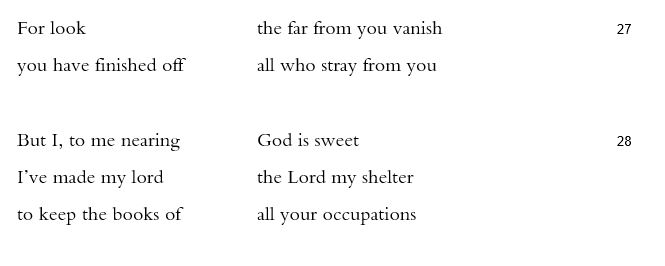
When, for example, the first-person speaker returns at the end of the psalm to talk about “them,” in verses 20-31, we may feel that the Lord’s advocacy for the weak is righteous and thoroughly necessary—“oh he stands | at the right of the poor / to rescue from those | indicting his neck” (31). Or we may feel that the raw cruelty of the psalm’s middle section, combined with the speaker’s unsubstantiated claims to be “weak and poor,” renders the speaker too unsavory to be sympathetic. The rhetoric of the psalm’s ending, after all, tries a little of everything: “oh sweet your care | free me” (21), “my knees totter | from fasting” (24), “let my nemeses | wear disgrace” (29), rescue me “so they can know | this is your hand / you Lord | did this” (27). Flattery, victimhood, despair, lashing out, flattery again.
Similarly, our understanding of the psalm changes if we hear the curses in verses 6-19 in the voice of the speaker or of the speaker’s accusers or even in the voice of the satan who shows up in the book of Job in the role of God’s prosecuting attorney. The verbs and more importantly the pronouns differ in this middle section, with no first-person singular, only an unnamed “he.” If it’s the defendant who speaks these imprecations, if he wants them dead, the plural accusers have become suddenly singular, only to become plural again at the end of the psalm. That is grammatically possible, but the more likely reading is that they are speaking about him. The death wishes are no less brutal, but the defendant entirely more sympathetic: they want him dead.
What commentators despise is likely the glee that the psalm itself seems to show in the curses themselves, indulging in the poetic lust for payback. Of all those curses, the image of homeless orphans begging and scrounging in the middens (10) may be the most vivid and haunting. Its only rival for poetic power is the speaker’s feeling of having been “walked out” “as a shadow as it spreads,” an expression followed by “I’ve been shaken off | like a sudden swarm” (23). It’s hard not to feel all of these lines deep in the bones.
And if it’s morally outrageous to think that someone could wish to see someone else’s children pleading and scouring through trash heaps, is it not more outrageous that there actually are such children in the world, year after year after year? Someone must want them to be there, or not want hard enough for them not to be.

 The Book of Psalms