(director: of the servant of the Lord, of David)

* * *
From its first line, Psalm 36 surprises. It starts with the hallmark of the prophetic oracle, the word ne’um, which is usually followed in the Bible by the divine name— “the word of the Lord”; “thus says the Lord”—and only rarely, by another human (Balaam in Numbers, David in 2 Samuel). Only here does the word personify a concept, pesh’a, revolt, transgression. Rebellion’s oracle is delivered to another abstraction: the criminal who lives in the speaker’s heart. The gesture is strikingly self-conscious for biblical art, as befits such an inward-looking series of verses. It’s Wrong who diagnoses the crook in the heart, the criminal whose eyes are not at all concerned about the Lord. We go down and in. Inside this cheat who lives in the heart are eyes that do not see but are “smoothed over, ”a second personification nested within the first. These are Russian dolls of self-deception and, as we learn in 2b, layers of self-loathing: “finding guilt | hating it.” Verse 3 moves swiftly out to the consequences: “The words of his mouth | harm and fraud / he is done being smart |doing good.”
From this inside-inside-out setup, the psalm turns to the much more common vertical axis: lying on a bed followed by standing on a road (4), care and faithfulness and justice to the skies and clouds and mountains, high and higher (5), “verdicts | the mighty deep” (6). Badness might be deep within the heart, a guilt, a hatred of guilt, a covering over of guilt or of the hatred of guilt, but four of the Lord’s key traits are mapped onto the planet’s heights and depths.
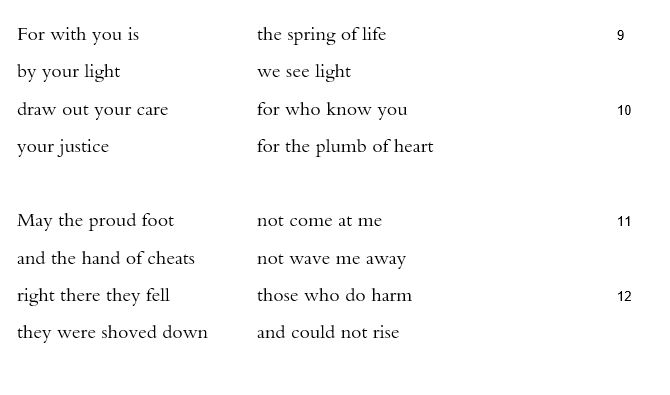
Shrewdly, the psalm turns from inwardness and upwardness to immersion, the nestling in wings (7), this suffusion with rich oil and “the stream of your charms” (8). The liquid is participatory: “you give them to drink / For with you is | the spring of life” (9); “draw out your care” (10). So is the psalm’s most immersive, participatory line, which returns to the eyes from verses 1 and 2: “by your light | we see light” (9).
The final stanza’s turn is a return. It retrieves both the inward and the vertical. “Those who do harm” recalls “harm” from verse 3 as well as, from verse 4, the one who “plots harm | from his bed” and “stands himself | on a road not good” (4). This one who plots harm, in context, was “the cheat in the heart” of verse 1, as verse 11 reminds, “the hand of cheats | not wave me away” (11). Here by the end of the poem, marked by a locative “there,” all of those who do harm have fallen— downward— “they were shoved down | and could not rise” (12). To the modern ear, the thought of something dangerous inside being “shoved down” sounds like a recipe for disaster. Freud spoke on dreams, of the mind’s art of disguise and disguising disguise. But in the outside world, the cheats standing by the road are dropped and the Lord’s care remains drawn out and soaked through.




 The Book of Psalms