(of David)

* * *
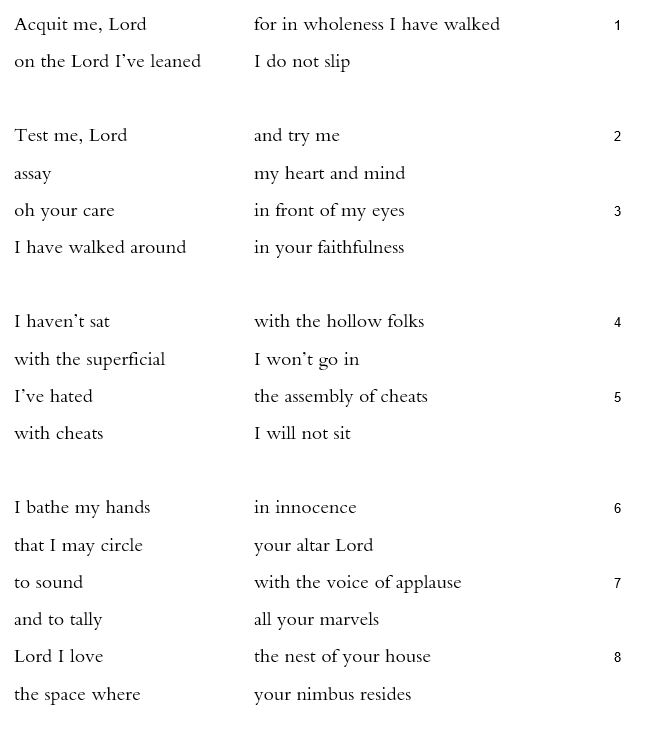
Psalm 26 choreographs a claim of innocence. But while the word choreography comes from the word chorus (χορός), the psalm is the performance of a singular speaker. The rarer word chorography, from the word for space or position (χώρα), refers to mapping territory, marking out space, which this psalm even more pointedly does. All the evidence of the speaker’s integrity and fidelity is presented in the psalmist’s body, feet, and hands, even the heart and the kidneys in verse 2 (translated “heart and mind”). This body is not static—the speaker walks and walks around, walks “in wholeness” (1,11) with sure feet (1, 12), and walks around in general “with your faithfulness” (3).
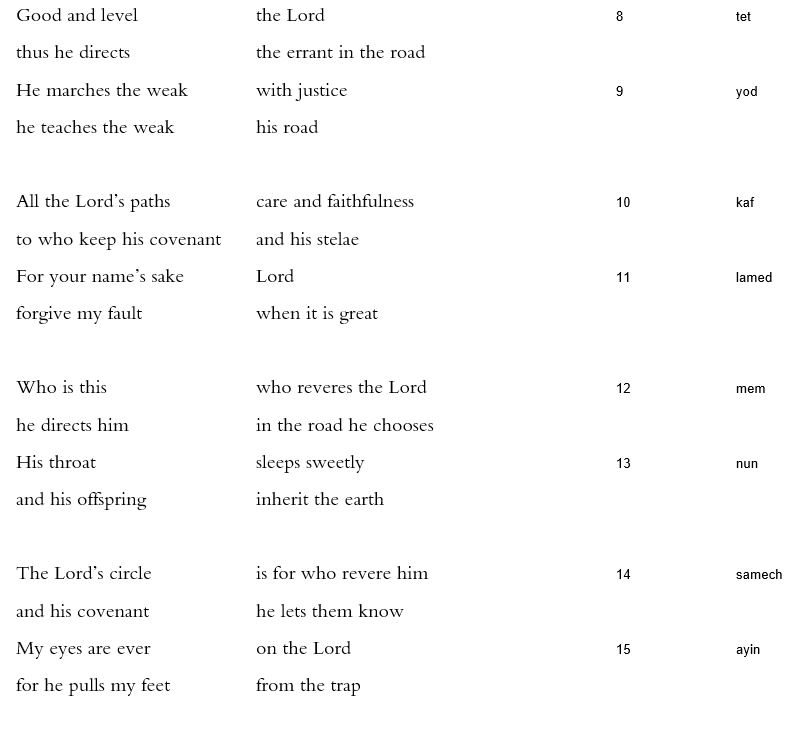
At the center of the psalm, the practice of walking around becomes a rite: “that I may circle | your altar Lord” (6). The circumambulation of the altar in verse 6 centers the speaker, enacting commitment, even as it honors the Lord. More, it marks out space, “the nest of your house / the space where | your honor resides” (8). That moment in the middle of the psalm stands out, too. It moves from visible motion, the dance, to aural performance, the voice: “to sound | with the voice of applause / and to tally | all your marvels” (7).
On either side of this central act at the altar, the speaker’s moving body is contrasted with the stilled bodies of the guilty. In verses 4 and 5, these are “the hollow folks… those who cover up…the assembly of cheats” with whom “I have not sat… I will not sit.” In verses 9 and 10, the empty and the deceptive have become “offenders” and even “the bloodstained,” defined now by acts of deception and filling, “in whose two hands | a scheme / whose right hand | has filled with a bribe.” It is their hands that cheat. Their feet don’t move.
And so in the end, the guilty cannot plant their feet “in the assemblies” (12). They aren’t even there, so of course they cannot kneel.
*
26:1 in wholeness I have walked Compare “in wholeness | I walk” in verse 11. The performance of the psalm seems to turn the metaphorical walking with integrity, here at the start of psalm, into a more literal kind of walking.
26:2 Test me The word bechaneini deftly includes the word chaneini, “feel for me,” which appears with a similar-sounding vav-prefix in verse 11. Brilliantly, the process of testing both incorporates and yields sympathy, pity, feeling.
26:4 with the hollow folks / with the superficial Literally, “with the men of emptiness and with the ones who are concealed.” The pairing points first to an absence of depth, then to an abundance of surface.
26:6 I bathe my hands See also 73:13. The verb nearly always indicates ritual cleanliness.
26:6 that I may circle | your altar The center of the psalm features a ritual circumambulation. The verb is cohortative with a vav-prefix, indicating a desire and purpose.
26:8 the nest of your house I miss the KJV word “habitation” here, but the Hebrew really is much simpler and more common, used for the home of animals in Jeremiah 9:11 and 10:22.
26:9 May you not lump Literally, “don’t gather with the errant my neck.” It’s an urgent attempt to distance himself or herself from those to be punished.



 The Book of Psalms