(a prayer of Moses, man of God)


* * *
Ascribing Psalm 90 to Moses accentuates— or invents— its archaic feel. The psalm’s abiding interest in timelessness and transience comes to seem ancient, its voice and wisdom instructive, authoritative. More pointedly, however, the name of Moses invites readers to attend closely to the language of flooding, passing over, and the face-to-face imagery, all of which recreate a story of emancipation.
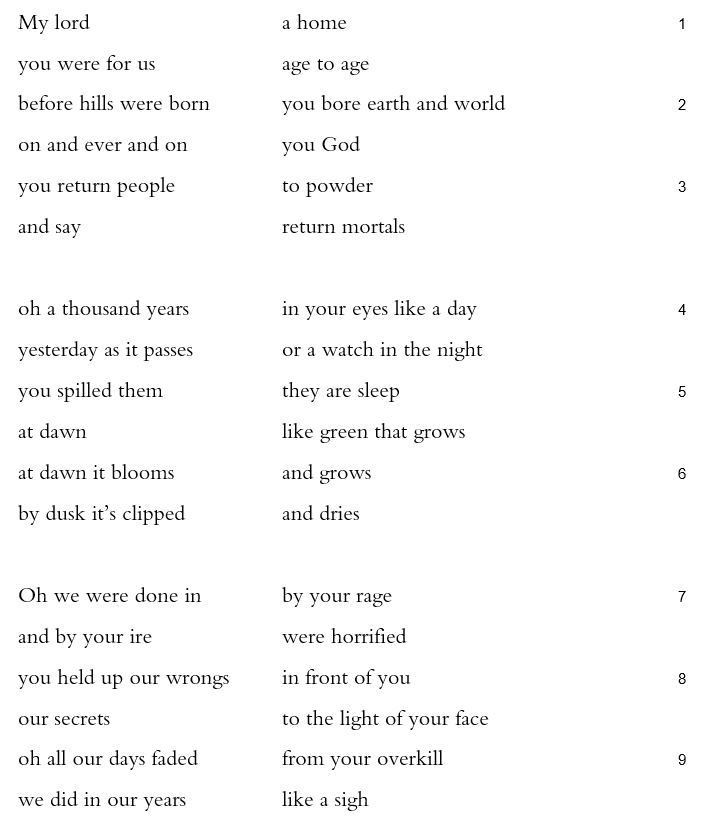
Curiously, this psalm so focused on ephemerality begins by invoking space. The first line nestles the word ma’on, a place to live, habitat, between “my lord” and “you,” before nesting “for us” between “you were” and “age to age.” The first two stanzas look to the ground, “the hills,” “earth and world” (2), “powder,” “mortals” (literally, “children of the soil”; 3), and “green that grows” only to be mown (5-6). But the rest of the poem is rootless, absent of places, an array of expressions for time, from “age to age” and “on and ever and on” (1, 2) to “how long” and “all our days” (13, 14). Four times, “years” and “days”/“day” are paired (4, 9, 10, 15), contrasting how God views time— “oh a thousand years | in your eyes like a day” (4)— with how humans view it— “like the days you hurts us/ the years | that we saw bad / let be seen by your servants | your doing” (15-16). God’s eyes shrink the years to a day. The eyes of human suffering instead see days stretching out to years. Here at the end of verse 15, “bad” (ra`ah) is lodged between two verbs for sight (ra’ah). Earlier, in verse 10, “the days of our years | seventy years” stretch to eighty years before being revealed as “trouble and harm” (10). Life is both too short and too long.
Within these competing conceptions of time, it’s easy to miss other repetitions and references to the Israelites’ journey from Egypt to the promised land. The root `eber has meanings that range from passing over (“yesterday as it passes,” 4; cf. “for I will pass over the land of Egypt” Exod 12:1) to an excess of wrath (“your overkill,” Ps 90:9, 11) to the word “Hebrew” itself, used seven times in the first two chapters of the book of Exodus. In Psalm 90’s second stanza, the passing of yesterday is followed by a loanword for flooding: “you spilled them” (5). The two uses of the word “overkill,” itself a kind of flooding, lie on either side of another loanword, gaz, “it is crossed” (10). Verse 14 presents saba`enu baboqer, “surfeit us | at dawn,” yet another kind of excess. Saba` is the root used memorably by Moses in the wilderness: “at dusk meat to eat and bread at dawn to surfeit” (Exod 16:8, cf. 16:12; note the repetition of “dusk” and “dawn,” cf. Ps 90:5-6). In Deuteronomy 6 and 8, Moses again uses the word to describe the promises of the land across the Jordan: “you will eat and you will be full” (Deut 6:11, 8:10, 12). As with so many biblical passages, the psalm reenacts the journey of liberation as a turning: God, who returns “people | to powder / and [says] | return mortals” (3), is asked to “return” and “feel sorry” (13). Even the image of God’s face involves a turning: the word “face,” panekha, in verse 8 is picked up in verse 9 by the verb panu, literally “they turn to face,” the idiom for the twilight failing of the light of day. The darkening of God’s face, the turning from day to night, the ending of one’s years, and the story of the forty years in the wilderness thus all are rhymed.
Three times, the psalm relies on a particular verbal ambiguity that results from the so-called vav-consecutive, a sequence of different verb forms: either a prefixed verb followed by a suffixed verb with a vav in front, or a suffixed verb followed by vav + a prefixed form. In terms of verb tense, the first sequence is imperfect/present followed by either the past/perfect tense or a second instance of the present tense. This construction appears twice in verse 6: “at dawn it blooms | and grows / by dusk it’s clipped | and dries.” The ambiguity means that the verse could also be rendered, “at dawn it blooms | and has grown / by dusk it’s clipped | and dried.” In verse 11, the second sequence appears: “oh it’s crossed fast / and we flit” could also end “and we flew.” In both cases, the effect underscores the transience of life: things grow and are grown all at once; life has been passed through quickly and quickly we fly and have flown. These routes of evanescence make one want to read Bishop’s “At the Fishhouses” again, or sing “I’ll Fly Away,” or kindle a candle in a medieval skull. Memento mori.
 The Book of Psalms