


* * *
The most sublime of all psalms, a triumph of biblical poetry, Psalm 104 is also the most potent natural theology ever written, its purpose not to deduce nor prove God’s existence but to celebrate the world as a surfeit of movement and light.
The poetry dazzles from the start. Its praise of the Lord in verse 1 includes the marvelous sound cluster, gadalta me’od hod vehadar lavashta, “you are vast and very / in fine finery | you are arrayed.” It’s so many dentals, such open vowels. Hod echoes me’od, and is echoed by vehadar: “very/ in fine finery.” The labial sounds of the verb lavashta (“you are arrayed”) quietly call back the word nafshi, “throat” from the beginning of the verse, linking God’s garments with the speaker’s speaking self. Verse 2 is similarly sonorous, carrying on with the o and a sounds: `oteh ’or kassalemah noteh shamayim kayri`ah, “wrapping light | like a cape/ extending skies | like a curtain.” The rhymes wed “wrapping” with “extending,” “cape” with curtain. The repeated shin/sin sounds continue from verse 1, now associating “throat” and “you are arrayed” with “cape” and “skies.” The word “curtain” picks up the guttural-with-r combination of the word “light.” If the sense is that the Lord is both wrapped in and unfurling the light and the sky, verbal dexterity underscores both parts, the enfolding and unfolding. Like a purloined letter, both cape and curtain reveal what they conceal.
Most of the psalm’s power and loveliness is not lost in translation. Genesis 1 orders creation through meticulous patterns of opposition and separation, the waters above separated from the waters below. Here, however, the waters spill. They spill carefully, perhaps, and they do have their places, but they spill nonetheless, from verse 6 all the way to verse 15, metamorphosing into animals and plants, into bread and wine and oil and bread. The waters “flit off” and “flee” (7), “they scale mountains | they go down dales” (8). They become “creeks | through ravines / between mountains | they go” (10). “They make drink | all the life of the field/ they slake the thirst | of the onagers” (11). The giving waters remind one of Keats’s autumn, which conspires with the sun “to load and bless | With fruit the vines that round the thatch-eves run… And fill all fruit with ripeness to the core.” What lines feel more like that ode than this psalm’s verses 13 and 14?
making mountains drink | from his lofts
of the fruit of your works | the earth is gorged
sprouting grass | for the herd
and greens | for the help of mortals.
The water brings fertility and food in a way that seems at first anthropocentric, as teleological as the Priestly creation story in Genesis 1, a kind of argument from design: “wine | he brightens the human heart / to glisten faces | oil / bread | the human heart upholds” (15). All of the water and all the green suddenly seem directed towards human fulfillment in this nearly ritual verse, the heart of a person pleased with bread and wine, drops of oil lingering around the mouth. And yet the “he” of verse 15 can refer both to God and to the wine itself, which weakens the purposiveness. By comparison with Genesis 1, the psalm claims absolutely nothing about human dominion.
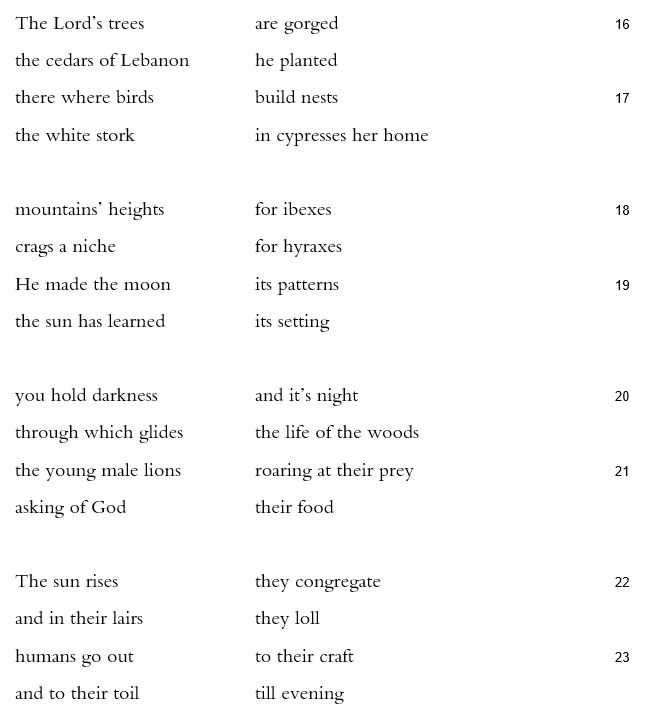
That the poem concerns much more than human fulfillment is clear because the poem keeps going. It leads not to bread and wine, but to trees and birds (“the white stork | in cypresses her home,” 17), and to the yearling lions “roaring at their prey / asking of God | their food” (21). Lions say grace. The sea does as well. “For you | they all wait / to give them food | in its time” (27).
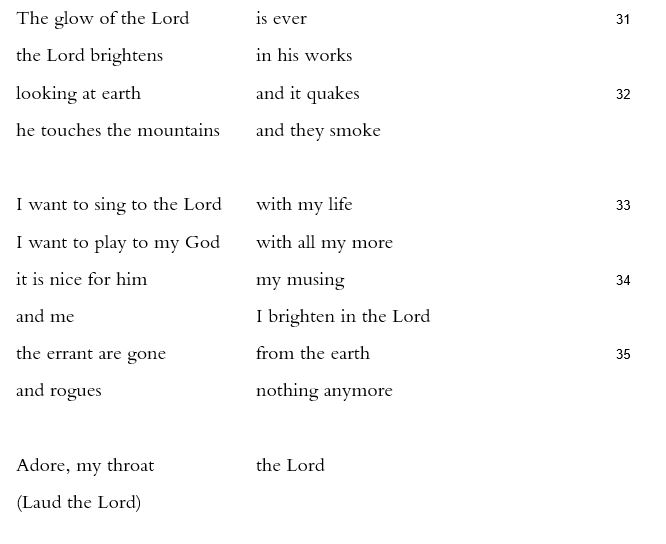
The swelling conclusion of the poem is neither pat nor perfect, neither crowning the human nor treating God, or knowing, or order with the kind of theological certainty that Hume rightly despises. Rather, the poem closes with the scene of its making, the psalmist expressing first-person wishes and explaining why:
I want to sing to the Lord | with my life
I want to play to my God | with all my more
it is nice to him | my musing
and me | I brighten in the Lord
the errant are gone | from the earth
and rogues | nothing anymore (33-35).
The pairing of ashirah (“I want to sing”) and azeimmerah (“I want to play”) is conventional, but the rest gets more and more surprising. The speaker’s life (33) calls back “the lives” of the sea (25), the “life of the woods” (20), and “all the life of the field” (11). In verse 33, her own “life” is paired with the word be`odi, a construction built of the prepositional prefix “with” or “for,” plus the first-person possessive suffix “my,” which surround the adverbial substantive `od, a word that conveys continuity as well as excess, the notion of still more besides. Its appearance here anticipates the `od of verse 35, where its negation help erases bad from the world. To the attentive reader, it also echoes other parts of the psalm, the similar sound of me’od, the Lord’s “very”(1) and ve`ed, the “on” in the “ever and on” of the earth’s foundation (5). Together, the speaker’s life and continuity, her exceeding of herself, call to mind the Lord’s self-exceeding and the continuity of the world, a continuity and a greater-than that both exclude the bad.
The passage’s middle and final verses surprise even more. “It is nice for him | my musing / and me | I brighten in the Lord” (34). Like verse 33, these verbs may be aspirational, jussive (“may it be nice for him”) and cohortative (“may I brighten in the Lord”), but they also read as declaratives. As declaratives they blur, amplifying meaning: “my musing” and “I” are nice for him, my musing is nice for him and for me. The speaker’s brightening joy recalls the wine and heart of verse 15 as it recalls the beautifully ambiguous phrase from verse 31, “the Lord brightens | in his works.”
On a first reading, verse 35 feels frankly out of place from all of this, abruptly turning to cheats and sinners, the wayward and the wrong. Just like verse 34, however, the verse is both a wish and a surprising declaration. “May all the errant be gone,” an optimist prays for the world. And yet, under the aspect of Psalm 104, perhaps the errant are already gone. What do the rogues amount to? Their character is privative, whereas the world is abundance.
The world is filled with light and motion. God moves (2-4); the waters move (7-10); plants sprout (14); animals nest and move (12, 17-18, 20-22, 25-27), including humans (23). God unfolds and enfolds light (2) and bodies of light (19-20), which move, making night and day (20-23). This light is the Lord’s glow, the Lord’s brightening (31). But more important than both the light and the movement are all of the images of filling and satisfying, images of surfeit. “Of the fruit of your works | the earth is gorged” (13), the psalm insists, later adding that “the Lord’s trees | are gorged” (16) and that the Lord opens a hand and all “are gorged with good” (28). This is Genesis 1, but more. God doesn’t just create light and see that it is good. The world is light and good, stuffed to excess.
To call Psalm 104 a natural theology may be a stretch if the term is narrowly conceived as a product of Western medieval and early modern rationalist theologians or of those willful 19th and 20th century Rip Van Winkles who imitate them. There is something much wiser about Gerhard von Rad’s insistence that the very idea of nature is alien to the Hebrew Bible. With no nature, how could there be either a natural theology or even a supernatural? Indeed, the luster of this particular psalm is how its spilling of water and light becomes the filling and feeding of the living of the earth, how these lives reply to the body of God, their wind taken and given. There is no nature because these are lives, not things, not objects contrasted with human or divine subjects. Just as importantly, the poem doesn’t argue. It celebrates and muses. And in its musing, ALL is supernature, lives are gorged, so gorged with good that the proper response is to brighten in the Lord, to see the rotten and rogues as nothing anymore.

 The Book of Psalms