(a song, a lyric, of the Qorachites; director: to Mahalat, a didactic for humility, of Heman the Ezrahite)
* * *
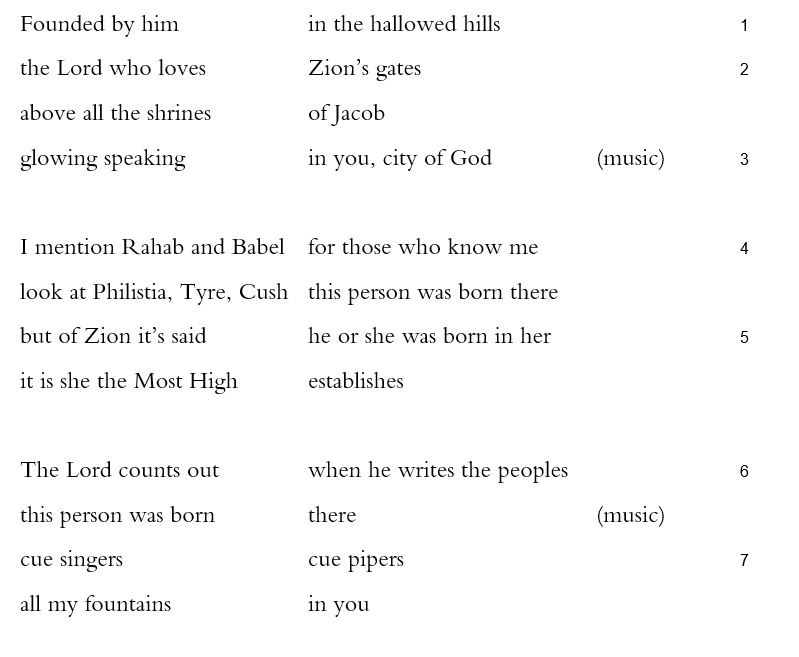
It gets dark here near the end of Book Three (Pss 73-89) but honesty about darkness matters. Besides the biological fact that death comes for us all, acknowledgment of death’s finality is a condition of moral and psychological integrity. The wish to have a whole, unified heart (86:11) means accepting that the nefesh, the soul that is trachea, larynx, glottis, esophagus, mandible, hyoid, sternum, the carotid arteries, is not some separable eternity that floats off while only the body rots. By far most of the Hebrew Bible holds no hope in personal, subjective immortality; if you want to live forever, you’d better have a people. Even politically, for the earliest audiences of the psalms, it must have been imperative to admit, finally, that the Davidic kings were dead and buried. For these audiences and for the Persian and Hellenistic occupiers reading over their shoulders, it must have been important to show that all the monarchic imagery was just memory and figuration for the kingship of the Lord, rather than some politically subversive belief that David himself might come back from the dead. Messianic and eschatological readings of the Psalms exist, but they are mostly willful and tendentious. Book Three closes not by hoping for a new anointed, but by insisting that while Jerusalem and Yahweh remain— in Zion is birth, according to Psalm 87— the literal monarchy is buried and, as Psalm 88 graphically reveals, dead.
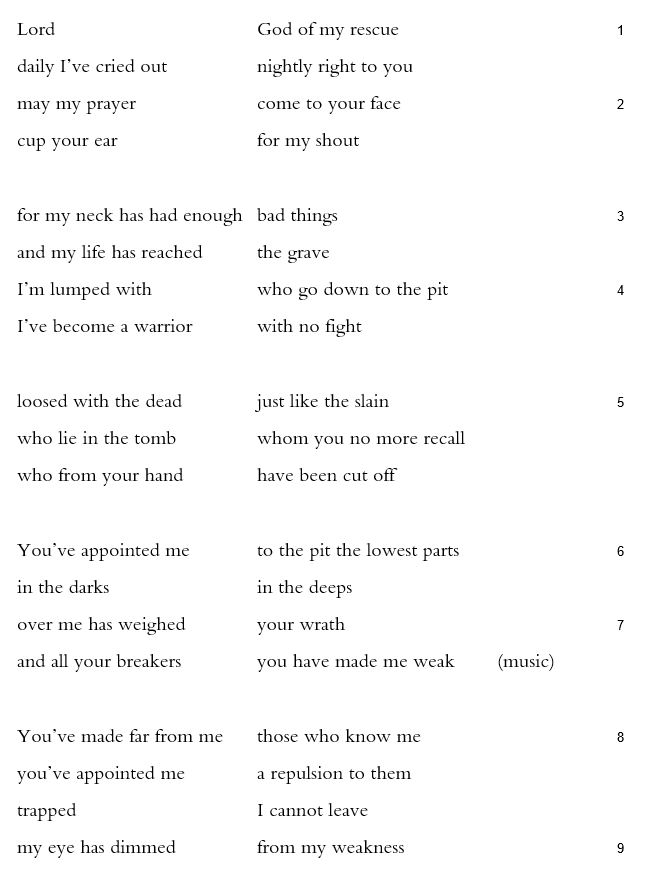
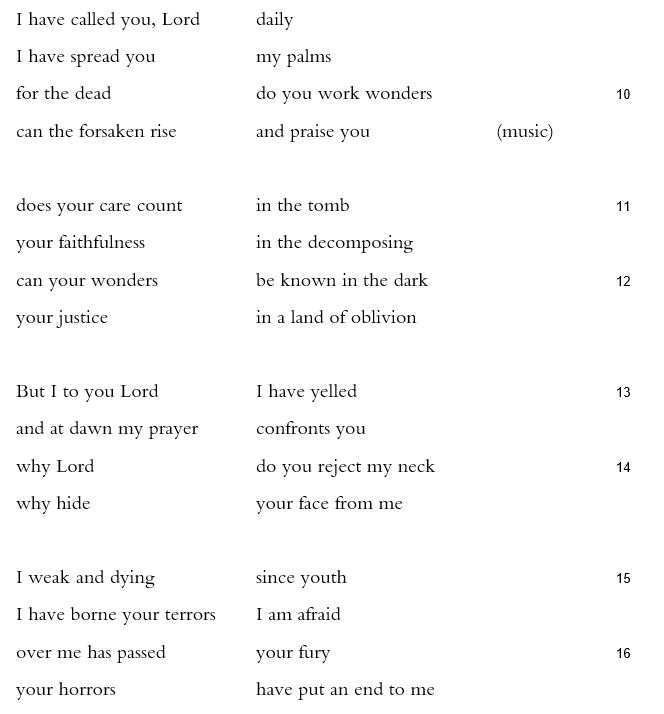
Psalm 88 reads like a scathing response to the naïve hyperbole of Psalm 86:13, “and you have freed my neck | from the deepest of the grave,” a line that allows literalists of every generation to imagine a bodily resurrection for King David. Literalists continue to hash Psalm 88 itself: “we cannot prove from which fatal disease the petitioner is suffering. There is no mention of leprosy… Very likely the petitioner is afflicted with a serious illness from his youth. It is possible that he lives outside the gates as an outcast” (Kraus II 192). Very likely, rather, the petitioner is dead, a persona, a poetic speaker who voices an author’s polemic against vacuous insincerities about dying and death, such as those centered by Psalm 86. The neck of the speaker of Psalm 88 “has had enough | bad things” (3): “at dawn my prayer | confronts you / why Lord | do you reject my neck” (14). Instead of freeing or rescue (88:1), Psalm 88 is all grave, whether named as she’ol (88:3, 11; cf. 86:13) or the tomb (88:5, 11) or “the pit the lowest parts / in the darks | in the deeps” (88:6; cf. 4). The psalm is a veritable thesaurus of “the dead” (5, 10), “the slain” (5), “the forsaken” (10), “the decomposing” (11), “the land of forgetting” (12), “your terrors… your fury/ your horrors” (15-16), and most significantly, darkness (6, 12, 18).
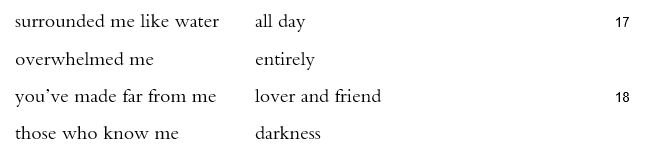
Or it could be a thesaurus if it were not arranged as a descent, ever darker and deeper. What begins with the “Lord | God of my rescue” and a cry and prayer that might come “right to you… to your face… your ear” (1-2) ends far from there: “you have made far from me | lover and friend / those who know me | darkness” (18). Instead of God’s face, or anyone’s face, it’s darkness; instead of rescue, it’s distance. In the second stanza, the speaker’s life “has reached | the grave” (3), but by the fourth stanza “over me has weighed || all your wrath” (7), and by the second-to-last stanza, “over me has passed | all your fury / your horrors | have put an end to me” (16). The psalm weighs down, a striking contrast from the metaphors of weight built into the theological terms kavod, for the heft of glory, or betach, the leaning back of trust. God begins the psalm as silence, becomes rage, and ends as terrors, the return of the waters of chaos in which the speaker drowns: the horrors have “surrounded me like water | all day / overwhelmed me | entirely” (17). These are not the held-back waters of Genesis and Exodus. They are the flooding undoing of creation.
In counterpoint with the descent is the psalm’s insistent repetition and recursion. “Over me” (7), “over me” (16), “over me” (17), the dead or dying speaker intones three times in a parody of a call to “my God” (`alai ~ a’alai). He calls to the Lord daily according to verses 1, 9, and 14, though in verse 14 the verb intensifies. “You’ve made far from me | those who know me” the speaker also says in both verses 8 and 18. “Those who know me” (meyudda`ai) calls back God’s similar participle in Psalm 87:4 (leyode`ai). It also calls to mind the question, “can your wonders | be known in the dark” (12), which itself calls back questions and statements from the beginning of Book Three: “how would God know/ is there knowing | for the Highest” (73:11), and “he will be known | as one who brings upon her / in a copse of trees | axes” (74:5). Linked with “those who know me” among the speaker’s lost friends is “one who loves,” ’oheiv, which also calls back Psalm 87, where it refers to the Lord. (Also referring to Psalm 87 is the counting of the dead in Psalm 88:4, which contrasts with the counting of births in 87:6). Likewise, the word yechad—here, “entirely” (88:17)— calls back the words “alone” and the verb “unite“ or “keep together” from Psalm 86 (86:10, 11). God’s singularity has become God’s absence, the speaker’s isolation.
Of all this psalm’s corrections of prior psalms, none is more cutting than its reframing of the claim made by the speaker of Psalm 86: `ani ve’evyon ’ani, “weak and in want | am I” (86:1). There, the speaker, allegedly David himself, claimed to be weak (`ani), and therefore asked God to `anah, to answer. The speaker of Psalm 88, by contrast, uses the verb `anah not to ask for a response, but to announce completed action, `innita, “you have made me weak.” He follows this with his own dark pun, `aiyini da’aba minni `oni, “my eye has dimmed | from my weakness” (9). When we get to verse 15, and the word pair `ani ’ani resumes, it’s clear that this speaker, in the actual grave, actually is weak.
The word the psalm seems to dance around in this profound wordplay is the word for nothingness, ’ein. It appears as the speaker characterizes himself in verse 4 as a man ’ein `eyal, of no strength. It is surely no accident that this second word, a rare word, a loan word for vigor, coming immediate after a negative, sounds like a deliberate way of naming God.


 The Book of Psalms