(a song, an Asaph lyric)

* * *
As the final psalm in the sequence from Psalm 42-83, a grouping often called the Elohistic Psalter for its heavy use of the name ’elohim (“God”), Psalm 83 derives much of its meaning from association with the first psalm (or “psalms”) of the collection, Psalm 42-43. As the final Asaph psalm, it recalls the preceding psalm, Psalm 82, as well as the first Asaph psalm, Psalm 50. Less apparently, Psalm 83 also relies on structural and thematic parallels with the story of the Tower of Babel in Genesis 11. Together these references make the case that those enemies who have conspired against Israel have sought to usurp what belongs to the name of Israel’s Lord, the only power over all other gods. Those enemies’ presumptuousness, the psalm implies, will be punished by scattering.
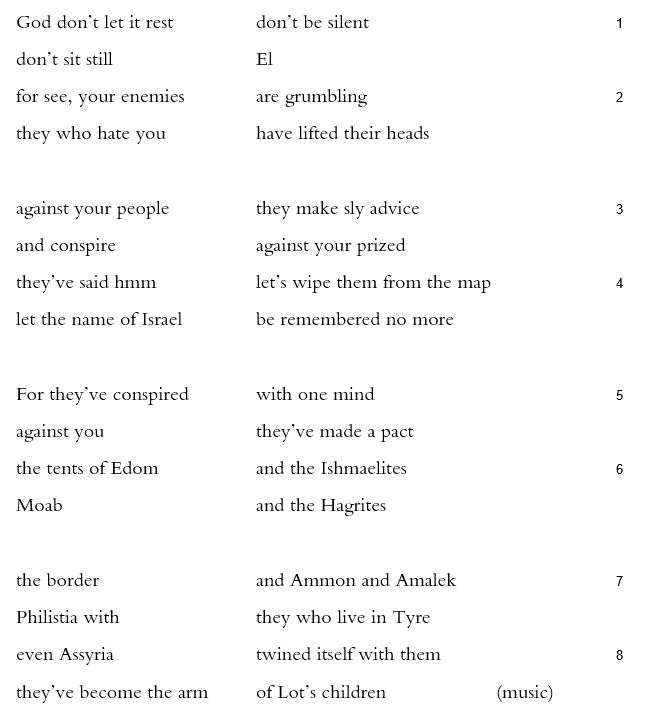
The psalm begins where Psalm 82 left off, linking negation and the gods: ’elohim ’al domi-lakh ’al techerash ve’al tishqot ’el, “God don’t let it rest | don’t be silent / don’t sit still | El” (1). Here as elsewhere we see the potent ambiguity of the name ’elohim which can be singular or plural or both, depending on context. “God don’t let it rest” looks in English like a clause with a verb that would decide the number, “God” or “gods.” But that initial construction in verse 1 contains no clues about number, literally saying “God/gods no rest to her,” where the female object marker is unstated, as happens sometimes. With the name ’el, the widespread Near Eastern name for God, there are two powerful dangers. The first is the ambiguity that, except for a difference of vowels audible but invisible in the original consonantal text, the name is identical with ’al, the adverb “not.” Thus a line like verse 1 has the consonant chain aleph + lamed five times, twice for divinity, three times for negation, but with the lurking sense that the verse is five names for nothing and three ways of saying silence. It reads like Paul Celan.
The other powerful danger of the name ’el is that it was so widespread, or seems to have been. As the name of everyone’s God, it may have been invitingly universal, but reflects no specificity for Israel. Psalm 50’s solution to this problem is to call God ’el ’elohim YHWH, “God of gods the Lord,” to say “Our God comes | and does not keep quiet,” and to imagine God taking the witness stand: “I want to speak, Israel / let me testify against you | God your God me” (50:1, 3, 7). Psalm 50 ends with a promise of a revealed name: “who offers thanks | honors me / and a name I will show | a path to God’s rescue” (50:23).
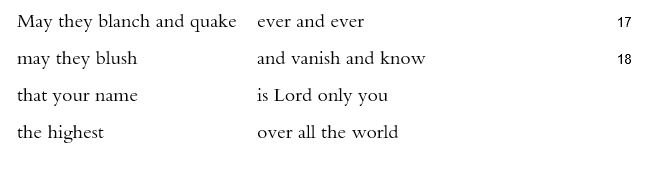
Prior psalms in the Elohistic Psalter approached this same set of problems, how to handle a God who can be or seem both singular and plural, near and far, present and absent, by repeating the name of God 27 times, as Psalm 42/43 does, and by asking where God has gone (42:3, 10; 43:23-24). Like the current psalm, Psalm 42/43 also played with near-homonyms for the name of God, from the deer ’eyyal (42:1) to the prepositions `al and ’el (42:5, 42:11, 43:5). In Psalm 83, the repetition of `al, the “against” in “against your people… against your prized” (3) and “against you” (5), reminds the reader of the wordplay at the beginning of the unit. These `al patterns culminate in the last verse of the Elohistic Psalter, 83:18, with the divine name `elyon which is now made an attribute of YHWH, the Lord, lifted `al kol ha-’arets, “over all the world”: “your name | is Lord only / the highest | over all the world.”
That phrase `al kol ha’arets shows up in similar form three times in the story of the tower of Babel “over the face of all the earth” (`al penei kol ha’arets, Gen 11:4,8,9; cf. Gen 1:29, 7:3; `al kol penei ha’arets Gen 41:56). The whole earth, according to Genesis 11:4, sought to build themselves a city and tower with its “head” in the skies and to make “ourselves a name.” Conspiring, the people twice say habah followed by tongue-twisters that play on the name of Babylon: habah nilbenah lebeinim, “come, let’s brick some bricks,” and habah nibneh lanu… vena`asu lanu “come, let’s build us… let’s make us…” (Gen 11:3-4). Habah, the Lord responds sharply in 11:7, with his own literal tongue twister, neiredah venabelah sham sefatam, “come, let’s go down and mix there their tongue.” Thus, the story concludes, the partial tower is named Babel, for sham balal YHWH sefat kol ha’arets, “the Lord confused the tongue of all the world.”
Every part of this story is valuable for Psalm 83, beginning with the aspirational conspiring of the others, the nations who lift their “head” (2-3) and say, “hmm | let’s wipe them from the map” (4, literally “they’ve said come, let’s cut them down from a nation”). These others don’t just threaten the people of Israel, according to the psalm. They threaten God: nirasha lanu, they say, “let’s seize us,” ’et ne’ot ’elohim, “the meadows of God.” That is, also: “let’s seize us | the meadows of the gods.” To this centripetal motion of adversaries who seek to work as one (“they’ve conspired | with one mind,” 5; cf. Gen 11:1, 6), the Lord is invited to respond again by dispersing the peoples of the whole world, not with a balal, but with a bahal: “with your stormwinds | quake them” (tebahalem, Ps 83:15), “May they blanch and quake” (veyibbahalu, 18). Rather than seeking a name for themselves, these conspirators have sought to erase Israel’s name: “let the name of Israel | be remembered no more” (4). The punishments the speaker calls for from the Lord are violent, to be sure, but centrifugal almost to the point of being cartoonish: “chase them thus | with your tempest / with your stormwinds | quake them” (15).
The ultimate purpose of these punishments is revealed in the repeated mention of the Lord’s name at the end of the poem: “so they ask your name | Lord” (16) and “may they blush | and vanish and learn / that your name | is Lord only / the highest | over all the world” (17-18). A project of usurpation that began in Babylon, continues, according to this psalm, through “Lot’s children” (8). If there is to be a true temple to a true God, the psalm suggests, space needs to made by and for the name of the Lord. The invading nations who hoped to converge “together” (yachdav 5; cf. Gen 13:6) are to be thwarted, the psalm hopes, by the work of the God whose name is YHWH “only you” (lebaddekha, Ps 83:18; cf. Isa 37:16, 20). The payoff, in a psalm with so many names of enemies, in a collection within the book of Psalms with such varied, ambiguous names for God, is to converge on one name and one name only.


 The Book of Psalms