
* * *
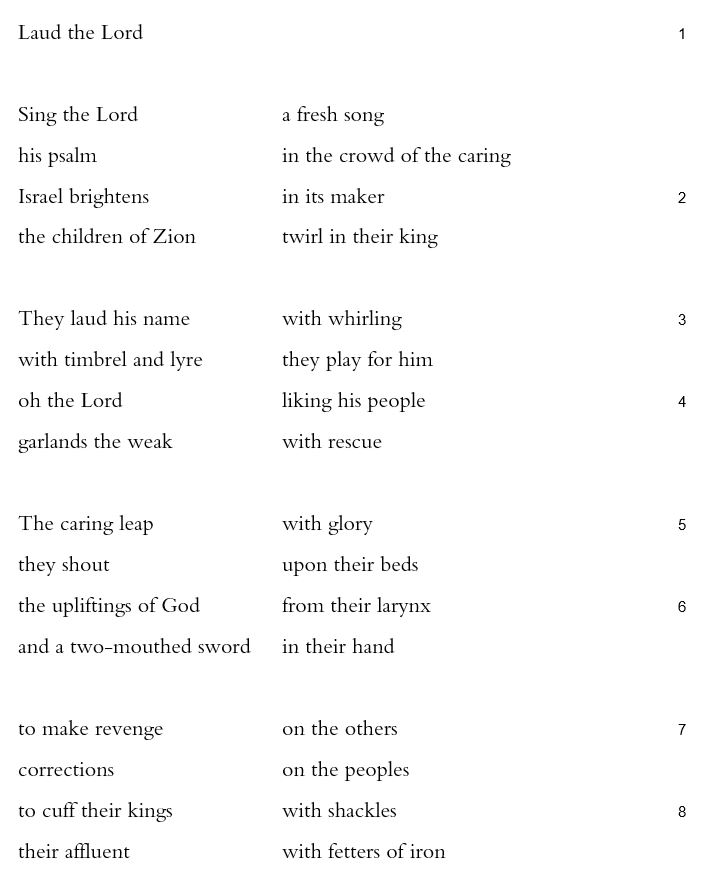
Reading Psalm 149, every reader assumes that the “timbrel and lyre” (3) are real, that they are literal objects touched and sounded and heard. So, too, “the fresh song” sung “in the crowd of the caring” (1) readers take as literal, though with an added sense of performance: that this song being sung now is the new one identified by the song itself. Even the psalm’s language of dancing, “twirl” (2b), “whirling” (3a), and “leap” (5a), seems more likely to indicate literal joyful movement than to symbolize internal feelings of gladness. The literal anchors readers, especially when it’s easy to see.
What’s definitively figurative in the psalm is easy to see as well. “He garlands the weak | with rescue” cannot be literal because it’s abstract (4b). The image, or figure, is there in the verb “garland,” which can mean both a kind of encircling and an adorning or beautifying: divine help is thus like a necklacing of the poor, like a laying of a lei. The figurative sails the reader off in search of what is meant but not said. With no literal, the reader drifts; with no figurative, there’s only treading water or there’s no water to tread.
Poetry—psalms are no exception—layers the literal and the figurative. To continue the nautical metaphor, poetry tacks. The lines “with whirling / with timbrel and lyre | they play for him” (3) may be literal, but they borrow language from other dances with instruments. The ideal reader recalls the celebration of Miriam and “all the women” in Exodus 15:20, the untimely celebration of Jephthah’s daughter in Judges 11:34, and the vision of a restored Jerusalem in Jeremiah 31 (esp. Jer 31:4). The timbrel and the lyre are no less real for being richly allusive, but they mean more than one literal thing. Likewise in verse 4, both the Lord’s “liking” and the word “weak” reuse words from Psalm 147 (Ps 147:11, 147:6), words that are also found in the late chapters of Isaiah. Psalm 149 doesn’t just hold up objects and state facts about them. It figures meaning by allusion and reference; poems are about other poems, as Harold Bloom among others relentlessly showed.
What, then, is the reader to do with these other concrete objects in Psalm 149, the troublesome “beds” (5) and “sword” (6), the “shackles” and “fetters” that avenge captivity (8), the “verdict written down” (9)? Are those literal beds that the covenant faithful, “the caring,” literally bounce and shout upon, while—depending how one links verses 5 and 6—wielding a literal sword? Are the neighboring nations of verse 7 literally to be punished with literal manacles and chains, governed by a literal verdict (already or yet to be) written down? All of these things cannot be literal, unless jumping and yelling on a bed with a sword somehow facilitates revenge.
In his nineteenth-century commentary on Psalm 149, Franz Delitzsch writes,
“By means of this psalm Gaspar Scioppius inflamed the Roman Catholic princes for the thirty years’ religious war in his book Classicum Belli Sacri, a book which was not written with ink, but with blood. And within the Protestant church, by means of this psalm, Thomas Münzer stirred up the Peasants’ War” (Gunkel 366).
In our time, the bottom of the cage of the internet is lined with confident screeds that would make the second half of Psalm 149 support theologies of private militarization or armed insurrection, even theories of divine authorship for select clauses in the Bill of Rights, taking that sword literally, all too literally.
But there is every reason to read the sword figuratively. It’s a cherev pipiyot, literally a sword with two mouths. The “mouth” of a sword is the idiom for its blade edge, so the word is taken to mean “double-edged” (Judg 3:16) But pipiyot is a word that only appears here and in Isaiah 41, in a passage of consolation for those released from exile to Babylon. The Lord tells them they have been strengthened, their enemies finished off.
Now, I have turned you into a grind-board, newly sharp with teeth (pipiyot). You can thresh mountains and crush them and the hills you can turn to chaff. You can winnow them and a breath will lift them, a tempest toss them, and you will whirl in the Lord and the hallowed of Israel you will praise. (Isa 41:15-16)
By the use of that rare word, Psalm 149 invokes the entire passage, importing Second Isaiah’s message of comfort, as well as its image of leveling mountains to make the road home more smooth. That the sword has two “mouths” seems relevant as well, given the proximity of shouting and the even more proximate rare word garon, “larynx.”
It’s not even clear that most of the other objects are literal, either. Biblical beds suggest not just privacy (Exod 8:3, 2 Sam 4:11) and rest (2 Sam 4:5, Job 33:15) but sexual intimacy (Prov 7:17, Songs 3:1, Isa 57:8). The word mishkebotam, “their beds” (Isa 57:2, Hos 7:14) is very close to mishkenotam, “their homes” (Ps 49:11, cf. Isa 54:2). Verse 5 could then pair— whether it is a scribal error or just a near-homonym— the words kavod and mishkan, synonyms for the sanctuary (Ps 26:8). In association with revenge, the shackles and fetters of the vengeful second-to-last psalm in the Psalter call to mind the “chains” and “ropes” of the vengeful Psalm 2, making a tidy chiasm (Ps 149:8, Ps 2:3).
Even if the sword is literal, it is by no means clear whether it is grammatically linked to the sequence of infinitives that follow, “to make revenge… to cuff their kings… to make for them | a verdict written down” (7-9). Verse 9 concludes with an ambiguous pronoun in its pronouncement: “this is an honor | for all his caring.” Which? All three of the infinitives, plus the sword? Just the last infinitive, without the sword? Does the psalm’s conclusion suggest that it is glorious and honorable to wave a doubly dangerous sword intending revenge against governments and the 1% in some frothy apocalyptic vision of a verdict to be delivered? Or does it suggest that, of the three infinitives, making revenge, locking up the oligarchs, and making a written verdict, only this last is “an honor | for all his caring”? When possibilities multiply like this, certainty goes.
None of this is to kid-glove the Bible or to dispute Goethe’s conclusion that Psalm 149 may well be a “nasty” psalm (qtd. in Prinsloo 395). Nor is it to tame a psalm that, for all its confusions and discomfiting, clearly argues for a divine preference for the weak (4) over the affluent (8). It is to insist, rather, on not making texts say what we want them to say. From the second verse of Psalm 146 to the end of Psalm 150, the first-person singular has disappeared entirely from the book of Psalms in favor of a collective vision of a society built from castoffs (147:2), “making verdicts for the oppressed” (146:7), shackling others’ “affluent | with fetters of iron” (149:8). This is not a psalm that rubber-stamps gun ownership as necessarily caring or honorable, nor does it suggest God craves blood.

 The Book of Psalms