(director: don’t destroy, in stone, of David at Saul’s sending to watch the house to kill him)
* * *
Psalm 59 starts straightforwardly with a fourfold wish for rescue (“free me…evacuate me… free me… rescue me,” 1-2) and a threefold “not guilty” plea (“no crime is mine | no wrong is mine Lord / no fault is mine,” 3b-4a). By its second half, however, the psalm labors to reconcile its three invocations of God as strength (`oz) with its three invocations of God as care (chesed). “Strength” and “Care” are proximate or paralleled all three times: “Strength | for you I wait / for God | my Fort // my God my Care | goes before me” (9-10a), “I sing | your strength / and ring out at dawn | your care” (16), and “My Strength for you | I want to play / for God my fort | God my care” (17).
In a call for rescue from enemies encircling like packs of wild dogs, the combination of might and caring makes sense. Freeing another person requires motive and means. Love without power spins its wheels; power without love careens. Only together can kindness and strength free.
The sticky question, however, is what strength and care are to do with those enemies once the liberation is complete. And in verses 11-13, the speaker seems wildly incapable of deciding:
don’t slay them | or my people will forget
strew them | with your force
and take them down | Our Shield my lord
for the fault of their mouth | the words of their lips
may they be caught | in their conceit
and for the curses | and lies they recount
finish them in rage | finish them off entirely
that they may know | God reigns
in Jacob | to the ends of the earth
Having roused “the Lord | God of Forces / God of Israel,” and asking God in battle gear “to deal with | all the others” (5), the speaker asks now for these enemies to be spared, dispersed, and demoted (11). Then, promptly, she asks for them to be wiped out (12-13). Verse 13, as it stands, seems like a contradiction in terms: “finish them off entirely / that they may know | God reigns” (13a-b). If the goal is to teach “them” that God reigns, death would seem to be both definitively instructive but not particularly useful.
Which response does the speaker want from God “my Fort / my God my care” (9-10)? Is it to not “feel for | all the harmful traitors” (5) or to “finish them in rage” (13)? Does the speaker not see these differences, too blood-blinded to tell that scattering enemies and eradicating them are completely different responses? Or is this one long slippery slope, from God’s laughing and scoffing at enemies to making an example of them to finishing them off? Are all these responses equal parts Strength and Care?
The psalm’s two refrains show clearly the questions are not resolved. “My Strength… / God my fort | God my care” (17, cf. 9-10) lead us one way, pairing kindness and power. Those dogs that twice come snarling at dusk (6-7, 14-15), even after the call for their obliteration, they lead down another road entirely.
My name is Mark Minster. I’m an English and Comparative Literature professor with a background in ministry and in poetry. I teach courses on writing, reading, religion, and nature.
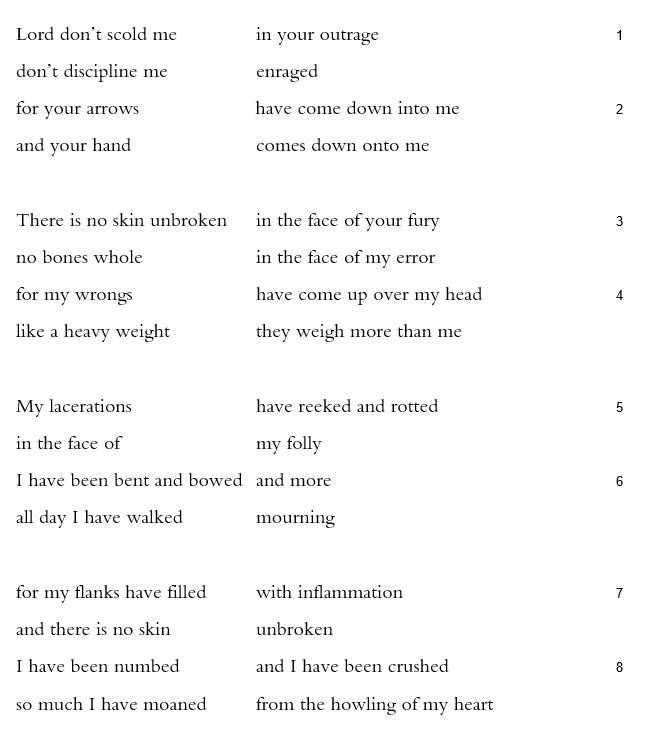
Psalm 38 is a lament as vivid in its depiction of bodily suffering as it is elusive about the causes. The speaker sees her pain first as a result of divine wrath: “your arrows | have come down into me / and your hand | comes down onto me” (2). In the second quatrain, most of the psalm’s themes arrive:
There is no skin unbroken in the face of your fury
no bones whole in the face of my error
for my wrongs have come up over my head
like a heavy weight they weigh more than me (3-4).
Paralleled, the Lord’s “fury” gives way to the speaker’s “error,” the word usually translated as “sin.” This unnamed mistake grows plural in “wrongs.” These wrongs themselves proliferate, continuing the downward movement from the punishment of the first two verses (“have come up over my head” in verse 4, see also 6 and 8) as they spread a contagion that dominates the psalm. Likewise, the repeated phrase “in the face of” recurs in the poem, both penei (3, 5) and its synonym neged (9, 17), creating an immediacy that is confrontational, face to face, even as it accentuates the speaker’s distance from her loved ones, friends, family, and God.
By far most of the psalm emphasizes the ache that spreads within, across, and beyond the sufferer’s body. “My lacerations | have reeked and rotted / in the face of | my folly” (5). But what folly? Even in verse 18, the crime she feels punished for goes unstated: “my guilt | I confess / I suffer | from my error.” Did the error cause the lacerations? When she describes how “there is no skin unbroken” (3, 7) and how “my flanks have filled | with inflammation” (7), are these injuries rather a consequence of the angry, physical “discipline” of Lord? Or are her wounds the work of those enemies who show up for the first time in verse 12: “those who seek my neck | struck me”? The outward movement of pain and its consequences reaches those who mock the speaker and beyond: “my foes are lively | they have grown strong / they have grown great” (19). These foes introduce another possibility, that the speaker’s pain comes less from divine punishment than from terrible people’s abuse: “they block me | for my chasing the good” (20). Maybe the speaker just suffers, period, certain the pervasive pain is real, and this suffering is compounded by uncertainty, and by worry about its causes as well as its effects.
The superscription indicates that this is a psalm for memorial purposes. But who is to keep what in mind? Are we supposed to agree with the sufferer’s supposition that her physical anguish stems from something she did or didn’t do, something she is or was? Are we to keep right there in mind the disappointing family and friends who distance themselves from the sufferer at the worst possible time? Or the reprobate foes who mock the sick? Or is the superscription a reminder to keep suffering itself in view, the sufferer closer to mind than anyone else in the psalm, God or family or friend or foes?
My name is Mark Minster. I’m an English and Comparative Literature professor with a background in ministry and in poetry. I teach courses on writing, reading, religion, and nature.
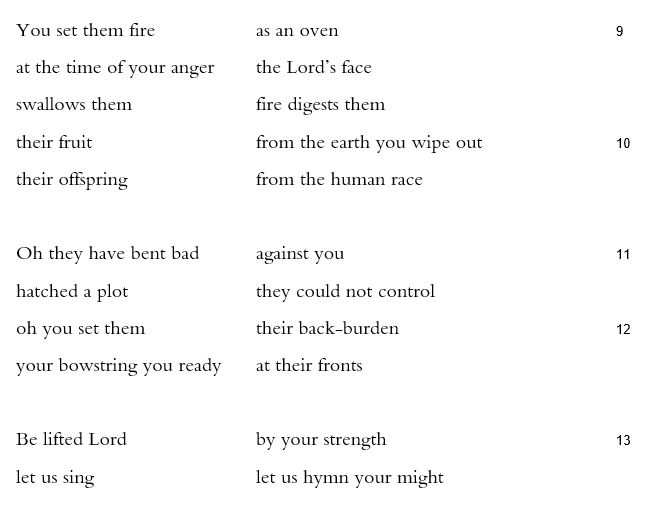
Psalm 21 is explicitly a royal psalm and a martial one at that. It is also, implicitly, a providential psalm. The king is mentioned twice, once at the start of each half (1a, 7a), and there’s a golden crown (3b), while the conclusion pairs “strength” and “might” (13; cf. Ps 89:13). Throughout the psalm runs the insistence that whatever the king has is a gift from the Lord: “sweet gifts,” “blessings that last” (3a, 6a). “You gave him” (2a, 4a), the psalm repeats; “you set” (3b, 5b, 6a, 9a, 12a). The psalm’s claim is that the Lord’s strength pleases the king (1). And why should it not, since the evidence for the claim is a list of all the Lord has handed him?
Both halves begin with the king’s reliance on the Lord. The first half ends with gladness, as it began (1a, 6b). But the happiness that the Lord’s face elicits in verse 6 contrasts sharply with the fury of the Lord’s face in v. 9. If glad reliance frames the king’s gifts in the first half of the psalm, the second half is enclosed by a deft contrast between the king’s posture—leaning without being shaken (7)—and the posture of his punished foes, who are bent with burdens and shaking in terror (12).
This overall structure inverts Psalm 18, which moved from the mythological anger of a descending God to the king’s military campaign against an array of enemies. Here we start with the king’s rewards—narratively, the result of the rescue called for in both Psalm 20 and Psalm 18—and then we move back to God’s punishment. Fittingly, the psalm closes not with descent but ascent: “Be lifted Lord | by your strength” (13). All’s right with the king— God’s in his heaven (again).
*
21:5 grandness and grandeur The words in Hebrew are hod and hadar, both gesturing at the decorative splendor.
21:7 the Highest As a parallel to “the Lord” in this verse, the word `elyon functions primarily as a divine epithet, though it can also mean “the most.” Sadly, using the lowercase “highest” here, as in “the highest / utmost care,” wouldn’t preserve the ambiguity, but would make the secondary reading seem primary.
21:9 at the time of your anger | the Lord’s face / swallows them Though it’s on the page here as three lines with two parts, verse 9 parses better as a pair of lines with three elements each. Still, “at the time of your anger” fits with both the fiery oven of 9a and the Lord’s consuming face. Note the shift from second to third person. Clearly this conception of divine rage as fire serves as a model for those who want to imagine a hell with punishing fire, or a fiery apocalypse. And yet the moment here is not eschatological—it’s contemporary with, or even a precondition for, a human realm.
21:11 they have bent bad | against you The verb natah is to stretch out or to lean or to diverge (e.g., Job 31:7). “Turn bad” is accurate, but more on-the-nose than the original.
21:12 their back-burden Literally, “you appointed them a shoulder.” In 1 Samuel 10:9, the shoulder represents the turning of the back. Here in Psalm 21, however, the verb doesn’t indicate turning, and so the more common implication of “shoulder” in the Bible makes more sense: the location of a weight to be carried (e.g., Gen 9:23, 24:15, 45; Judg 9:48). In other words, the Lord is imagined here to be subjugating foes.
My name is Mark Minster. I’m an English and Comparative Literature professor with a background in ministry and in poetry. I teach courses on writing, reading, religion, and nature.
(director: of the Lord’s servant, of David, who spoke to the Lord the words of this song on the day the Lord rescued him from the grip of all his enemies and from Saul’s grasp. He said…)
* * *
The parallels that shape biblical poetry on every level—from word to line, from verse to stanza to poem— are just juxtapositions. This, then that. These two, then those. The art is collage. The kiru in a haiku is similar, a jump cut from one image to another. So are the leaps in a Chinese shi (a word pronounced much like the Hebrew shir; both words mean “song”). The questions of reciter and writer are always these: why this with that? why here, why there?
In Psalm 18, these questions are best asked first of the fiery mythological passage in verses 7-15, in which God rages thunder and lighting, and of the bellicose passage in 37-45, in which the speaker, equipped “with strength for battle” (39), obliterates his enemies, grinding them to powder, dumping them “like the muck of the streets” (42) until other nations “cringe to me… wilt / they quake at the borders” (45). Why pair a powerful scene of divine descent with a bloodthirsty warrior’s boast? The theophany, including its introductory and closing verses, takes up almost the first third of the psalm (4-19), while the whole warrior’s passage takes up most of the last third (32-48). As panels surrounding a center, they invite—and reward— comparison. The warrior finishes what “the Lord / the Highest” started (13). God “sends his arrows | and scatters them” (14) which becomes, by narrative causality, “training my hands | for battle / so my arms can bend | a metal bow” (34). Cosmic precedent justifies both national conflict and the singular authority of the warrior. After all, it is God, the speaker asserts, who arms him, “who grants me | retribution / speaks down | peoples beneath me” (47). This much seems obvious: Psalm 18 works to authorize charismatic military force—“my enemies | you’ve given me their napes / those who hate me | I wipe them out” (40). It justifies war by making brutal personal vengeance seem both divinely sanctioned and as natural as a storm.
And yet between this pair, these two thirds of the psalm, is lodged a striking central section, verses 20-31, in completely different language and a completely different tone. The stitches show. In the tight and unified verses 16-19, the speaker claims that he has been rescued by the Lord from the dangers he describes only metaphorically back in verses 4-6, and that this rescue has occurred “because he likes me” (19b). The intervening mythological verses, by the way, make no reference to any humans, neither enemies nor victim, nor to good or bad (despite the suggestion of anger in verses 7 and 15). After verses 16-19, however, morality shows up suddenly, in full Deuteronomic language. As with the flood story in Genesis, where competing explanations for Noah’s rescue show up in subsequent verses, at a seam in the text—“Noah found grace in the eyes of the Lord. These are the generations of Noah. Noah was a just man and perfect in his generations..” (Gen 6:8-9)—so here the center of the psalm offers a second, competing explanation for the speaker’s rescue. Not that God “likes” him, but “he treats me | as for my justice / as for my clean hands | he returns me” (Ps 18: 20). The center of the psalm introjects a moral:
With the caring you show yourself caring 25
with one who’s whole you show yourself whole
with the clean you show yourself clean 26
with the twisted you show yourself wound up
From here the seams overlap. Verses 27-29 link the Deuteronomic vision of retributive justice to the speaker’s military prowess. They anticipate verses 32 and on: “by you I outrun an army” (29a) sounds more like “making my feet like a doe’s” (33a) than it does anything from verses 20-26 or 30-31. For their part, verses 30-31 pick up the word “whole” from verses 23, and 25, stitching together the moral that patches the poem: “he is a shield to all | who shelter with him” (30).
The tying together of the psalm’s three parts thus implies that the mythical, anthropomorphic God of storms and fury, doubtless already archaic by the time of Psalm 18’s assemblage, justifies military actions led by a charismatic fighter, because both ancient mythology and contemporary war are subsumed under the category of divine justice. This tying together is completed at the psalm’s edges, its beginning and its end, which rope the three parts to the story of David, turning the warrior into a king, making the mythical historical. That there is no mention between verses 1 and 50 of anything royal, let alone of David in particular, hardly registers with most readers. Most scholars still call it a royal psalm (Dahood, Kraus, and more).
Linking psalms to David, especially this one, which bears the book of Psalms’ longest superscription and which appears in slightly different form in 2 Samuel 22, has at least two important functions. The rhetoric and poetry of this psalm shape how we read David, deepening the history-like prose about Israel’s monarchy. Into David’s narrative is imported this psalm’s argument, its mythology, its militarism, its sanction. History gains immediacy. At the same time, the recitation of this psalm, whoever sings it, whenever, wherever, gains simultaneously historical and timeless meanings. Its justification of aggression brings to the performative present a newly mythologized David, whose offspring it emboldens to carry on.
*
18:1 of the Lord’s servant… Despite its length, the superscription links this psalm not to one specific “day” in David’s life—one would be hard pressed to find such a day, either before or after he became king—but to the sweep of his life as a whole.
18:1 I feel tenderly for you | Lord my strength This line can be read as part of the superscription, part of the psalm itself, or both, or even neither. Stylistically it could fit with the first verse, perhaps. But it does not appear in the parallel version in 2 Samuel 22, and the image of tendern-heartedness—the root rechem comes from the word for “womb”—is conspicuously out of place.
18:4 they terrify me This is a good example of why it’s important to register verb forms with care in translation. In a sequence of mostly suffixed verbs, the English past or present tense, this prefixed form stands out, with its imperfect aspect and present or future tense. Cords of death would continue to terrify me, too.
18:7 And the earth shakes | and shivers Here the issue of tense is more complicated: we have prefixed verbs introduced with a vav, which usually functions in narratives like the historical present or the past tense (called the vav-consecutive, or vav-conversive). And yet as a sequence and in context both, this mythological storm works better in the present tense, blurring the line between the historical and the present. The words sound similar in Hebrew: vattig`as vattir`as.
18:10 climbs on a cherub It was tempting to render “cherub” with a different spelling (keruv would be more accurate) to dislodge delicate images of doughy babies. The mythical cherubim were doubtless more like griffins. In Hebrew, there’s a tight play on words: Vayyirkav al-keruv.
18:12 out of the bright before him | thunderheads have passed Strong wordplay in the original: minnogah negdow `avav `averu.
18:25 you show yourself caring The reflexive stem of the verb chesed. It’s only three syllables in Hebrew, but that information density is impossible to capture here. The implication is that God’s caring is reflexive, caring for one who cares as well as for himself, perhaps even that he reveals himself in this caring-for.
18:27 the peering proud Lit., the eyes of the rising. Since a literal rendering doesn’t work in English, the translation tries to capture both the hauteur and the eyes.
18:30-32 The god The Hebrew ha’el can mean any number of things: God, a god, the god, even “is God?” Translation forces a choice, though each option is fraught. It’s used here three times—30a, 31a, 32a—and could mean God each time. But the passage seems to be asking, then answering what kind of god God is, so some distinction between Ha-‘El and ‘Elohim seems important to preserve.
18:41 They yelp | and none who helps them The verbal roots are close in Hebrew: yeshavve`u and moshi`u.
18:44 At the hearing of an ear | they heed me In the original, this is lesheim`a ‘ozen yisham`u li. The verbal dexterity is nice.
18:47 speaks down Used rarely in the causative stem, the common verb “to speak,” dabar, takes on the meaning of “subjugate.”
My name is Mark Minster. I’m an English and Comparative Literature professor with a background in ministry and in poetry. I teach courses on writing, reading, religion, and nature.






 The Book of Psalms