Psalm 133 is as solid as it is liquid. Its hardness comes from simple structural strength— it is one argument (1) plus two analogies (2, 3)— as well as the firm rhetoric of sitting together in a specific place, “there [where] God ordered / the blessing | living ever and on” (3b-c). Its fluidity comes, not by contrast but by continuity, from the “sweet” goodness of gathered brothers (1), which becomes the “sweet oil” that spills down Aaron’s spilling beard, becoming the dew, becoming the blessing, becoming life. Powerful features of the psalm’s sounds, rhymes, repetitions, plays on words, are both wet and dry, keeping the psalm moving while holding it in place.
Poems are not often about what they say they’re about; they’re about what they do. (Eliot famously describes meaning as the meat a burglar throws a watchdog.) The ostensible argument of Psalm 133 concerns the aesthetic and moral beauty (“how stunning | how sweet”) of the reunion of brothers. This thesis sends us down to the psalm’s two comparisons in search of similarities: in what ways is the sweetness of the communion of brothers like the anointing of a beard, particularly, and strangely, the oil on the beard of a priest? In what ways, then, are fraternal unity and beard oil like the dew on some mountain far from Zion “running down over / the mountains of Zion” (3b)? Are the brothers of Psalm 133 united by sensuous viscosity, like Melville’s Ishmael squeezing whale sperm “till I myself almost melted in it… till a strange sort of insanity came over me; and I found myself unwittingly squeezing my co-laborers’ hands in it” (“A Squeeze of the Hand,” Moby-Dick)? The comparisons of the psalm are a logical stretch, we must conclude: sibling harmony is really not all that similar to dripping oil or falling dew.
The logical stretch of the analogies raises the possibility, I think a likelihood, that the psalm’s similes are not there to clarify or develop anything about the unity of brothers. Rather, the unity of brothers is given in verse 1 as good. Sweet oil and dew are not figures that elucidate brotherhood. Rather, brotherhood is the figure that elucidates anointing, which is the real substance of verses 2 and 3: the anointing of the Aaronic priesthood and the anointing of Zion. The discourse of brotherhood grounds the valuation of Aaronic priests as equal to, and yet greater than, their Mosaic and Levite siblings. Brotherhood likewise supports the passing of the blessing from Israel’s other sacred sites, Mount Hermon, to Zion alone. If the point of Psalm 133 is to encourage sibling unity, its moral is pat and its methods messy. If, on the other hand, Psalm 133 presumes the beauty of sibling unity, its real work is to transfer the register of brotherly love to the temple priests of Zion, sanctioning their work as perpetually anointed and permanently giving of life. The psalm is easily misread as a priestly blessing of brothers. It’s the other way around.
My name is Mark Minster. I’m an English and Comparative Literature professor with a background in ministry and in poetry. I teach courses on writing, reading, religion, and nature.
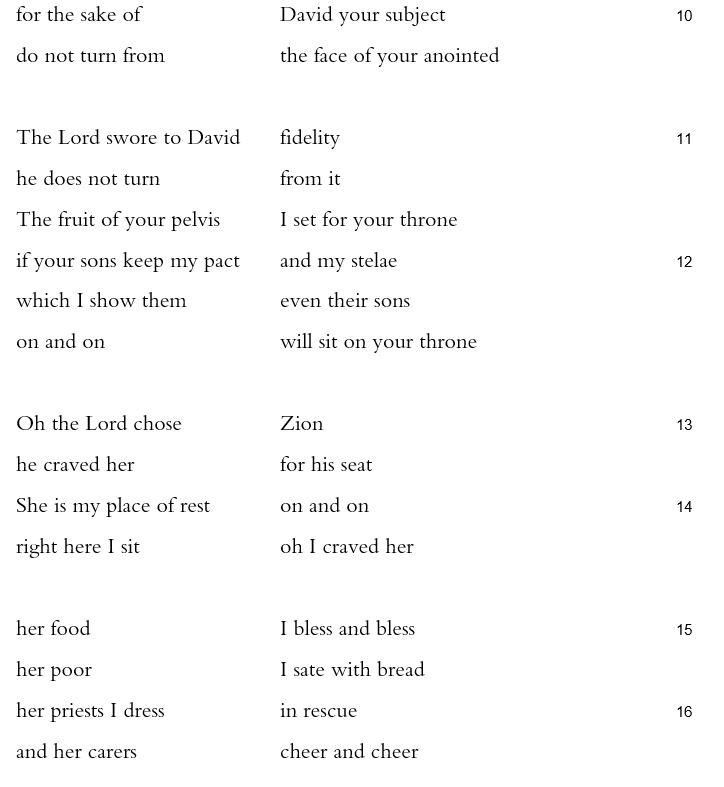
Readers of ancient texts have to be especially alert to the time axis, that horizontal arrow that traces the production and reproduction of cultural memory. In hymns about foundational figures, for example, there is the t=0 of the moment of writing, a point that stretches to a line segment for songs with complicated composition histories. To the left or negative side of t=0 lie those events and motives that hymns half-remember/half-create, as well as the distance (the time) between those moments and composition. We ourselves lie to the right or positive side, celebrants, preservers, students, critics, analysts of tradition, since our readings, too, take place in time. To understand Psalm 132, in other words, the axis of time helps distinguish the unknowable actual King David from the David of the books of Samuel and Kings; the David of Chronicles from the David of Psalms; David in the centuries before, during, and after the Babylonian Exile of the 6th c. BCE, as opposed to the Davids of Rabbinic Judaism and early Christianity or the Davids of the mercantile and monarchical European Middle Ages, or those Davids invoked by defenders of 21st century theocracy and kakistocracy. Always the question: who makes what memories to what ends?
So, when Psalm 132 begins by asking the Lord and thus the audience to “remember Lord | for David / all | his humblings” (1) and to remember David’s promise not to rest until Israel God’s can rest (2-5), who is reminding whom of what, and why? With no clear referent, David’s alleged abasements could indicate almost anything in his biography, from fugitive folk hero to King of Judah to King of Israel as well, watching so many of his enemies and sons die. David’s comedowns could be personal failings or political setbacks, or they could be successful displays of public humility (most recently imagined in Psalm 131).
David’s oath, for its part, is an evident invention, an elaboration rather than a recollection. Both the Deuteronomistic History (1 Samuel 4-7 and 2 Samuel 6-7) and 1 Chronicles 13-17 follow the movement of the Ark of the Covenant, culminating with David’s role in establishing what David in Psalm 132 calls “a place | for the Lord / a tabernacle” (5). According to both of the narrative works, David took Jerusalem for his capital, then moved the ark there from Kiriath-Jearim. And only then, “when the king sat in his house, and the LORD had given him rest round about from all his enemies” (2 Sam 7:1; cf. 1 Chron 17:1), did David say to the prophet Nathan, elliptically “See now, I dwell in an house of cedar but the ark of God dwelleth within curtains” (2 Sam 7:2; cf. 1 Chron 17:1). In both 1 Chronicles and 2 Samuel, however, God rejects David’s implied offer to build a temple, instead deferring that responsibility to “one of your own sons… He is the one who will build a house for me” (1 Chron 17:11-12). Psalm 132 inverts both sequence and emphasis. In the psalm, David is determined not to rest until he finds “a place | for the Lord / a tabernacle” (5). If the Lord’s place is Jerusalem as a whole, David’s mission has already been accomplished, according to the narratives. Yet if “a place | for the Lord” means the temple in particular, nevertheless the narratives state that David has already rested in his palace and that God demurs at David’s desire to build a temple. This remembered vow in Psalm 132 idealizes David even more than Chronicles does, even more than strands in Samuel do, aligning him almost entirely with God’s desires. To do so, the psalm asks God to remember words David never said.
The attentive reader will note with interest that the verbs in David’s oath here all appear in the David narratives of Samuel and Kings, just not in ways one might expect. “I mount,” ’e`eleh (2 Sam 2:1, 19:34), “I give,” ’ettein (2 Sam 5:19, 21:6; 1 Kgs 3:5), and “I find,” ’emtsah (2 Sam 15:25, 16:4), all show up in both psalm and stories. The word ’abo’, “I go into” (3), is used by David once in the Deuteronomistic History, in the negative, when he tries to persuade King Achish of the Philistines to let him enter battle against King Saul (1 Sam 29:8). The same word is used in two other significant places. First, by Uriah, David’s loyal soldier, as he foils David’s attempt to cover up his crime with Uriah’s wife Bathsheba by sending Uriah home:
Uriah said to David, “The ark, and Israel and Judah are sitting in tents, and my lord Joab and the subjects of my lord are camping on the ground in the field, but I should go into my house to eat and drink and lie down by my wife? By your life and the life of your breath, I will not do this thing.” (2 Sam 11:11)
Later, when David is old and probably senile, the prophet Nathan uses ’abo’ in conversation with Bathsheba, orchestrating the scene with David that will land her son Solomon on the throne:
“Go on and go into King David. You’ll say to him, ‘My lord the king, did you not vow to your subject saying, oh, Solomon your son will be king after me, and he will sit on my throne? Then how is Adonijah king?’ And while you’re still there talking with the king, I will go in you after you and fill out your words.” (1 Kgs 1:13-14)
If these are three coincidences, they are certainly meaningful. None of them shows David at his best. All of them turn on dishonest vows—David’s double-dealing with Achish and Saul; his violation of both Bathsheba and Uriah, contrasted with Uriah’s vow of loyalty; and Bathsheba and Nathan’s manipulation of David, which, while not technically a lie (“did you not vow?”), nevertheless asks David to remember words he never said, a promise he appears not to have made.
Through the first half of the twentieth century, most scholars argued that the archaic language of Psalm 132 meant an early date of composition. But like many things, monarchies are idealized when they no longer exist. The David of this psalm really only makes sense, most scholars now would agree, as a product of post-exilic cultural imagination, as a signifier of unity, centralization, and as an alternative to some “scepter | of wrong.” A key question, Kraus writes of Psalm 132, is how the Ark of the Covenant came from Sinai to rest at Zion. That does indeed seem to be something that pre-exilic audiences might want to hear answered, alongside questions like these: where was David when Saul was killed? How did David come to hold Saul’s crown? How exactly did Solomon gain the throne? If David was chosen, why did he not build the temple? Later audiences, after the destruction of Solomon’s temple, must have asked what happened to the ark and to the divine presence in Jerusalem? After the return from the exile, by contrast, audiences must have wondered why, without a monarchy, centralized worship in Jerusalem still mattered. Psalm 132 seems disinterested in all of those questions except this last: why still visit Zion without a king to compel us? Maybe no question matters more to the book of Psalms.
Why? First, it was David’s vow and his disposition that led the Lord to promise, the psalm answers, presenting two parallel vows, David’s in 1-5, the Lord’s in 11-12 and 15-18. Second, the Lord loves Zion (13-14) and promised to take care of her (15-16). And finally, there is the Lord’s promise to perpetuate David’s lineage, which was both unconditional (“The Lord swore to David | fidelity / he does not turn | from it,” 11) and conditional (“the fruit of your pelvis | I set for your throne / if your sons keep my pact” (11c-12a). That means, for its earliest audiences, the psalm invoked and invented memories of David for the sake of Zion’s centrality, something it could do only if David was already the subject not of memory but lore and if monarchy was a matter of the past.
Indeed perhaps the most telling lines in the psalm are those that deal with the priests and the chasidim, the ones who care and are cared-for: “May your priests | dress in justice / may your carers | cheer” (9) and “her priests I dress | in rescue / and her carers | cheer and cheer” (16). The psalm may dangle a symbolic messianic hope at the end, a horn, a lamp, and a flowering crown, but the true heroes of the psalm are not future kings, but present-tense priests, the makers of memories.
My name is Mark Minster. I’m an English and Comparative Literature professor with a background in ministry and in poetry. I teach courses on writing, reading, religion, and nature.
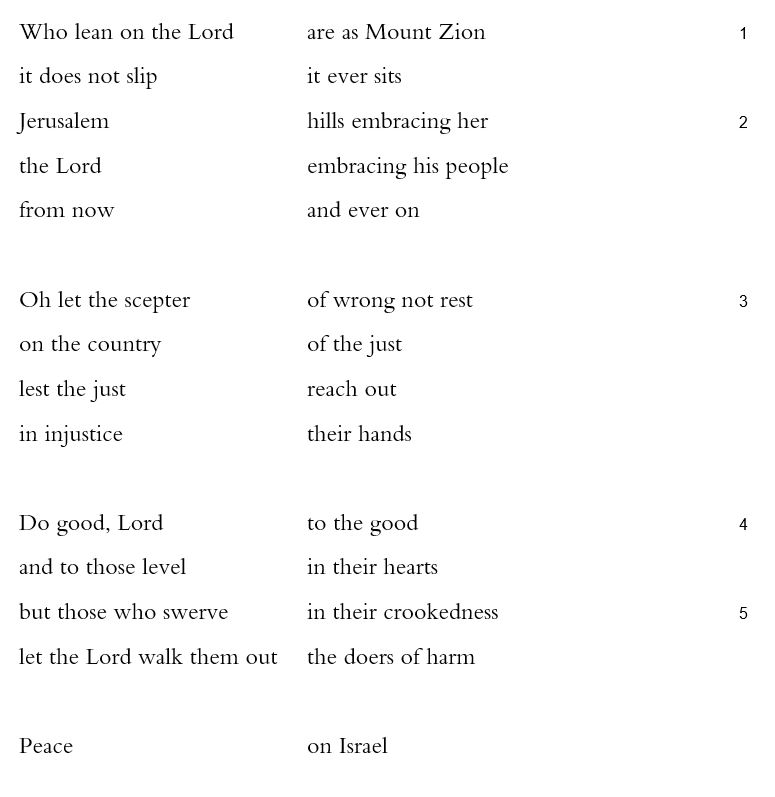
It’s easy to miss how strikingly revisionary is the image that begins Psalm 125. Ordinarily, Mount Zion is depicted as the Lord’s home, his house, his throne (see for example, 1 Kgs 8, especially verses 11-14; see “my hallowed hill” Ps 2:6; “the Lord | who sits in Zion” Ps 9:11; “great in your center | the hallowed of Israel,” Isa 12:6; see also Zech 2:10-11) Towards Zion centripetally, usually, the people come (see Isa 51:11; Jer 3:14, 31:12, 50:5; see Zech 8:3-8). Here in Psalm 125, however, it is the people who are like Zion. The mountain’s lasting stability is compared to their trust: “it does not slip | it ever sits” (1). The Lord, by contrast, has radiated out to the hills centrifugally: “Jerusalem | hills embracing her / the Lord | embracing his people” (2).
The image registers displacement and foreign occupation without the need for figures of absence or rupture, a divine chariot or silence. Rather, it is trust itself that’s centered, a mount encircled by hills that never move. With the Lord rippled out to the hills, the center is instead occupied by “the scepter | of wrong,” a governance which the speaker prays will be only temporary (3a). Why? “Lest the just | reach out / in injustice | their hands” (3c-d), the psalm continues, powerfully extending the scepter, an extended arm, to the extended arms of the people. Unwanted rule, a scepter of wrong, multiplies its wrongs, either by licensing the masses to do wrong or by inciting the just to revolt.
The first stanza centers loyal followers within an embracing, constant Lord; the second centers an unjust ruler within the encircling hands of the corruptible just. The third stanza, verses 4 and 5, takes something from each of those first two. Contrasting “the good” with “the doers of harm,” those “level | in their hearts” with “those who swerve | in their crookedness” (4-5), the psalm ends by mapping permanence against impermanence, alignment against veering off, good against bad. Fittingly for one of the “songs of steps,” it relies on the common verb “to walk” as it invites the Lord to show the bad the door. If there were a colonizing censor, Persian or Hellenistic, who scoured this psalm for evidence of sedition, it would have be easy to miss or dismiss how subversive is Psalm 125’s closing call for “Peace | on Israel.” “Do good, Lord | to the good” sounds even more innocuous, merely more retributive justice in the texts of an occupied people. As verses 3 and 5 make clear, however, this is a notice of eviction.
And yet, because rhetorical figures unleash energies beyond intent or control, the image of the trusting as more central even than God and the image of a scepter as wrong both take on lives of their own. What could be more anti-establishment, more— to borrow twenty-first century parlance— disruptive, than the paired wish to “let the scepter | of wrong not rest” and “let the Lord walk them out”? Mount Zion might not physically move except in tectonic time, but that scepter will never be trusted again. “Peace | on Israel,” indeed.
My name is Mark Minster. I’m an English and Comparative Literature professor with a background in ministry and in poetry. I teach courses on writing, reading, religion, and nature.
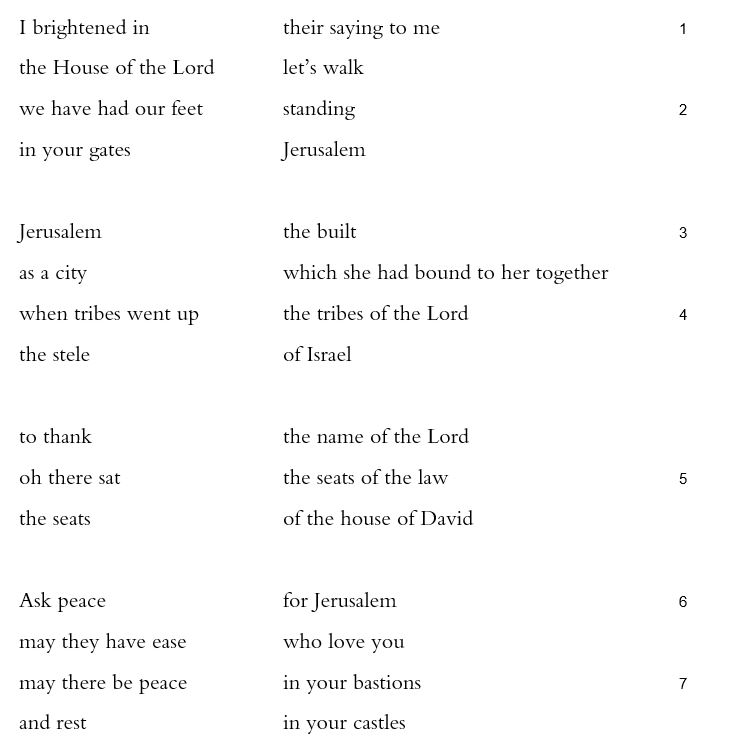
In Psalm 122, a shared walk to the temple in Jerusalem, in the present tense, calls to mind past-tense unity, leading to an impassioned plea for present and future peace. In addition to this narrative movement from present experience (1) to cultural memory (2-5) and back to the urgent now (6-9), the psalm is tightly knit by a host of subtle techniques. Tight knitting itself may be the psalm’s most important theme, shown first in that strange and lovely formulation of verse 3b, “as a city | which she had bound to her together” (ke`ir shechubberah lah yachdav). Once, the line implies, Jerusalem bound her tribes to her, and Jerusalem was their binding.
Invisible in English are the many verbal repetitions that knit the name Jerusalem (yerushalayim) to the word “peace” (shalom). These puns emphasize the shin and the mem, or shin and lamed, or all three letters at once. Verse 4, for instance, begins with shessham shebatim, “when [or where] tribes,” and ends with l’sheim YHWH, “to the name of the Lord.” Verse 5 starts, “oh there sat | the seats of the law,” ki shammah yashbu kis’ot lemishpat. Verse 6 is most explicit and most concentrated: sha’alu shalom yerushalayim; yishlayu ohavayikh, “Ask peace | for Jerusalem / may they have ease | who love you.” Verses 7 and 8 both name “peace”; verse 7 adds the word shalvah, or “rest.” Collectively, then, both when and where, the word “name” and the the law, and ease, rest, and asking, all are bound verbally together with both Jerusalem and peace.
A number of these repetitions are patterned. Psalm 121 had six uses of the word shomer, “to guard,” arranged in two groups of three, plus four instances of the Lord’s name. Psalm 122 also names the Lord four times (1, 4a, 4c, 9), adding Jerusalem three times (2, 3, 6), “peace” three times, and “house” three times (1, 5, 9). The three mentions of the house set the temple at the psalm’s beginning, middle, and end, with its historical identity as “house of David” centered in verse 5. There in the psalm’s center, another pattern culminates: the echo of Psalm 1:1’s movement from walking (121:1) to standing (121:2) to sitting (121:5), marking the remembering, the reimagining, of the first temple as an act of wisdom and morality.
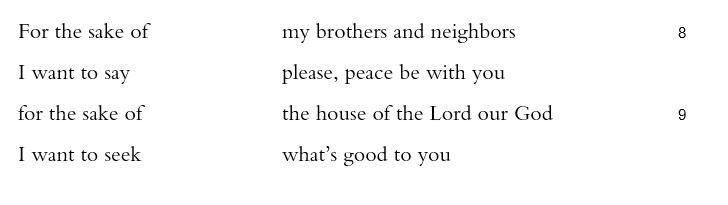
A whole theology or politics might be built on the final two verses, verses 8 and 9, the twinned purposes of the speaker’s walk through the city to the temple. If it is easy to play on words, it is much harder to really wish for peace. And it’s downright dangerous to equate Jerusalem with peace or to view the binding together in verse 3 as anything but ideology dressed up as memory. In Jerusalem, so much blood has risen, so very much has fallen.
As Philip Larkin suggests in “Church Going,” a temple may be destined, once “disbelief has gone,” to become “A shape less recognizable each week,/ A purpose more obscure.” And yet Psalm 122’s final pairing of two cohortative verbs, “I want to say” and “I want to seek,” with their contents, “please, peace be with you” and “what’s good to you,” show that this destination can indeed be “A serious house on serious earth.” Seeking what’s good for one’s neighbor takes poem and psalm beyond words.
My name is Mark Minster. I’m an English and Comparative Literature professor with a background in ministry and in poetry. I teach courses on writing, reading, religion, and nature.



 The Book of Psalms